
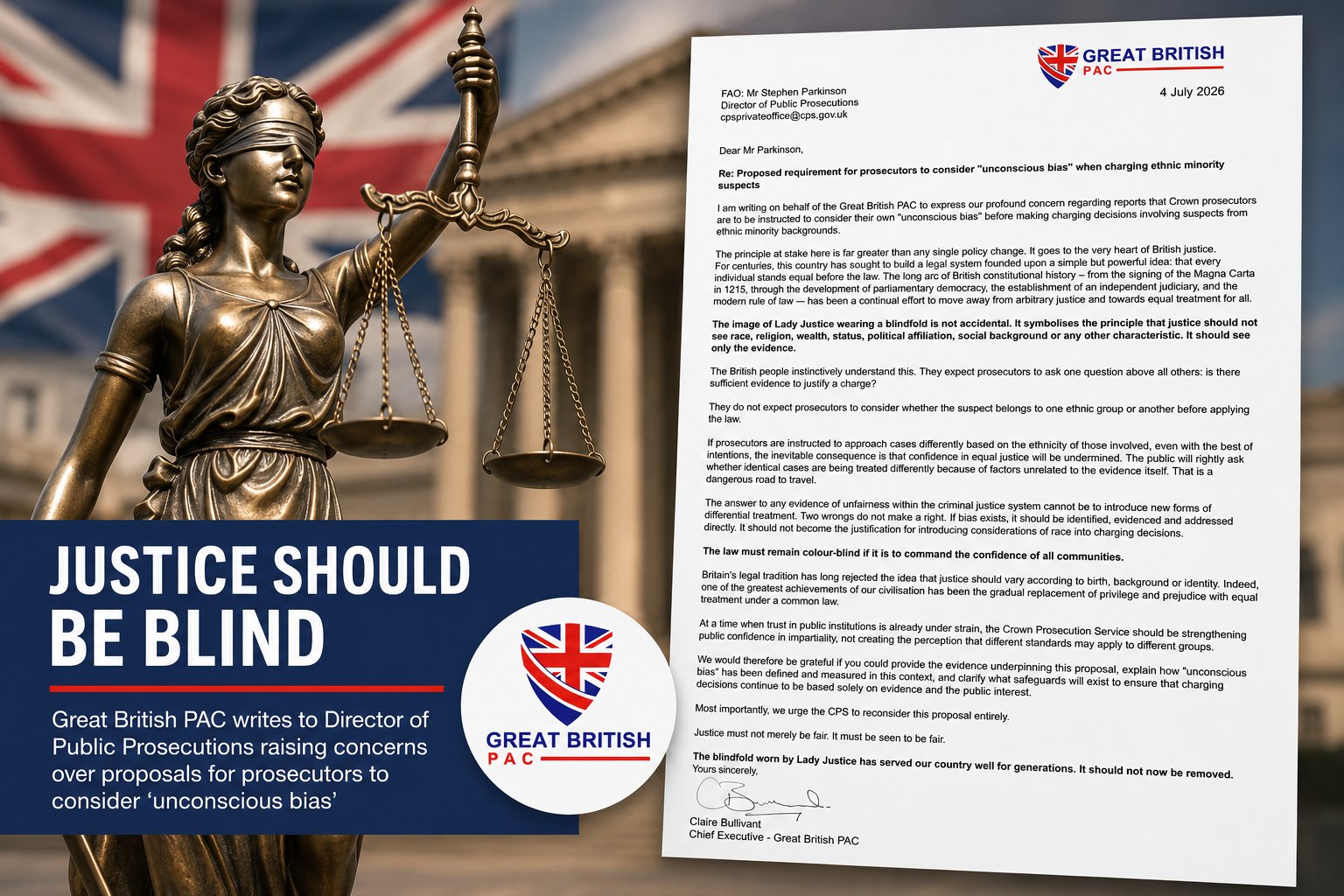
Should the colour of a suspect's skin ever shape a prosecutor's decision to charge? The Great British PAC says no, and has written directly to the Director of Public Prosecutions, Stephen Parkinson, to say so. The letter urges the Crown Prosecution Service to abandon reported plans that could oblige prosecutors to weigh their own “unconscious bias” when deciding whether to charge suspects from ethnic minority backgrounds.
Alongside the letter, the PAC has opened a public campaign inviting supporters to add their names and to contact the CPS themselves. At the heart of the campaign is a warning: that the proposal would chip away at one of the oldest guarantees of British justice, namely that every citizen stands equal before the law.
What the letter argues
Written by the PAC's chief executive, Claire Bullivant, the letter makes the case that a charging decision should rest on two things only, the strength of the evidence and the public interest, and never on a suspect's race or ethnic origin. This is not, the PAC insists, a narrow quarrel over a single line of guidance. It opens up a far larger question about whether equal treatment can survive inside the criminal justice system.
The letter sets the debate against the sweep of Britain's legal and constitutional story, a story in which the nation has spent centuries pulling away from arbitrary justice and towards a system that treats every citizen alike. It points to landmarks along that road, among them Magna Carta, the growth of parliamentary democracy and the founding of an independent judiciary.
That history, the PAC argues, is exactly why the blindfolded figure of Lady Justice still carries such force: justice is not supposed to notice race, religion, wealth, rank, political conviction or social standing. The only question that should occupy a prosecutor, the letter says, is whether the evidence is strong enough to justify bringing a charge.
As the letter puts it: “The British people instinctively understand this. They expect prosecutors to ask one question above all others: is there sufficient evidence to justify a charge.”
Justice must be seen to be fair
A central worry the PAC raises is one of perception. Fold ethnicity into charging decisions, even at one remove, and the public may reasonably begin to ask whether otherwise identical cases are being handled differently according to who is involved. Confidence in the courts, the letter cautions, rests not only on fairness being done but on people believing that fairness is being applied to everyone equally.
Where genuine evidence of bias exists within the justice system, the PAC says it should be confronted head-on through reforms grounded in evidence, rather than answered with what it calls “new forms of differential treatment”.
The letter states: “If bias exists, it should be identified, evidenced and addressed directly. It should not become the justification for introducing considerations of race into charging decisions.”
Trust in public institutions, the PAC notes, is already strained. In that climate, it argues, the CPS ought to be shoring up faith in its own impartiality, not fostering a sense that one set of rules might apply to some groups and a different set to others.
The questions put to the DPP
The letter presses the Director of Public Prosecutions for answers on several fronts. It asks for the evidence said to underpin the proposal, for an explanation of how “unconscious bias” has actually been defined and measured, and for detail on the safeguards that would keep charging decisions anchored solely in evidence and the public interest. Ultimately, the PAC calls for the proposal to be dropped altogether.
Bullivant closes the letter with a warning about what is at stake: “Justice must not merely be fair. It must be seen to be fair.”
“The blindfold worn by Lady Justice has served our country well for generations. It should not now be removed.”
Add your name
The Great British PAC is asking members and supporters to stand with the campaign. If you share our concern about plans that could require Crown Prosecutors to factor in their own “unconscious bias” when deciding whether to charge suspects from ethnic minority backgrounds, you can co-sign our letter to the Director of Public Prosecutions today. You can also make your voice heard by writing to the CPS directly at cpsprivateoffice@cps.gov.uk. Justice is supposed to be blind, and together we can help keep it that way.