
Free Markets, Not Mandates: Stop the Government's Online Prominence Regime
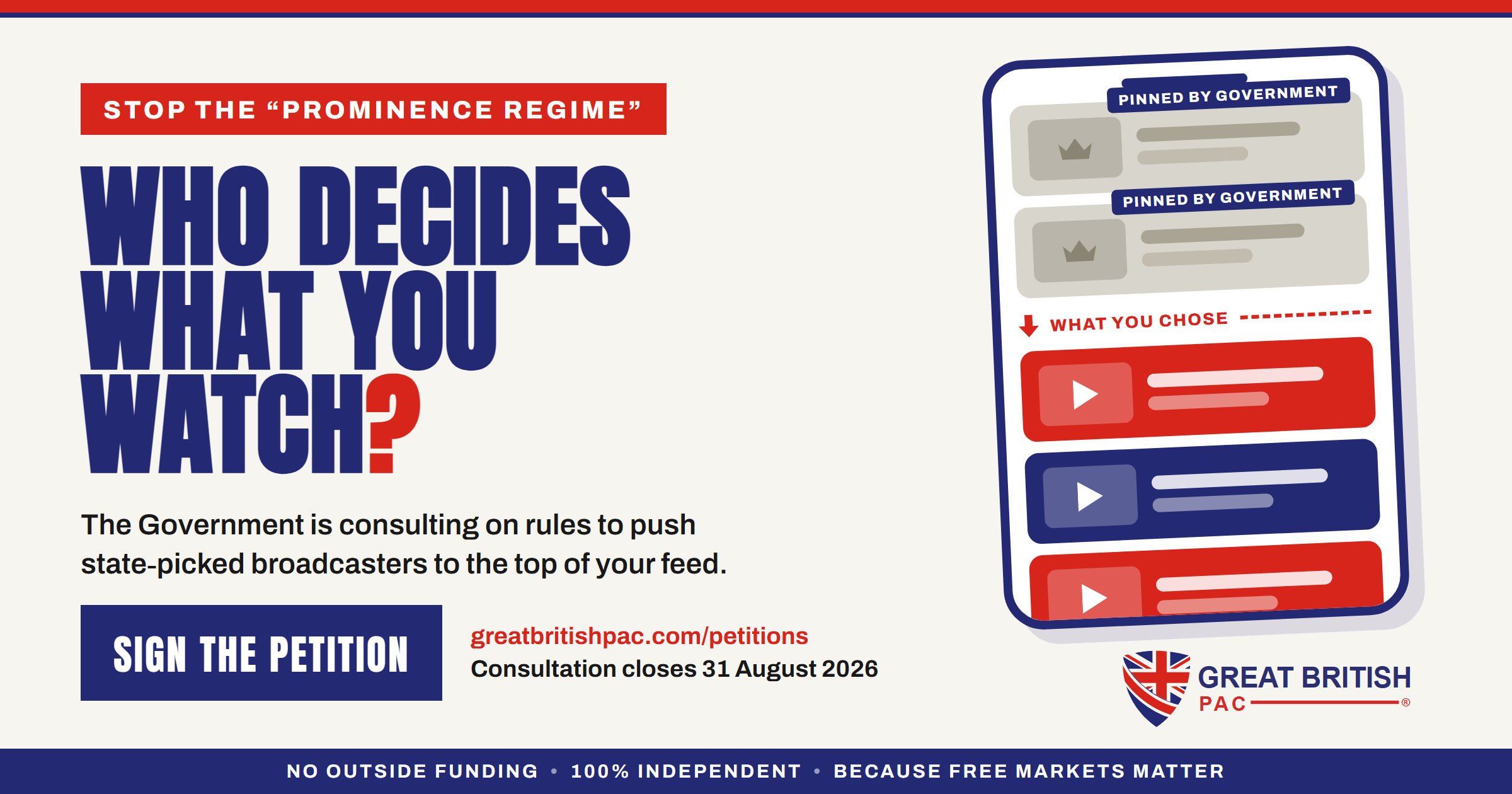
The Government is consulting on a mandatory "prominence regime" that could force online platforms to push legacy broadcasters such as the BBC, ITV and Channel 4 to the top of your feeds and search results, at the expense of the independent creators and publishers you actually chose. A free market for content production should remain free. Sign before the consultation closes on 31 August 2026.
We demand
- 1
Scrap plans for a mandatory prominence regime on video and social media platforms.
- 2
Reject any law forcing platforms to rank state-favoured broadcasters above independent creators and publishers.
- 3
Abandon proposals for government-set criteria deciding which news providers count as "trustworthy".
- 4
Protect the right of creators and independent publishers to compete on merit, not ministerial favour.
- 5
Defend the public's right to choose how they access news and content online.
- 6
Keep Britain the best place in the world to build an independent media business.
The full petition
When you open an app to watch or read something, who should decide what you see first: you, or the Government?
On 23 June 2026, the Department for Culture, Media and Sport published a green paper, "Watch this space: a new strategic direction for UK media". Inside are proposals that could create a mandatory "prominence regime" for the online world.
Under the options being consulted on, social media and video sharing platforms could be required to push content from legacy public service broadcasters, such as the BBC, ITV and Channel 4, up your feeds and search results. The paper itself describes prominence as giving certain content "a privileged position" in search results and recommendation feeds. It says the Government will "explore legislative options to establish a prominence regime" for news on social media, and it asks whether broadcasters' comedy, drama, entertainment and sport should be made easier to find too.
None of this is law yet. It is a proposal under public consultation, and that is exactly why your signature matters now. Ministers say their preference is voluntary industry deals, with legislation held in reserve. The consultation closes at 11:59pm on 31 August 2026, and a White Paper is promised later this year. The time to stop a bad idea is before it hardens into legislation.
The state has no business picking winners in the content market.
Britain's traditional broadcasters have not lost viewers to a conspiracy. They have lost them to competition. Ofcom's own research, published in 2025, found that YouTube had overtaken ITV to become the UK's second most-watched video service. Millions of Britons freely chose independent creators, podcasters and challenger outlets. Nobody mandated that. It happened on merit.
Instead of asking why audiences switched, the Government proposes to march them back by regulation. We believe that is protectionism, plain and simple: incumbents that lost the argument in the marketplace winning it back in Whitehall. If legacy broadcasters are losing the battle for attention, the answer is better content, not regulation that hands them your attention by law.
Feeds and search results are finite. Every slot handed to a legacy broadcaster by mandate is, in effect, a slot taken from a creator or publisher you chose. Nothing would be banned, but critics warn that reach is everything online: content pushed out of sight might as well not exist.
Britain's independent creators, journalists and digital-first outlets built their audiences the hard way: view by view, subscriber by subscriber, with no licence fee and no guaranteed slot. Oxford Economics found YouTube's creative ecosystem alone contributed over £2.2 billion to UK GDP and supported more than 45,000 jobs in 2024. Behind those numbers are livelihoods: editors, producers, small studios, family businesses. Britain should be the best country in the world to build an independent media business. Who will invest here if reach can be rationed by ministers to favour legacy broadcasters?
And who decides which voices deserve the privilege? Ministers admit they have "not yet determined what criteria" would define a "trustworthy" news provider. In effect: take the power first, write the rules later. And even if a few independent outlets made the favoured list, the principle would be unchanged: ministers, not you, would rank the news. We believe no government, of any party, should decide whose journalism counts as trustworthy. The consultation even asks whether individual users should be allowed to switch these measures off. When the state has to ask whether you may opt out of its choices, something has gone badly wrong.
Parliament has already legislated to give broadcaster apps prominence on smart TVs under the Media Act 2024. These new proposals explore going much further: from regulating TV menus to shaping what is recommended to you across the open internet. In our view, that is not modernisation. It is the state stepping between you and your right to access information in the manner you choose.
A free market for content production should remain free. We are calling on His Majesty's Government and the Department for Culture, Media and Sport to scrap the proposed mandatory prominence regime, reject any government-set test of which news providers count as "trustworthy", protect the right of creators and independent publishers to compete on merit, and defend the public's right to choose.
Your signature strengthens our formal submission to the consultation, but the Government must also weigh every individual response it receives. If you can, reply in your own words before 11:59pm on 31 August 2026 at:
https://www.gov.uk/government/consultations/watch-this-space-a-new-strategic-direction-for-uk-media-green-paper-and-public-consultation
It doesn't matter which political party you support. A power created by one government is inherited by every government that follows. If you would not trust your least favourite politician to decide what Britain sees first, then no politician should have that power.
This is people power in action. The legacy institutions have lobbyists. You have your name and your voice. Together we can make it impossible for ministers to claim nobody objected.
Nobody has paid for this campaign. This petition has received no funding from any platform, broadcaster, company or third party — not a penny. It is an entirely independent initiative of the Great British PAC. We defend the free market because it matters, not because anyone pays us to.
Make your voice count. Tell the Government to drop the mandatory prominence regime and trust the British people to choose for themselves. Sign the petition today.
Stand up and be counted for your country. Thank you.
Promoted by Great British PAC, greatbritishpac.com, on behalf of the Great British PAC. This petition is entirely independent and has received no funding from any platform, broadcaster or third party.