Brexit: Tell Them Again. The UK Must NOT Rejoin the EU
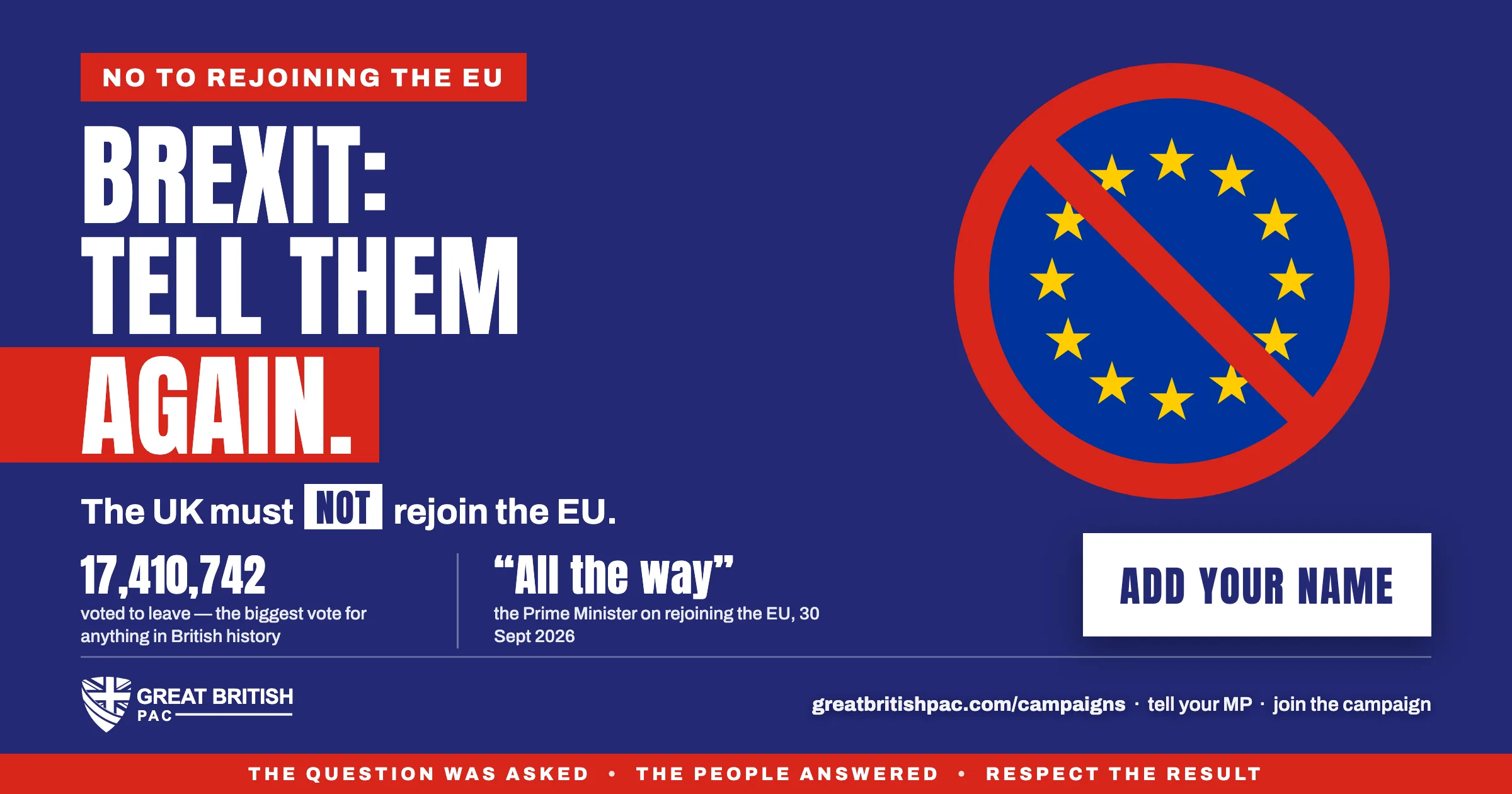
17.4 million of us voted to leave the EU. Now the Prime Minister says rejoining is an option: “we could go all the way.” This is not another petition for a minister's in-tray. It is a show of strength, and the start of the campaign to defend Brexit. Add your name, tell your MP, and stay in the fight.
What we are asking for
- 1
Rule out taking the United Kingdom back into the European Union.
- 2
Keep the promise made at the 2024 election: no return to the single market, the customs union or freedom of movement.
- 3
No route back to Brussels by the back door — not by summit, not by stealth, not in stages.
- 4
Tell the public the real terms before any “option” is put to them: the bill, the Euro, Schengen, and who makes our laws.
- 5
Every MP, of every party, to say publicly where they stand.
- 6
Use the freedoms Brexit gave us, instead of bargaining them away.
Why this matters
They asked. We answered. Now the Prime Minister wants to ask again.
On Tuesday 29 September 2026, in his first conference speech as Prime Minister, Andy Burnham said that "Brexit has done more harm than good" and promised to set out "different options" for Britain's long-term relationship with the European Union.
The next morning, on BBC Radio 4's Today programme, he spelled them out: "We could stay as we are. That's definitely an option, if people think this is the right place to stay. We could look at what George Osborne has said about a customs union, we could look at what the Liberal Democrats said at their conference about the single market, or we could go all the way."
He added: "There's no point me denying it. I've said I would like to see Britain rejoin in my lifetime."
No Prime Minister has said that since the referendum. Rejoining the European Union is now on the table in Downing Street.
This is not another petition for a minister's in-tray.
We know why people have stopped signing them. A list of names arrives in Whitehall, somebody sends a polite reply, and nothing happens. We are not going to pretend otherwise.
We are asking you to be counted. Add your name and three things happen. You join the people who will not let this pass quietly, and that number is what makes a campaign impossible to wave away. If you ask us to, we will write to your own MP in your name, because every one of them is now going to have to decide where they stand, and they count the constituents who write to them. And if you choose, we will keep you posted as the Great British PAC launches its campaign to defend Brexit.
The question was asked, and it was answered.
On 23 June 2016, 17,410,742 people voted to leave the European Union — more votes than have ever been cast for anything in British history. At the 2019 general election the country returned a Government with a majority of 80, elected on a promise to get it done. Britain left on 31 January 2020.
Nobody voted for this.
Mr Burnham became Prime Minister on 20 July 2026, without a general election. The manifesto his party was elected on in 2024 ruled out a return to the single market, the customs union and freedom of movement. He has said he will keep to it for this Parliament, and then make the case for something different at the next election.
A promise you are already planning to drop is not a promise kept. And "options" drawn up around a summit with EU leaders are not a mandate from the British people.
We will be straight with you about the polls.
Many people now tell pollsters that leaving was a mistake, and a campaign that pretended otherwise would deserve to lose. But look at what happens when the question is asked honestly. In June 2026 YouGov found 55% in favour of rejoining. Then it asked about rejoining without the opt-outs Britain used to have, and support fell to 35%, with 43% against.
That second question is the real one. Britain would not be returning to its old seat. It would be applying as a new member under Article 49 of the EU treaty. The budget rebate is gone. The opt-outs from the Euro and the Schengen border-free zone ended when we left. New members are expected to commit to both, and anything different would have to be negotiated from scratch, with every existing member state holding a veto.
It would cost far more than it did. In 2019, our last full year as a member, Britain paid £18.9 billion into the EU budget before the rebate, and £9.4 billion net once the rebate and the money spent here were taken off. The rebate was worth £4.5 billion that year, and it would not be coming back. Meanwhile the European Commission has proposed a budget of almost €2 trillion for 2028 to 2034, up from €1.2 trillion for the seven years before. On those plans, and with no rebate, the campaign group Britain Unbound estimates that Britain's gross bill would be around £35 billion a year: nearly double what we last paid. That budget also has to repay the EU's pandemic recovery fund. Brussels expects to have borrowed up to €634 billion for it by the end of 2026, the grants are repaid from the EU budget between 2028 and 2058, and Britain had left before any of it was borrowed. As a member we would share that bill.
And it would bring the EU's Migration and Asylum Pact with it. The Pact has applied across the EU since 12 June 2026. Every year it sets a pool of at least 30,000 asylum seekers to be relocated between member states, and each country's share is worked out from its population and the size of its economy. On that formula Britain's share would be around 15%: at least 4,500 people a year. A country can pay €20,000 for each person it does not take, and if too few places are offered, the rules can require countries to take on asylum claims instead. As a member, Britain used to choose whether to take part in EU asylum law at all. That choice ended when we left.
The EU that people are being asked about is not the EU we would be joining.
And you are rarely told what leaving has delivered.
We pay Brussels far less. In 2020, the last year Britain paid in like a member, the net bill was £9.4 billion. In 2024 it was £1.1 billion, the tail end of the exit settlement. Across 2021 to 2024 we paid £15.6 billion in all. At the old rate it would have been more than £37 billion.
We sign our own trade deals. The agreement with India came into force on 15 July 2026, and the Government expects it to add £4.8 billion a year to our economy in the long run. Full access to the Pacific trade bloc, the CPTPP, followed on 1 September 2026 and is expected to add around £2 billion a year. No EU member can sign a trade deal of its own.
Our exporters pay less to sell to America. Most British goods face a 10% tariff in the United States. Most goods from the EU face 15%.
And Parliament has changed laws that EU rules stood in the way of. VAT came off sanitary products on 1 January 2021. The export of live animals for slaughter was banned in 2024.
Rejoining means giving up our own trade deals, taking the EU's tariff and paying the membership bill again: around £35 billion a year, gross, on the estimate above.
This is about who decides.
You can think the last ten years were handled well or handled badly. The answer to a job done badly is to do it properly: to use the freedoms we took back, not to hand them back. A country that reopens its biggest democratic decision whenever the government of the day finds it inconvenient has not really decided anything at all.
It doesn't matter which party you support. Leave voters came from every party and from none. An MP of any party can respect that result, and every one of them should now be asked whether they will.
Tell them again. Add your name. Tell your MP. And be ready, because this is where the campaign starts.
Stand up and be counted for your country. Thank you.
Promoted by Great British PAC, greatbritishpac.com, on behalf of the Great British PAC.