
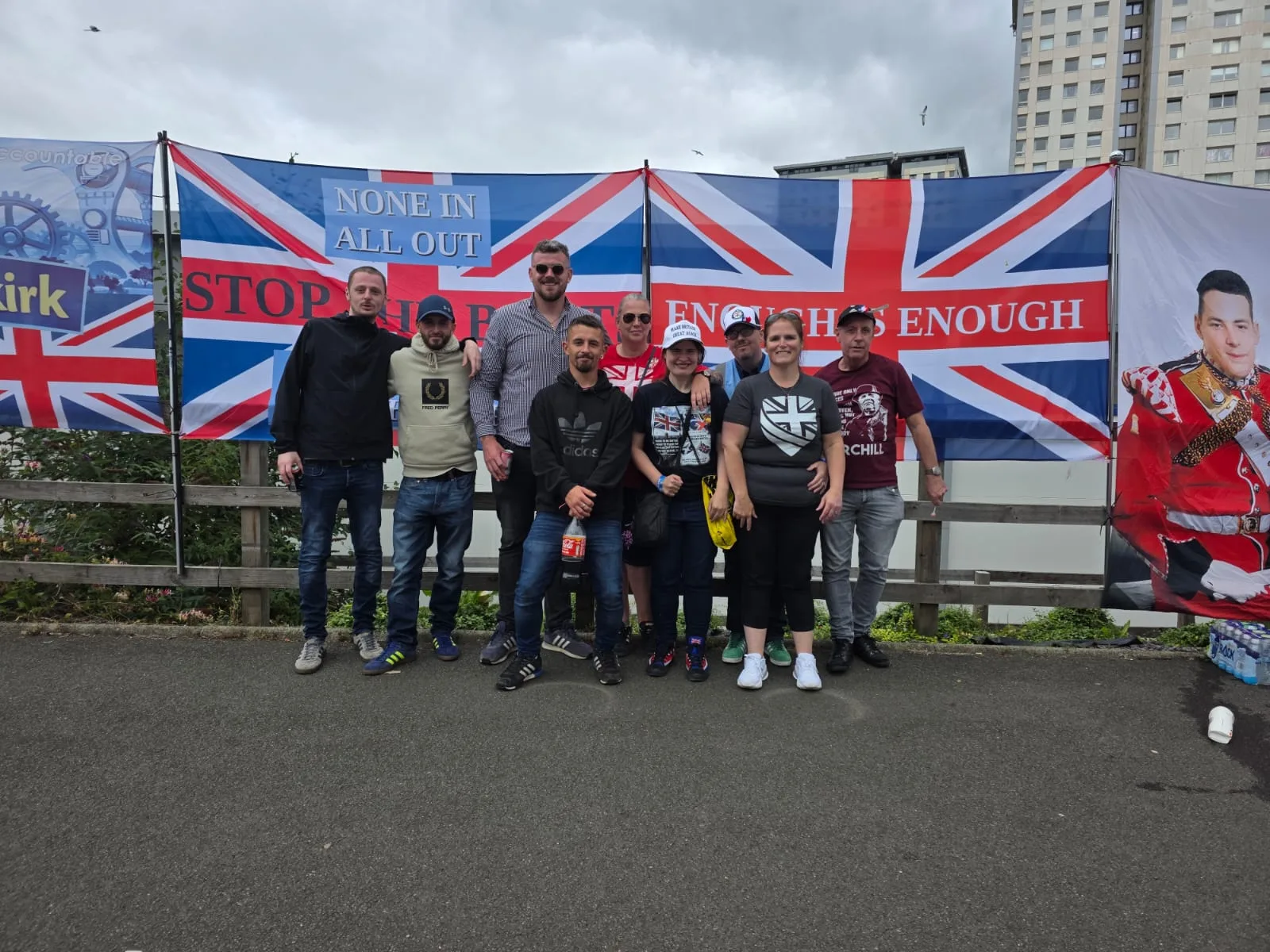
On the first anniversary of the Falkirk asylum hotel protests, the Cladhan Hotel stands empty. The Great British PAC joined local residents to mark a year of peaceful, persistent campaigning.
A Quiet Victory at the Cladhan: Falkirk Marks One Year of Standing Firm, and the Hotel Stands Empty
On Saturday 15 August 2026, Ronni McMenemy, Great British PAC Scotland Director, was proud to attend the "The Right Unites" gathering outside the Cladhan Hotel in Falkirk as part of the Great British PAC. The Great British PAC was there to stand alongside local people who have turned out, week after week for a full year, to raise legitimate concerns about illegal immigration, asylum policy, public safety, and the pressure placed on their town without consultation.
The anniversary carried a weight that no organiser could have scripted. By the time the attendees gathered, the biggest practical victory of the campaign was already visible to anyone passing Kemper Avenue. The Cladhan is empty. BBC Scotland News understands the building is no longer being used as accommodation for asylum seekers, and the town's Labour MP, Euan Stainbank, confirmed the day before the anniversary, following discussions with the Home Office, that there are currently no residents at the premises.
How it began
The Cladhan, a former hotel in the heart of the community, was acquired as asylum accommodation in 2021 under the previous Conservative government. What transformed it into a national flashpoint was a series of serious crimes linked to former residents. Sadeq Nikzad was jailed for nine years at the High Court in Livingston last June for the rape of a 15 year old girl in an attack in October 2023. Earlier this month, Muhammad Sheikhi, 23, a former resident at the Cladhan, was jailed for four years for sexually assaulting two women in Falkirk in November last year.
The first major protest followed in August 2025, when hundreds gathered outside the hotel. What began as local anger over the uncontrolled placement of asylum seekers in a residential community became a sustained, peaceful, though often heavily policed, campaign by ordinary Falkirk people and their supporters. Groups such as Voices for Falkirk kept the pressure on through every season. Councillor Claire Mackie-Brown (Reform UK, Upper Braes) has been a consistent local voice, supporting residents' right to be heard.
The wider context makes the local achievement more striking. According to Home Office statistics, 97,519 people were in receipt of asylum support at the end of March 2026, with 20,885 of them, some 21 per cent, still housed in hotels. In Scotland alone, 6,587 people were seeking asylum as of 31 March this year, more than half of them in Glasgow. In Falkirk itself, official figures show the number of asylum seekers in hotel accommodation fell from 92 in the three months to December 2025 to 53 by March 2026, and now, it appears, to none.
A result worth celebrating, with caveats
Credit for the empty building does not belong to any single group. Mr Stainbank has repeatedly pressed Home Office ministers to prioritise the Cladhan in the government's Hotel Exit Plan. On 8 June, Alex Norris, Minister for Border Security and Asylum, specifically referenced the hotel in Parliament, telling MPs: "I want to see that hotel closed." Pressed again on 13 July, Mr Norris said the government was "resolute about closing that hotel."
But it would be dishonest to pretend that political pressure alone delivered this outcome. Twelve months of sustained local campaigning, in all weathers, under smear campaigns, facing counter protests and media hostility, played a real part in forcing the issue up the agenda. People power and persistent presence worked where polite requests and political promises alone did not. That is something to celebrate.
The caveats matter too. The locals still do not know where the men previously housed at the Cladhan have been moved to, and formal, permanent closure as asylum accommodation has not been confirmed beyond its current empty status. Mr Stainbank himself continues to advocate for exactly that, stating that it "can only be achieved through the significant reduction in asylum applications and the significant increase in processing" which the government claims to be overseeing. Until the policy that created this situation is fixed, the fight is not over. But the hotel standing empty on the anniversary is a tangible result of the community's year long effort.
How the day unfolded
Voices for Falkirk organised the anniversary gathering under "The Right Unites" banner outside the hotel on Kemper Avenue. Supporters set up flags and banners opposite the building, Union Jacks, St George's crosses and Lion Rampants draped over railings and flying overhead. The atmosphere was determined but orderly, attended by local people, families, and patriots from further afield who believe communities have the right to object to a failed asylum hotel policy without being smeared.
Speeches addressed the year of disruption, the crimes that sparked the protests, the lack of transparency from the Home Office and accommodation contractor Mears, and the broader need for control of the borders and an end to the hotel system. One protester, speaking to the BBC, called for the UK to leave the UN refugee convention and impose mandatory jail sentences on those crossing the Channel. Councillor Mackie-Brown was present, part of the local leadership that has stood with residents throughout.
The Great British PAC was there because this is exactly what we exist for, giving ordinary people a voice on the issues Westminster ignores, supporting local campaigns, and turning up where it matters. While others talk, our people show up. Communities across Britain face the same pressures on housing, services and safety, and they should be able to raise them peacefully without being dismissed as extremists.
The counter protest
Stand Up To Racism Scotland and Falkirk For All organised a "Unity March" from Callendar House, framing the entire year of local protest as far right racism and fascism. Their pre event messaging described Voices for Falkirk and the regular protesters not as locals with genuine concerns but as "organised networks of racists, fascists and white supremacist groups", and presented the day as a chance to demonstrate the "collapse of the far right" a year on from the original large protests.
Karen Morrison, an organiser for the Unison union in the Forth Valley, told the BBC the march was about rebuilding community. "I understand why people are angry," she said. "But they are angry at the wrong people. Asylum seekers are not to blame for the ills of our society, social housing, jobs; we need to go back into communities to help people understand that."
In reality, the two sides remained largely separate. Police were heavily deployed, precisely to avoid a repeat of the disorder seen at the Cladhan last summer and elsewhere in Scotland in recent months. The opposition marched through the town centre, our gathering stayed focused at the hotel, and although the two groups briefly came together near a bandstand, officers separated them before matters escalated. Police Scotland did its job professionally and kept the peace. That deserves thanks.
Thanks and recognition
Thank you to Police Scotland for the deployment that kept the two sides apart. Thank you to Councillor Claire Mackie-Brown for consistently supporting local residents, speaking up, and being present throughout the year and on the day. Above all, thank you to the organisers of Voices for Falkirk and to everyone who has turned up week after week for twelve months, regardless of weather, to demand answers and accountability. That sustained presence is why the hotel now stands empty.
The Great British PAC will continue to stand with communities like Falkirk. Legitimate concerns about illegal immigration, public safety and the impact of asylum hotels on towns are not hate. They are the reasonable response of people who have watched their streets change without consent, and who have seen the consequences. The Cladhan standing empty is a win. We celebrate it. We also note that the underlying policy failure remains, the whereabouts of those previously housed there are unknown, and there is no guarantee the site will never be used again. The work continues.
People. Action. Country.