
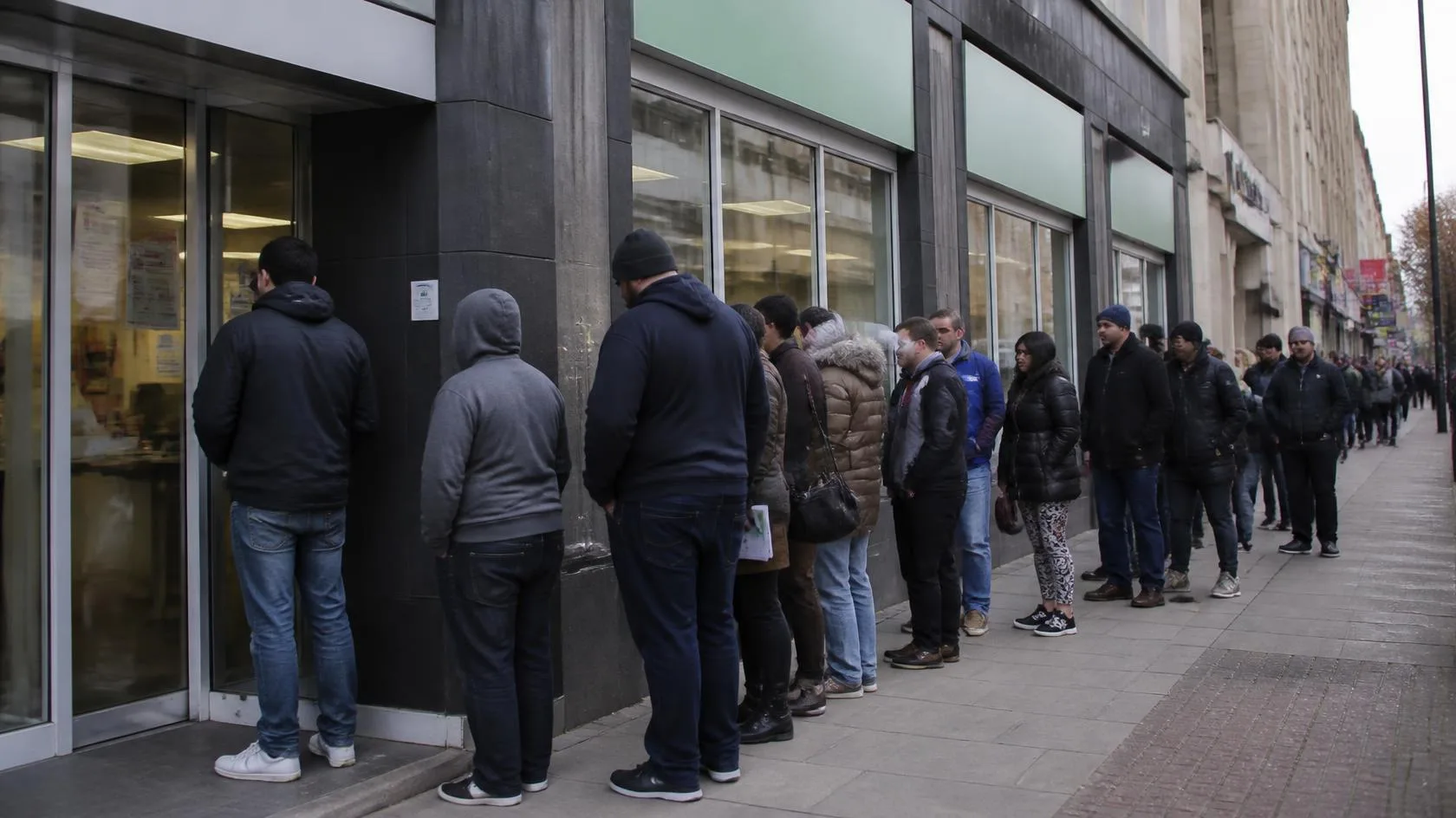
In the sober arithmetic of modern British life, a peculiar equation has emerged, one that ought to trouble every taxpayer, parent, and policymaker in the land. A teenager who claims Universal Credit on grounds of "anxiety" can now receive roughly £100 a week more than a contemporary earning the National Minimum Wage in a part-time job. The figures, drawn from Department for Work and Pensions data and analysed by the Centre for Social Justice, suggest that the traditional moral compact between effort and reward, the very foundation on which post-war Britain was rebuilt, has been inverted.
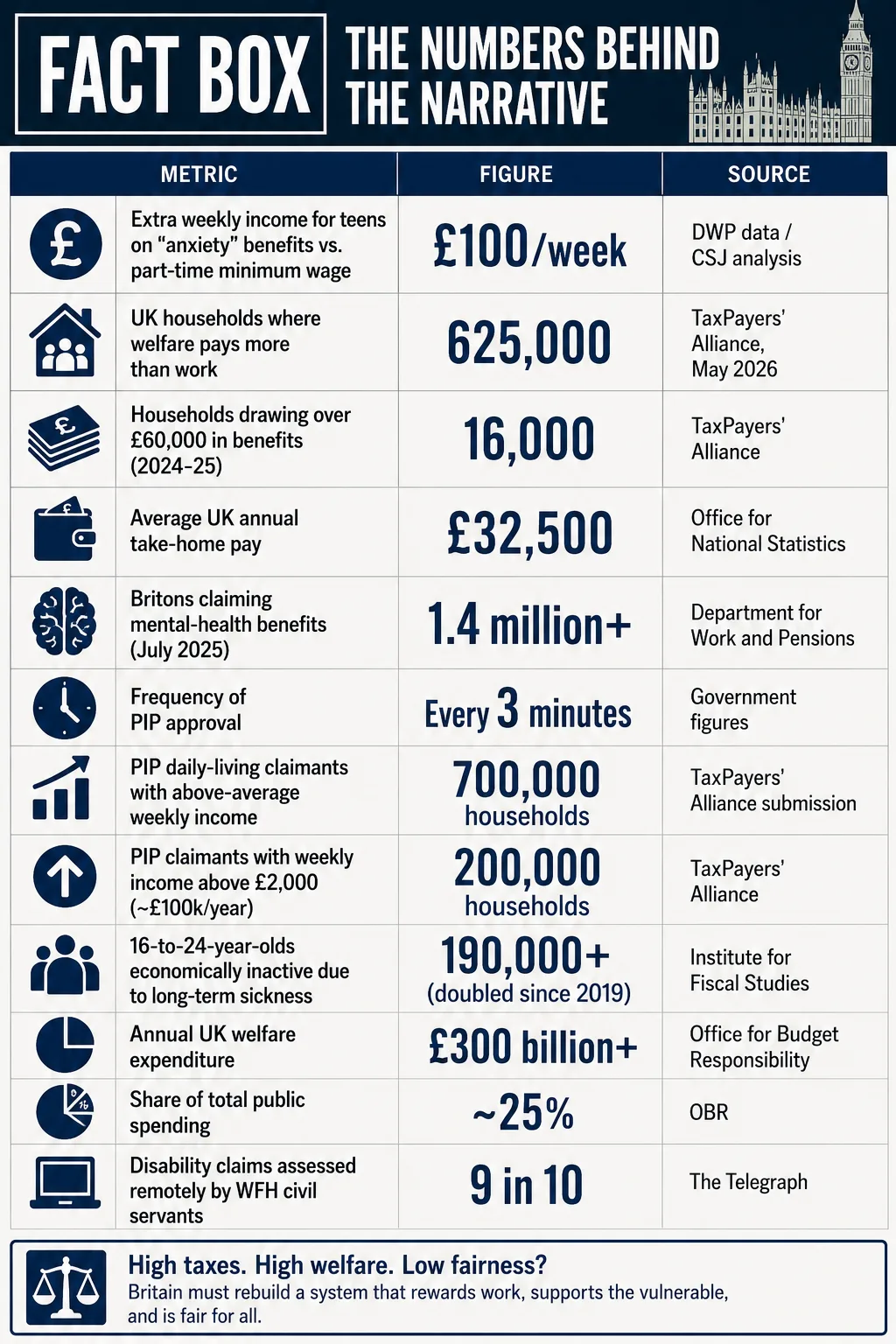
The scale of the inversion is not marginal, it is systemic. Research published in May 2026 by the TaxPayers' Alliance found that welfare now pays more than work for approximately 625,000 British households. Of those, some 16,000 households drew benefits totalling more than £60,000 in the 2024‑25 fiscal year, almost double the national average take‑home pay of £32,500 reported by the Office for National Statistics. To put that in perspective, a family living entirely on state support can, in certain configurations, outearn a mid‑career nurse, a police constable, or a newly qualified solicitor.
The rise of the "anxiety economy"
Nowhere is the shift more visible than in the extraordinary growth of mental‑health related claims. According to figures published by the DWP in July 2025, more than 1.4 million people are now claiming benefits citing mental‑health conditions, and a Personal Independence Payment (PIP) application is approved every three minutes. The PIP scheme, originally designed as a modest supplement for those with genuine, long‑term disability, has expanded into what critics describe as a parallel income stream for the moderately unwell and the merely stressed.
The TaxPayers' Alliance, in its formal submission to the government's PIP review, disclosed figures that ought to have prompted a parliamentary inquiry. At least 700,000 households receiving the PIP daily living allowance, and 600,000 receiving the mobility allowance, already enjoy a gross weekly income above the national average. Astonishingly, roughly 200,000 households drawing the daily living allowance report a gross weekly income above £2,000, equivalent to more than £100,000 a year. "Cash benefits for this group undermines the sustainability of the system," the pressure group wrote. "Lack of means testing in PIP is at odds with the rest of the benefit system, which is either means tested or contribution based."
Compounding the concern, more than nine in ten disability benefit claims are now assessed remotely by civil servants working from home, according to reporting by The Telegraph. The reliability of such assessments, when they touch upon subjective conditions such as anxiety, depression, or fatigue, remains a matter of considerable public debate.
A cultural inversion
The consequences of this quiet revolution are not merely fiscal, they are cultural. When a school‑leaver can rationally calculate that a life on benefits will yield a higher, more predictable, and entirely tax‑free income than an entry‑level job, the incentive structure that once drove social mobility collapses. The teenager who chooses the P45 over the payslip is not lazy, he is arithmetically literate.
Consider the following exchange, imagined but plausible, between a schoolboy and a careers adviser recast for our times:
"Have you thought about what you'd like to do after leaving school, Jenkins?" "Not really, sir." "Well, anxiety is very popular this year. But if you fancy a less crowded field, there are opportunities in obesity, eczema, constipation, even acne. Some of the boys have done rather well on tennis elbow."
The satire writes itself, but the underlying data does not. According to the Institute for Fiscal Studies, the proportion of 16‑to‑24‑year‑olds classified as economically inactive due to long‑term sickness has more than doubled since 2019, rising from around 93,000 to more than 190,000. The pandemic, and the emergency welfare architecture erected in response to it, appears to have reprogrammed a generation's expectations of the state.
How did we get here?
The origins of the current system are not, contrary to partisan claim, the product of any single administration. In October 2010, the then Chancellor George Osborne told the Conservative Party Conference that "if someone believes that living on benefits is a lifestyle choice, we need to make them think again." His remarks, mild by any historical standard, provoked fury on the left. Yet the trajectory Osborne sought to reverse had been set in motion a decade earlier.
The late Frank Field, one of the most thoughtful Labour parliamentarians of his generation, put it plainly in 2015: "It was Gordon Brown's unthinkable expansion of the tax credit system that created the welfare monster we have today." Brown's reforms, launched through the HMRC tax credits programme, deliberately expanded the number of households drawing state support, thereby normalising dependency and, in the view of critics, cementing a client relationship between the electorate and the party of government.
Covid accelerated the trend. The furlough scheme, the temporary £20 uplift to Universal Credit, and the rhetorical embrace of "state guarantee" reprogrammed large sections of the population with the belief that a citizen's income is a public utility rather than the fruit of labour.
Fact Box
The private sector plays along
So embedded is the culture of entitlement that the private sector has begun to mirror it. Retailers now offer discounts to benefit claimants on goods ranging from holidays to sex toys, and local authorities have been reported using taxpayer funds to provide claimants with nights out, beauty treatments, and beach huts. Theme parks such as Alton Towers and Drayton Manor have recently imposed restrictions on their queue‑jump passes for "anxious" customers, amid growing concern that the concessions are being systematically abused.
The uncomfortable question
Which brings us to the question few in Westminster are willing to ask aloud. Why is the state so apparently eager to expand a client class of permanent dependents? Why has every successive administration, whether nominally of the right or the left, presided over the further blurring of the distinction between those who genuinely cannot work and those who have simply chosen not to?
Several explanations suggest themselves. First, dependency is politically useful. A voter whose income is guaranteed by the state has a vested interest in the continuation of the party that guarantees it. Second, mass welfare masks the deeper structural failures of the labour market, chronic underinvestment in productivity, a housing crisis that makes low‑paid work economically irrational, and an immigration policy that has, according to figures from the Migration Observatory at Oxford, suppressed wages at the bottom of the income distribution. Third, and most cynically, a population conditioned to expect state support is a population less inclined to protest, to organise, or to demand reform.
Whatever the motive, the arithmetic is now unarguable. Britain spends more than £300 billion a year on welfare, roughly a quarter of all public expenditure, according to the Office for Budget Responsibility. That sum is drawn from a shrinking base of taxpayers, many of whom now earn less, in real terms, than the households they subsidise.
What taxpayers can do
Alton Towers can restrict access to its free passes whenever it chooses. The taxpayer enjoys no such privilege. Reform, if it comes, will require political courage of a kind that has been conspicuously absent from British public life for a generation. It will demand honest means‑testing, in‑person assessment, and a rediscovery of the moral principle that work, however modestly rewarded, is the foundation of a functioning society.
Until then, the teenager who chooses the claim form over the CV is not the villain of this story. He is its most rational actor.