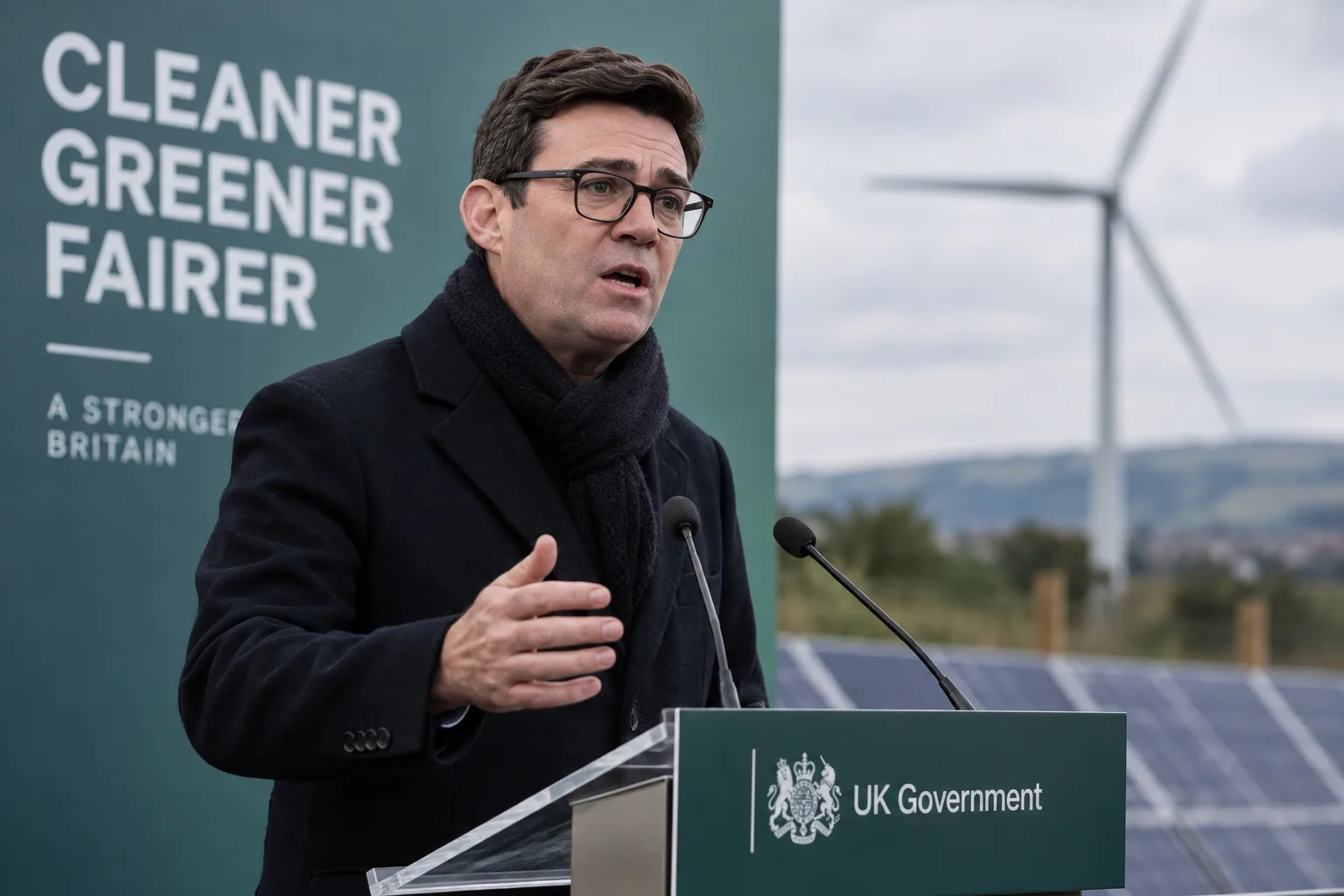
The Prime Minister has made his firmest commitment yet to net zero by 2050.
Writing in the Guardian on Thursday, Andy Burnham said the UK must fully commit to the target, arguing that the British public can no longer pretend the changing climate is something happening to somebody else. "I am determined that we meet the commitment on which Labour was elected and reach net zero by 2050," he wrote. "I want Britain to believe in itself again."
The article accompanied an announcement of nearly £30m for community-led renewable energy schemes, under a programme the government calls People's Power. Projects that win funding must give the community a defined legal and financial interest in the asset they build, whether that is solar panels, a windfarm or a hydro scheme, with a share of the benefits retained locally. Ministers describe the money as the first payment on up to £1bn of Great British Energy funding, intended to support more than 1,000 community and council-led projects.
Burnham used the same piece to confirm that VAT will come off household electricity bills from October, a measure he says he set in motion in his first week in office.
What the article does not mention is the decision sitting on Miatta Fahnbulleh's desk. The Energy Secretary had been expected to recommend approval of the Jackdaw gasfield off Aberdeen this month. That has slipped. Multiple Whitehall sources say no decision will come in the remaining days before the Commons rises for conference season, which takes the announcement past the Holborn and St Pancras byelection on 8 October.
The Department for Energy Security and Net Zero said it does not comment on speculation, adding that any decision would take into account all relevant evidence, including environmental assessments and public representations received during the consultation process.
The Greens have drawn their own conclusion. Zack Polanski, who is contesting the seat Keir Starmer vacated, said Labour had started the campaign with "an act of dishonesty and betrayal". "They are clearly going to allow new drilling in the North Sea but want to keep it under wraps during a byelection where they know the public want tougher action on climate, not backsliding," he said. Andrew Bowie, the shadow energy secretary, wrote to the Prime Minister asking him to confirm the delay. If it is true, Bowie said, it "would be nothing short of you placing the interests of the Labour party before the interests of Great Britain".
A separate decision on the Rosebank oilfield is also pending. Both fields already hold licences, so what is at stake is environmental approval, which was quashed after the Court of Session ruled in January 2025 that the developers, Shell and Equinor, had to account for the emissions produced by burning the oil and gas they extract. Labour's manifesto promised no new drilling licences, and granting these permits would not breach that promise. A number of Labour MPs oppose the projects regardless. The industry says the two fields would supply around 10% of UK oil and gas output at their peak. Campaigners say the fuel they contain would cause as much as £336bn of climate damage. Donald Trump has urged Burnham to open them.
Burnham's language marks a clear shift from July, when a group of climate organisations accused him of near silence through the heatwave and his most visible intervention was a ban on portable barbecues. Downing Street points to his first Commons statement as Prime Minister and to a visit to Stourbridge after fires there. Both are true, and neither is a decision on a gasfield. The 2050 target sets the government's long-term direction. Jackdaw presents a much more immediate choice, and approving it or refusing it will carry consequences for energy policy and for the Prime Minister's own support.
The backdrop is a summer that broke records. The Met Office said summer 2026 was provisionally the UK's hottest on record, with a mean temperature of 16.5C, beating last year's 16.1C in a series going back to 1884. Its rapid attribution study found that figure was made around 130 times more likely by human-induced climate change. Five heatwaves between May and August left the majority of the country in drought, and the number of wildfires topped the 1,017 recorded last year. The Met Office has since confirmed 38.2C at Hartpury College in Gloucestershire on 13 August as the highest temperature of the year.
Net zero remains one of the sharpest dividing lines in British politics. The Conservatives and Reform UK have both rejected the 2050 target. MPs have called for the words "net zero" to be removed from the name of the department that runs energy policy, a suggestion it rejected as an unnecessary distraction.
Claire Bullivant, CEO of Great British PAC, said:
"Britain does need to believe in itself again, but that means believing in British industry, British workers and our ability to produce more of the energy we need here at home.
"While the Prime Minister talks about Net Zero and announces millions more for green energy projects, one of the most important decisions for Britain's energy security has been kicked down the road yet again.
"Jackdaw is about more than one gas field. It is about whether Britain is prepared to use its own resources, protect skilled North Sea jobs, attract investment and reduce our reliance on energy produced overseas.
"There is nothing patriotic about leaving British resources in the ground only to import the energy we still need from elsewhere. It's actually far more detrimental to planet Earth to import oil and gas from far flung places and transport it across the world than it is to drill in our own backyard.
"We should absolutely invest in new technologies and cleaner sources of power, but energy policy has to be rooted in reality. Britain needs affordable, reliable energy, and during the transition that means making sensible use of our domestic oil and gas alongside nuclear and renewables.
"The Government should stop dithering, give industry the certainty it needs and put Britain's energy security, jobs and prosperity first."
The Jackdaw decision has not been dropped. It has been delayed, with current reporting placing it beyond the byelection. Setting a target for 2050 is free. Approving a gasfield, or refusing one, is not. That is the difference between the article the Prime Minister wrote this week and the decision he has left on his Energy Secretary's desk.