
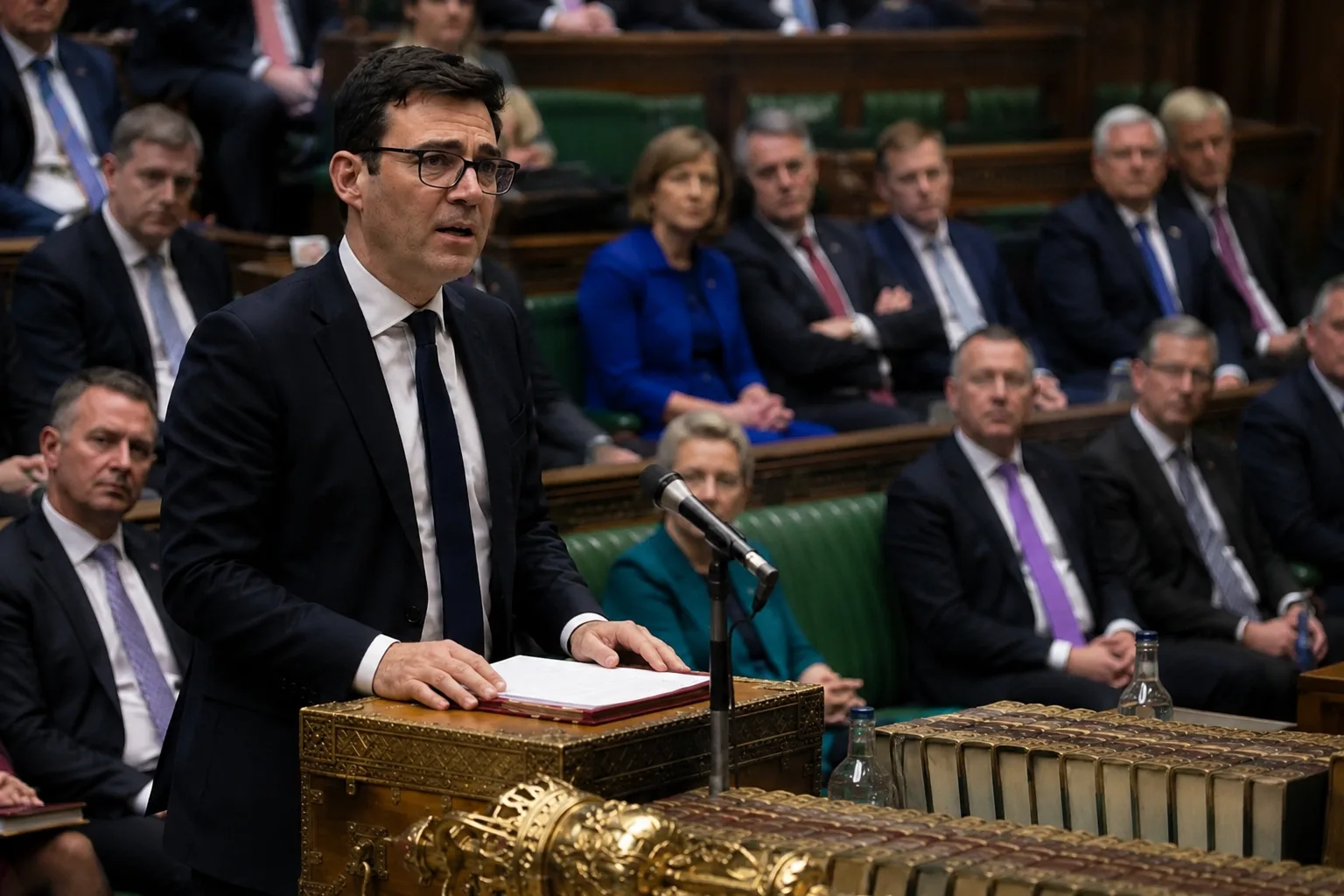
Andy Burnham and his Chancellor, John Healey, are considering a proposal that could raise capital gains tax as high as 45pc and use the proceeds to help fund a £20bn increase in the personal allowance. No decision has been made. The proposal is not Government policy.
The submission comes from Dale Vince, the green energy entrepreneur behind Ecotricity, who has given Labour £6m since 2013 through his business. It was sent to the Treasury and to the policy unit in No 10 last week, and was first reported by The Telegraph. Mr Vince will canvass for it at Labour conference this weekend, four weeks before the Budget on 28 October.
The proposal would bring capital gains tax into line with income tax. Mr Vince's submission claims that would raise £14bn a year. The money would go towards lifting the personal allowance from £12,570 to £15,570, just below where it would stand had it not been frozen since 2021.
The rest of the cost would be met by ending interest payments on Bank of England reserves, the cash the Bank holds on behalf of commercial lenders. The proposal estimates that the two measures together would cover the £20bn that the National Institute of Economic and Social Research puts on a £3,000 rise in the allowance.
NIESR modelled the change for Mr Vince, and its figures were seen by The Telegraph. It found the lowest fifth of earners would be about £600 a year better off. The rise would be worth something to every income taxpayer, not only the lowest paid, and £15,570 is the point at which NIESR believes the Treasury gets the most benefit for the lowest cost. Push the allowance higher and it starts to exceed the incomes of the bottom fifth of earners.
For Mr Burnham, the proposal lands amid mounting pressure over the cost of living. He arrived in No 10 promising a "cost of living Government", with inflation still running high after the war in Iran, and he is under pressure from Cabinet ministers and union leaders to act on household bills. Pensioners are also on course to be brought into income tax for the first time as the frozen allowance is overtaken by the state pension.
Reporting suggests that a number of senior figures in the party, at Cabinet level among them, favour such a move.
In May, Louise Haigh, the Prime Minister's second-in-command, called for CGT to be brought closer in line with income tax, saying this would "shift the tax burden away from punishing work and towards unproductive capital accumulation". Wes Streeting, who was on course to challenge Mr Burnham for the leadership before he became Defence Secretary, has backed the idea too, saying previously that Britain needs "a wealth tax that works". Last week Sharon Graham of Unite, Labour's biggest donor, told Mr Burnham to step in with an increase in the allowance "to put more money in workers' pockets".
Mr Burnham's own comments on the question are more cautious. Before he entered No 10, he said the frozen allowance was "the thing I heard the most on the doorsteps" in his Makerfield constituency. He said he was looking at raising it, then warned that the move was "difficult" and "not without significant consequences" for the public finances. The decision, he said, would be taken at the Budget.
The £14bn estimate is where the numbers become more contested. HMRC's latest published ready reckoners for illustrative tax changes estimate that raising the higher rate of CGT by ten percentage points, with effect from April 2026, would reduce receipts by about £3.6bn in 2028-29, once behavioural responses and the knock-on effects on income tax and stamp duty land tax are taken into account. HMRC says very large rate rises can reduce Exchequer yield because of taxpayer behavioural responses. The figures were published in June 2025 and the 2026 update has been postponed. They are illustrative estimates, not a forecast of any specific proposal.
That is a different proposal from Mr Vince's, and it is not a verdict on what his would raise. The point is that receipts depend heavily on what taxpayers decide to do, which is why estimates of this kind attract so much argument.
Mr Vince's £14bn also rests on more than a rate rise. It is drawn from a 2024 report by the think tank CenTax, which proposed a 40pc higher rate and a 45pc additional rate, along the lines of income tax, the abolition of the uplift at death that erases a capital gains liability on assets held until death, and other measures to limit avoidance. His submission is intended to arrive in stages over several years, which would give investors a window to sell before the higher rates begin.
Claire Bullivant, CEO of Great British PAC, said:
"Once again Labour appears to be reaching for the same tired answer to every economic problem, tax something more and hope nobody changes their behaviour.
"Raising the personal allowance would undoubtedly be welcomed by millions of working people who have been dragged deeper into the tax system by frozen thresholds. But attempting to pay for it by potentially pushing Capital Gains Tax as high as 45 per cent raises a very different question: what happens to investment, entrepreneurship and ultimately tax revenues when people decide Britain is no longer an attractive place to invest or realise gains?
"The extraordinary thing is that HMRC's own modelling already provides a warning. Its figures suggest that increasing the higher rate of CGT by ten percentage points could actually reduce Treasury revenues by around £3.6 billion a year by 2028–29 because people change their behaviour.
"So before Labour starts spending an assumed £14 billion windfall, it might want to establish whether that money would ever materialise.
"You cannot tax a country into prosperity. The United Kingdom needs an economy that rewards work, investment, enterprise and people taking risks to build businesses here. Working families deserve to keep more of what they earn, but that should come from responsible spending, economic growth and a government prepared to tackle waste, not another enormous increase in taxation dressed up as reform."
What the Treasury already collects is worth keeping in mind. Rachel Reeves, the former chancellor, raised the main rates of CGT from 10pc and 20pc to 18pc and 24pc in her October 2024 Budget. Before that the Conservatives cut the annual exempt amount from £12,300 to £3,000, in two stages. HMRC's receipts data puts CGT receipts at around £22.2bn in 2025-26, above the Office for Budget Responsibility's earlier £20.3bn forecast for the year. The OBR describes the tax as particularly difficult to forecast because receipts are heavily influenced by asset prices and by the number and timing of disposals.
Treasury officials have been tasked with finding ways to "ease pressure" on squeezed families. No final Budget decisions have been made and the discussions are said to be at an early stage. A Treasury spokesman said: "As has always been the case, decisions on tax are a matter for the Chancellor to set out at fiscal events, rather than routinely commenting on rumour, speculation or proposals." No 10 was approached for comment.
In five years the personal allowance has been frozen, the main rates of capital gains tax have gone up and the annual exempt amount has been cut from £12,300 to £3,000. Anyone holding assets will be watching 28 October to see what comes next in that sequence. How much the Treasury actually collects will depend on how investors respond when the tax changes. The £14bn is not a windfall waiting in an account.