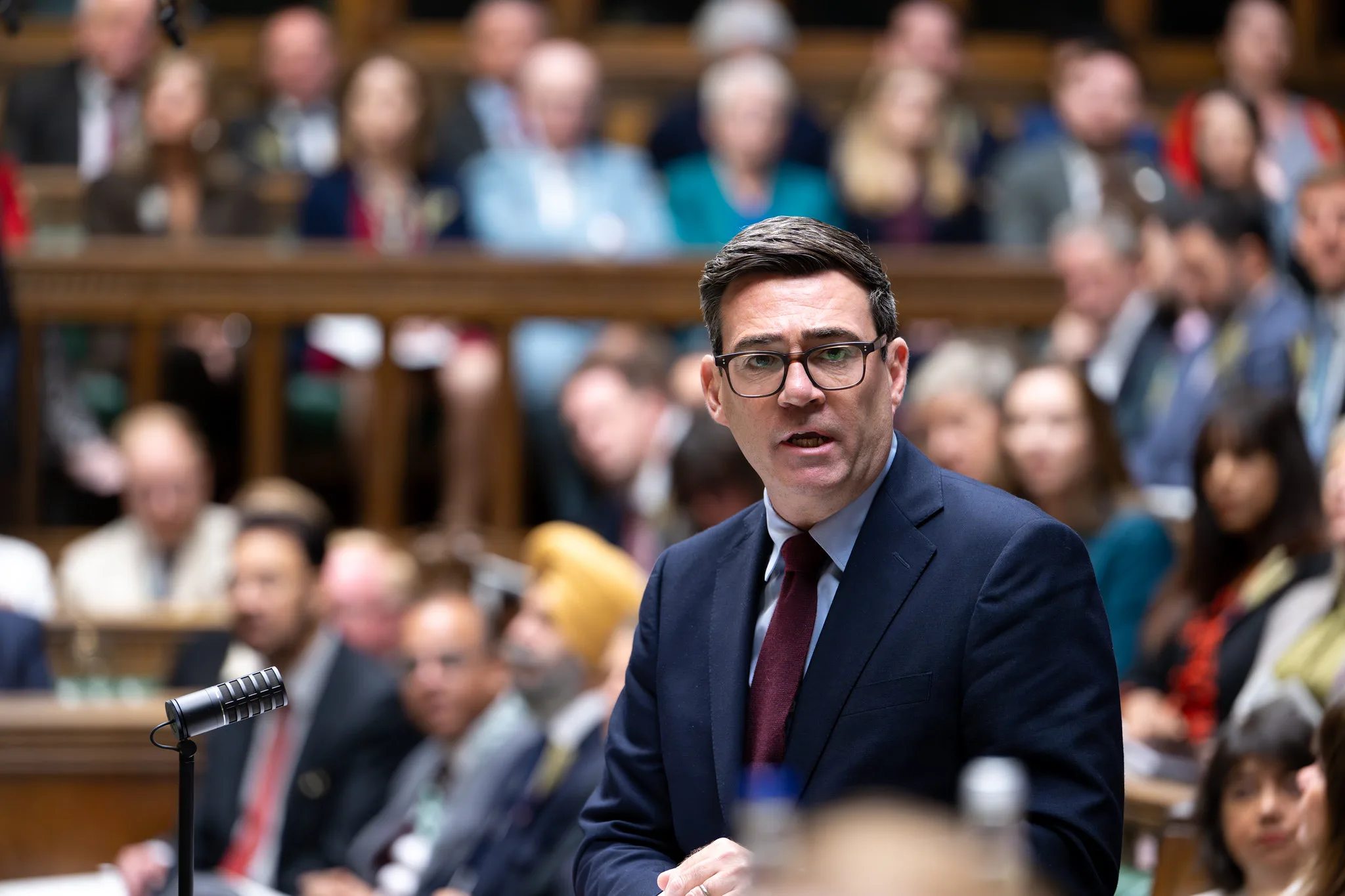
Andy Burnham has put Britain's membership of the European Union back on the table.
At Labour's conference in Liverpool, the Prime Minister told delegates that Brexit had "done more harm than good". Two days later, in a round of broadcast interviews, he went further. Britain should weigh its options, he said. They run from keeping the current arrangements to a customs union, a return to the single market, or going "all the way" to full membership. Asked by the BBC whether an in-out referendum could feature in a future Labour manifesto, he replied: "Yes, things are possible." He also said a referendum "wouldn't be the right thing to do right now", and that he wanted first to "look at the options".
That is a long way from a commitment to rejoin. Mr Burnham has set out no timetable, and he has said he will keep to the 2024 manifesto, which ruled out the single market, the customs union and freedom of movement. But a Prime Minister reopening the question is a change of position in itself.
Within hours, Nigel Farage had pounced. At a Reform UK rally in Doncaster, he told supporters Mr Burnham "might just give me the biggest boost in my career I've ever, ever had". He added: "Thank you, Andy, if you're watching." To reporters he said the Prime Minister had "actually put me back into the debate about the European Union" and predicted a second referendum would "divide the country bitterly in a way perhaps we've never seen before". He claimed Mr Burnham had opened a "huge flank" for Reform in the red wall seats of the north and Midlands.
For Reform UK, it is the fight Mr Farage says he wanted.
The mandate question is the one he has not addressed. Mr Burnham became Prime Minister after Sir Keir Starmer's resignation without first leading Labour into a general election. Reopening the question of EU membership therefore raises an obvious question about what mandate would be required before any fundamental change to Britain's post-Brexit settlement. He has said only that he will set out the options around a summit with Brussels in November.
The money is tighter still. Sir Keir's government never fully recovered from the revolt of 49 Labour MPs in July 2025, when plans to find £5bn of savings from the welfare bill were watered down after a backbench rebellion. The gilt market has added to the pressure. On 1 October the yield on 30-year gilts rose as high as 6.029%, the highest since January 1998, according to LSEG data. The new chancellor, John Healey, has said "fiscal discipline" will be at the core of his first Budget on 28 October.
A debate about EU membership, by contrast, commits no money today. That is part of its appeal for a government with little room to cut and little room to spend.
The polling helps explain why the argument is politically significant. A megapoll by the Messina Group, published this week and reported by the Guardian, put rejoin ahead of six other options for Britain's relationship with the EU. The poll of 11,461 people, carried out from 12 to 24 September and weighted by referendum result, found 49% in favour of rejoining and 28.5% against. Asked when Britain should rejoin, 25.9% said immediately and 22.9% said within three years. The same poll found that almost a third of voters believed an in-out referendum would be needed before any change, while more than one in six thought a general election mandate would be enough.
Mr Farage believes Mr Burnham has calculated that new language on Europe will help Labour win back voters who have drifted to the Greens in the big cities. His own claim is that, in the red wall, it does the opposite.
The welcome from the continent has been warm. Emmanuel Macron said a British return would be "very good news", while warning that Britain could not simply "pick and choose among the Union's freedoms". Spain's Pedro Sánchez said Madrid would welcome Britain back "with open arms". Neale Richmond, a minister in the Irish government, said "the light remains on". Susanne Baumann, Germany's ambassador to London, said the UK was "an integral part of Europe", adding: "in Germany you will always find a partner for setting the ambition as high as we can."
Those invitations also come at a politically difficult moment for several of Europe's largest governments.
In France, the government is contending with a wave of school protests that began in the Paris region in September and spread nationwide. By Friday, Education Ministry figures had recorded disruption at more than 560 high schools, with nearly 400 closed. Fires have damaged school buildings, and the interior ministry has said about 2,000 people were taken into custody, most of them minors.
Germany is facing political pressures of its own. Friedrich Merz took office in May 2025 at the head of a coalition with the centre-left Social Democrats, and became the first chancellor in the history of the Federal Republic to fail at the first vote in the Bundestag. Last month his Christian Democrats won 4.9% in Mecklenburg-Western Pomerania, below the threshold for seats and the first time the party has been shut out of a state parliament since 1949. The far-right Alternative for Germany finished first with 38.3%. One in 10 Germans tells pollsters they are satisfied with their chancellor, the lowest figure since the ARD survey began in 1997.
A British return would not mean switching the old terms back on. Article 49 of the Treaty on European Union sets out the accession process: a state applies to the Council, the Commission is consulted, the European Parliament must consent, the Council must agree unanimously, and the accession treaty must be ratified by every member state. Membership brings participation in the EU legal framework, single-market obligations, freedom of movement within that framework, and contributions to the EU budget. The exact terms, including the size and shape of any financial contribution, transitional arrangements, the treatment of the opt-outs the UK held during its 47 years of membership, and how existing post-Brexit trade agreements would sit with single-market rules, would all be matters for negotiation. As a member, the UK held a rebate on its EU budget contribution, negotiated in 1984. There is no official estimate of what a hypothetical UK contribution as a new member would be today.
For now, those positions sit in obvious tension: Labour's existing mandate rules out the single market, customs union and freedom of movement, while full EU membership would require reopening precisely those questions.
And the union he would be rejoining is not the one Britain left. A decade on, both Britain and the EU are operating in a more competitive and more dangerous world, under growing economic and geopolitical pressure. Many of the economic and political promises made during the Brexit campaign remain heavily contested. That is not the same as the EU having the answers.
Claire Bullivant, CEO of Great British PAC said:
“Brexit was not a mistake. It was one of the greatest democratic victories in modern British history, when millions of people voted to take back control of our laws, our borders, our money and our destiny.
“Britain did not vote to leave the European Union so that a future Prime Minister could quietly lead us back towards Brussels because the political establishment never truly accepted the result.
“The freedoms Brexit returned to this country are precious. They give us the power to make our own laws, strike our own trade deals and choose policies designed for Britain rather than 27 other nations. The failure has not been Brexit, but failing so far to make full use of the freedoms it gave us.
“Instead of asking how quickly we can surrender those powers, Andy Burnham should be asking how we can use them to make Britain more prosperous, competitive and sovereign.
“And our sovereignty is becoming even more important as we enter the AI revolution. Artificial intelligence will transform economies, industries and ultimately the balance of power between nations. Britain needs the freedom to move quickly, innovate and make its own decisions. I do not believe Andy Burnham understands the scale of what is coming. This is a moment to embrace our independence, not surrender it.
“Great British PAC will fight any attempt to drag this country back into the European Union. We voted to leave. We are a sovereign, self-governing nation, and that is something worth defending.”
Mr Burnham has promised to set out the options around a summit in Brussels in November. If full membership is genuinely among them, Labour will eventually have to answer questions that go beyond whether Brexit worked: what terms Britain could realistically obtain, what obligations it would accept, what it would cost and what democratic mandate would be required to take the country back in.