
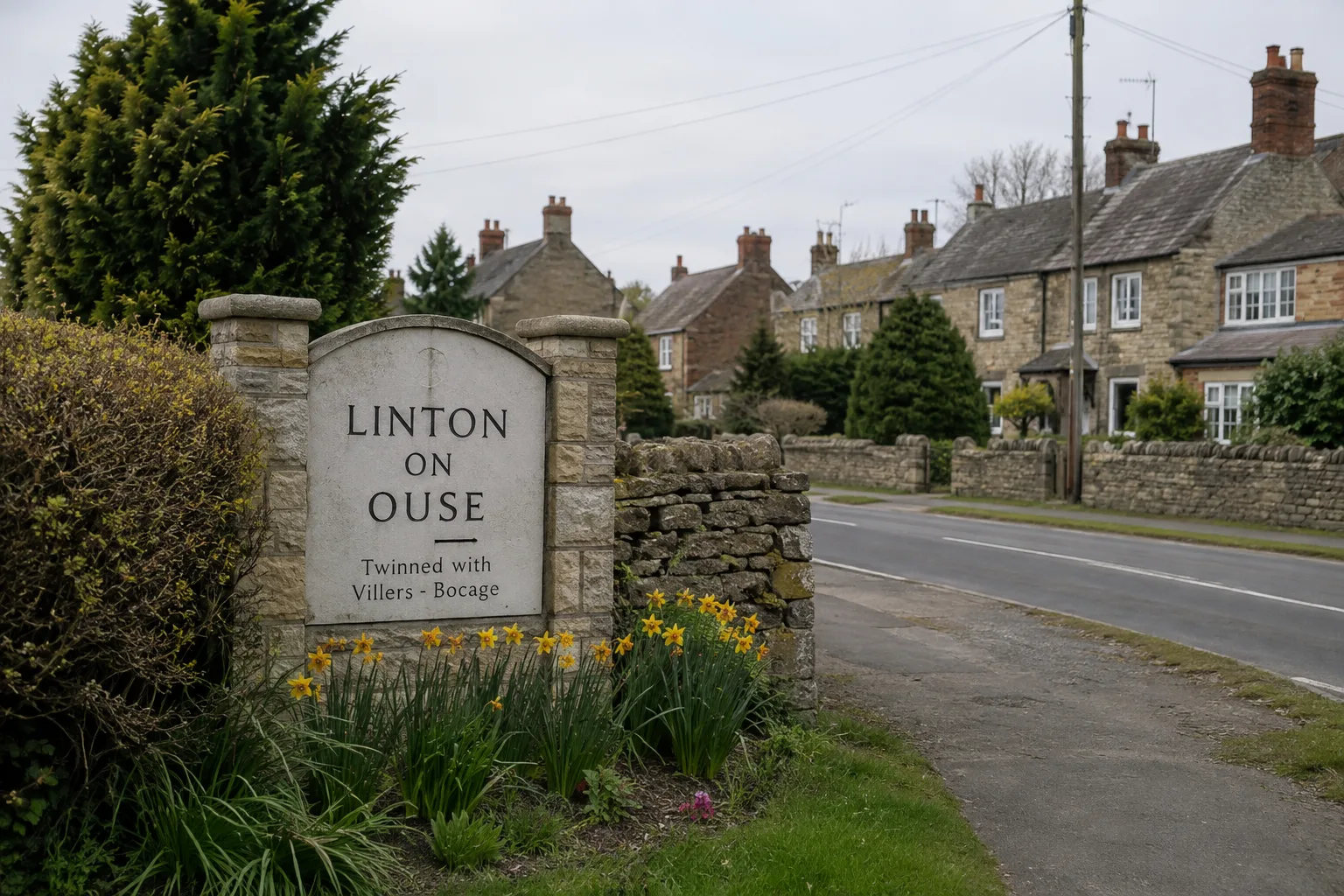
Housing asylum seekers at a former RAF base in North Yorkshire could cost taxpayers more than £500 a night for every migrant placed there, campaigners have claimed, in a fresh challenge to a government scheme they describe as "insane".
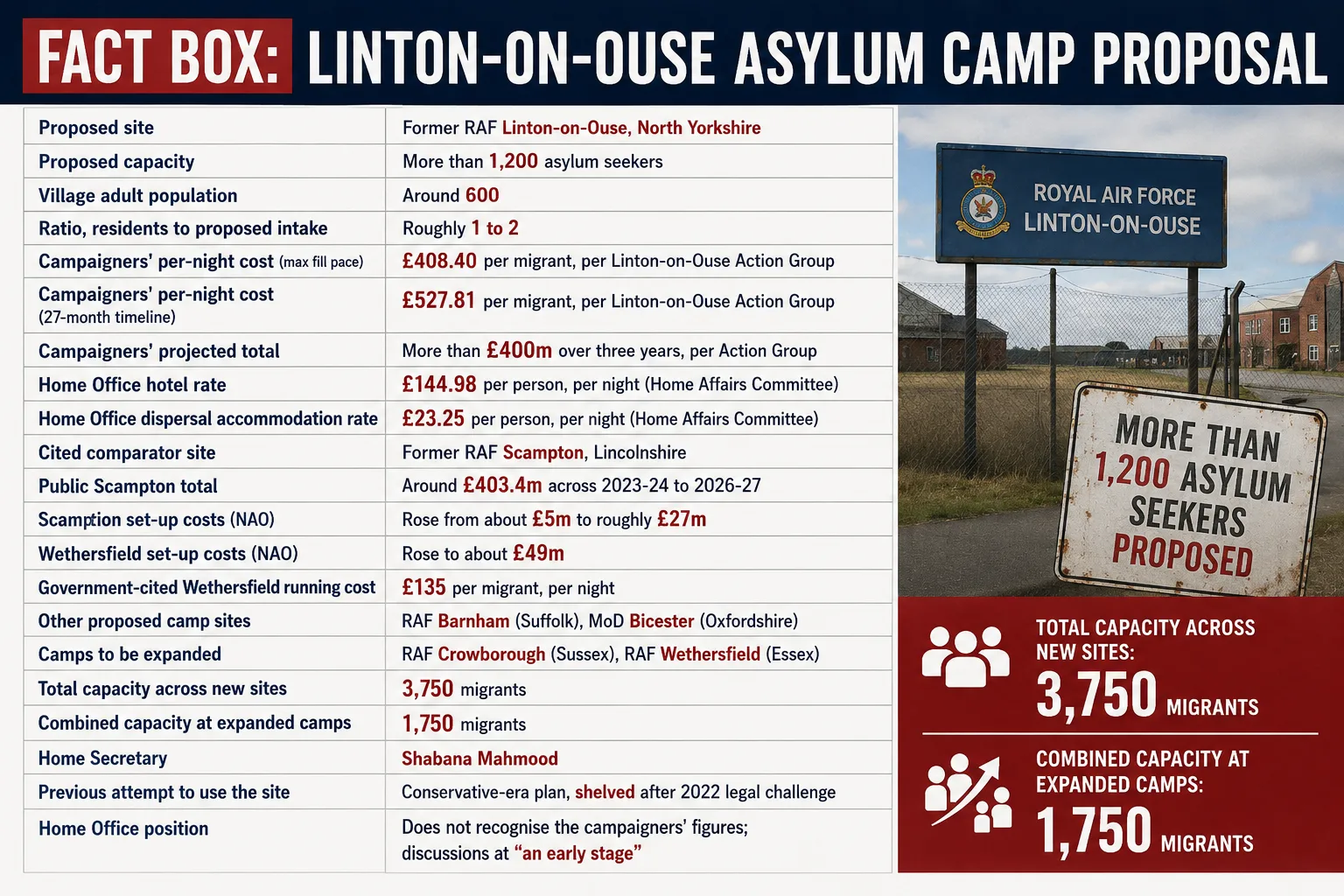
The Linton-on-Ouse Action Group, which opposes plans to place more than 1,200 asylum seekers at the disused base near York, said its own analysis showed the proposal could drain more than £400m from the public purse over three years of operation. The figures, set out in a 27-page submission appealing against the move, are extrapolated by the campaigners from costings published by the National Audit Office (NAO)for a broadly comparable project that the Labour government has itself abandoned as poor value for money.
According to calculations produced by the Linton-on-Ouse Action Group, taxpayers would face a bill of £408.40 per migrant per night if the camp filled at the maximum pace of 60 new arrivals a week, rising to £527.81 per night on a more realistic timetable of 27 months for the site to become fully operational. The group stresses that its per-night figures spread the total programme cost across a gradually filling site rather than assuming 1,200 residents on day one. Even so, the campaigners' lower estimate is, on their own reckoning, more than three times the £145 a night the state currently spends on asylum seekers in hotels, and more than 20 times the £23.25 daily budget for conventional dispersal accommodation such as houses in multiple occupation. The £23.25 dispersal figure and its £144.98 hotel counterpart are drawn from Home Office estimates cited by the Commons Home Affairs Committee in its report on the management of asylum accommodation.
The Action Group's headline claim, that the scheme could cost more than £400m over three years, is its own projection, not a Home Office figure. The Telegraph's own arithmetic underlines why the campaigners have framed their case in per-night terms: 1,200 residents at £527.81 a night would come to roughly £231m a year, or about £694m over three years at full occupancy, while 1,200 residents at £408.40 a night would come to around £537m over the same period. The group's lower £400m-plus total therefore reflects its assumption that the site would only gradually fill towards its 1,200 capacity, not that the higher per-night figures would apply to every bed for every night of the contract.
Residents point out that their village, which has around 600 adults, would be outnumbered two to one by the proposed intake, a balance they say would create safeguarding risks for local families and place "unsustainable" strain on services. "The financial justification for the Linton-on-Ouse asylum centre collapses under basic scrutiny," the submission says. "Far from providing a cost-effective alternative to the current system, this proposal represents an astronomical and fundamentally unviable drain on the public purse."
Olga Matthias, a spokesman for the group, said the projected costs did not match the standard of care asylum seekers required. "Yes, solutions need to be found, but in areas with existing infrastructure and asylum services where the huge investment for refitting, upgrading water, electric and sewage infrastructure is not required."
The base is one of three former military sites, alongside RAF Barnham in Suffolk and MoD Bicester in Oxfordshire, that the Home Secretary, Shabana Mahmood, has proposed converting to accommodate 3,750 migrants in total, according to the Home Office factsheets. Two camps already in use, at RAF Crowborough in Sussex and RAF Wethersfield in Essex, will also be expanded to house 1,750 asylum seekers, with their leases extended for up to four more years, as ministers press ahead with a pledge to close every asylum hotel reported by the BBC.
The campaigners' arithmetic leans on published costs for RAF Scampton in Lincolnshire, a decommissioned base the previous Conservative government began converting into an asylum camp before Labour scrapped the scheme, concluding that it failed every value-for-money test as set out on gov.uk. Public costings for Scampton put the projected total at around £403.4m spanning the 2023-24 to 2026-27 financial years, covering acquisition, set-up and running costs; a leaked Home Office memo, reported by the BBC in November 2023, estimated £108.9m of asylum accommodation costs at Scampton in 2023-24, £97.1m in 2024-25 and £51.9m in 2025-26. NAO set-up costs alone rose from an original estimate of about £5m to roughly £27m at Scampton, and to £49m at Wethersfield. The Linton-on-Ouse group said the two bases were sufficiently comparable that Scampton served as "the most accurate financial benchmark available".
It is the second time the group has attempted to block a camp at the village. In 2022, a similar proposal by the then Conservative government, likewise centred on the disused airfield, was shelved after residents mounted a legal challenge, as the BBC reported. Campaigners say the earlier scheme envisaged a comparable resident intake, although the operating model, contract length and site works proposed under the current plan are not, on the material published so far, identical to those set out four years ago.
The wider programme has already drawn fire from the spending watchdog, whose investigation into asylum accommodation found that large sites were expected to cost £46m more than hotels over a decade, with set-up costs ballooning fivefold or more per base. Ministers nonetheless defend the approach, insisting that basic, secure ex-military accommodation is preferable to the hotel system, which still housed tens of thousands of claimants at the last count, at an average of £144.98 per person per night on the Home Office's own figures.
The plan has been condemned by refugee charities. Imran Hussain of the Refugee Council said barracks "actually cost more money overall than hotels" and isolate people from essential services, while the British Red Cross warned that military sites, often remote, "can retraumatise people who have fled conflict and persecution" in coverage by the Guardian.
Local politicians have also rallied against the scheme. Marc Goddard, chairman of the parish council, said the village had fought the plan before and would "fight it again", while North Yorkshire Conservative councillor Malcolm Taylor said the base was the "wrong place in 2022 and it is the wrong place now". Carl Les, leader of North Yorkshire Council, said the Home Office announced its intentions without any prior engagement, a charge the department disputes.
Andy Burnham, who has long campaigned against housing asylum seekers in hotels and HMOs in working-class areas including his Makerfield constituency, has insisted that wealthier areas should "play their part" in accepting accommodation, despite No 10 conceding that the policy would cost more.
A government source said the campaigners' figures were not recognised, stressed that discussions around the site remained at "an early stage" and pointed instead to the running cost of £135 per migrant per night at Wethersfield, with Crowborough said to be at a similar level. For now, the future of the base hangs on feasibility assessments that the Ministry of Defence factsheet says could take months, and on whether ministers conclude, as their critics insist they must, that the arithmetic simply does not add up.