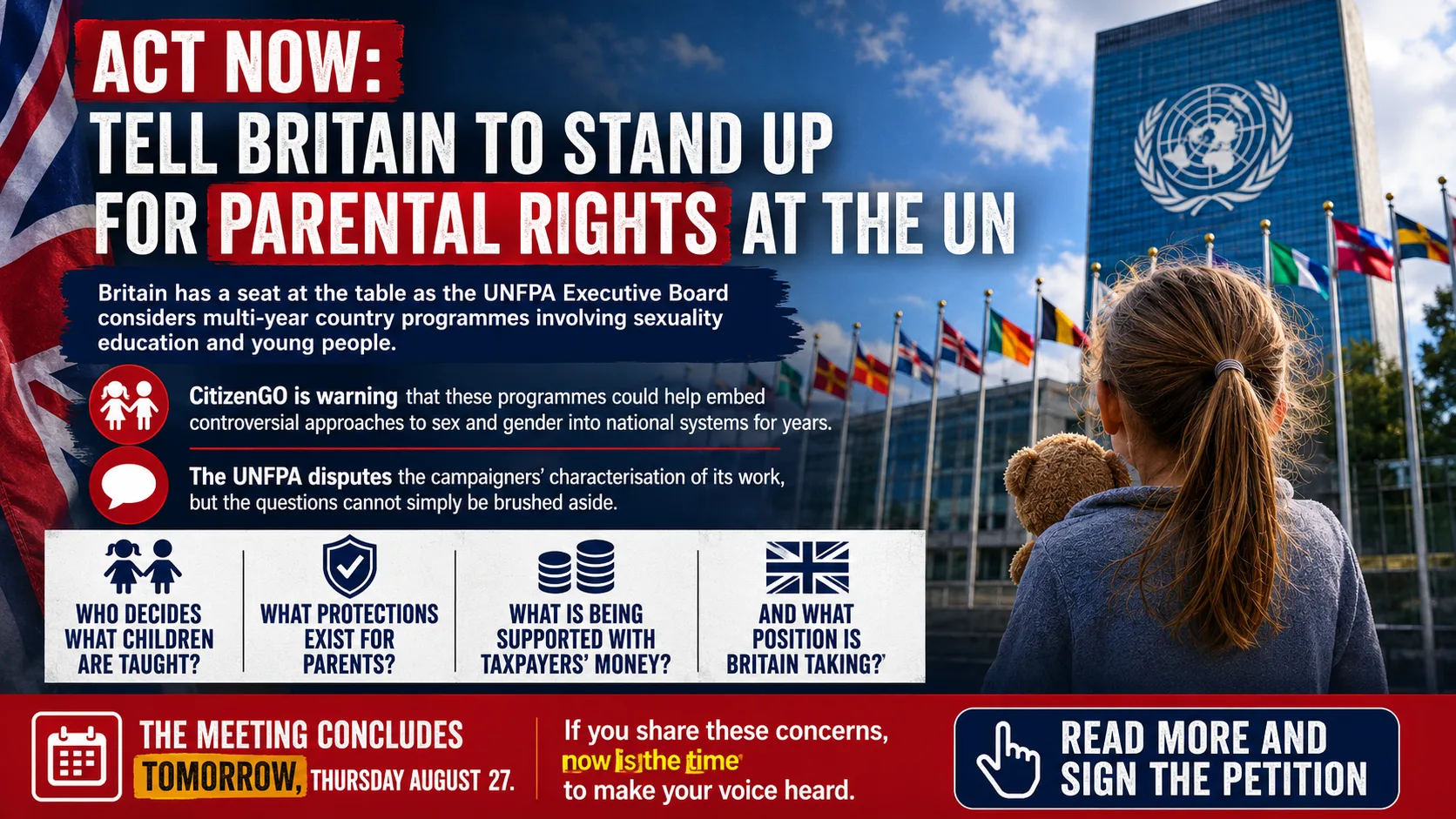
There is just one day left to act. Campaigners are urging Britons to sign a petition TODAY calling on the UK Government to oppose new UN programmes involving sexuality education, gender and young people before a crucial meeting concludes in New York tomorrow, Thursday, August 27.
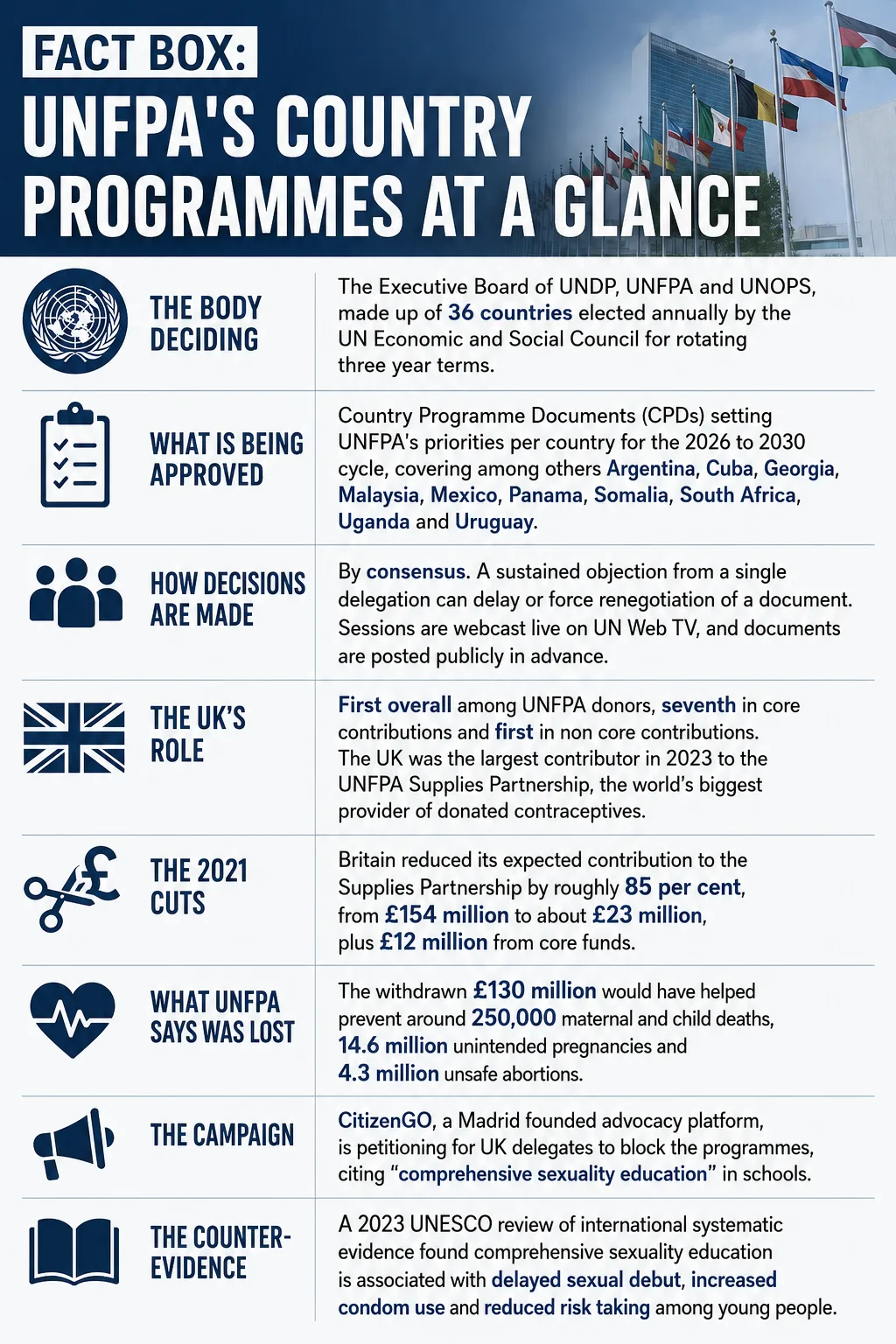
Britain has a seat at the table. As a current member of the 36-country Executive Board overseeing the United Nations Population Fund, UNFPA, the UK can raise objections to the multi-year Country Programme Documents now being considered.
SIGN THE PETITION TODAY:
https://citizengo.org/en-row/ot/19035-stop-the-un-s-backdoor-plan-to-indoctrinate-our-children
CitizenGO, which launched the international petition, is warning parents: "Your child's education is not the United Nations' to redesign."
The campaign group argues that the programmes could help embed controversial approaches to sexuality education and gender into national systems for years, and says governments must act before the current UNFPA Executive Board session concludes.
Its message is deliberately urgent: decisions are being taken in New York tomorrow, the programmes could establish frameworks lasting up to five years, and Britain is one of the countries with a seat at the table.
CitizenGO states: "No parents are invited. No parliament will vote."
The UN process itself is public, with documents published and proceedings webcast, but campaigners argue that decisions capable of influencing national education and health policies receive nowhere near the public and parliamentary scrutiny they deserve.
The Great British PAC is therefore urging supporters who share these concerns to read the evidence, sign the petition and make their voices heard today, before the opportunity to influence Britain's position passes.
What is happening?
Twelve UNFPA country programmes are currently before the board during its August 24 to 27 session, covering Albania, Botswana, Burkina Faso, Cameroon, Guatemala, Laos, Mali, Mozambique, Tajikistan, Thailand, Vietnam and Zimbabwe.
Most would establish frameworks running from 2027 to 2031.
At the centre of CitizenGO's concerns is UNFPA's promotion of comprehensive sexuality education, commonly known as CSE.
UNFPA describes CSE as a key component of its strategy for adolescents and young people and works with governments to develop programmes both inside and outside schools.
The agency says this provides young people with accurate, age-appropriate information about sexuality and sexual and reproductive health.
Critics argue that some approaches expose children to contentious ideas about sex and gender too young and risk diminishing the role of parents.
CitizenGO goes further, warning that the country programmes could help embed what it calls "radical gender ideology"and "sexual education indoctrination" into national systems for years.
From New York to national policy
Crucially, CitizenGO is not claiming that UNFPA itself runs schools or directly dictates national laws.
Its own petition acknowledges: "The UNFPA does not run schools. It does not pass laws."
Instead, the campaign argues that these country programmes matter because they can turn wider UN objectives and guidance into operational programmes developed with individual governments and involving national institutions.
CitizenGO puts its warning bluntly: "This is how a UN declaration stops being a piece of paper and becomes a worksheet in your child's hand."
UNFPA rejects the characterisation of its work as indoctrination.
But the controversy raises an important question: who should ultimately determine what children are taught about sex, relationships and gender, parents and their elected governments, or international organisations?
"No parents are invited. No parliament will vote"
CitizenGO is also challenging the level of democratic scrutiny surrounding the process.
Its petition states: "No parents are invited. No parliament will vote."
The UN process itself is not secret. Executive Board documents and Country Programme Documents are published, the meeting is publicly listed and proceedings can be watched through UN Web TV.
Nor can UNFPA simply impose a country programme without the involvement of the government concerned.
But publication is not necessarily the same as meaningful democratic scrutiny.
How many parents know these decisions are taking place?
How many parliamentarians have examined the programmes?
And how much public debate takes place before governments support multi-year programmes involving sensitive questions of children, sexuality and gender?
Britain has a say, and taxpayers have a stake
Britain is not simply an observer.
The UK currently sits on UNFPA's Executive Board and has historically been one of the agency's significant financial supporters.
British funding has supported UNFPA's work on maternal healthcare, contraception, family planning, reproductive health and humanitarian programmes around the world.
Supporters argue that this work saves lives and improves health outcomes, particularly in developing countries and humanitarian emergencies.
But where taxpayers' money supports programmes touching on children, sexuality and contested questions around gender, the Great British PAC believes ministers should be able to explain exactly what Britain is supporting.
What safeguards exist for parental involvement?
How does the Government assess UNFPA's approach to sex and gender?
What influence could these programmes have on education and health policy?
And has Britain's delegation raised any concerns about the programmes currently before the board?
British taxpayers deserve answers.
Can Britain say no?
CitizenGO believes it can make a difference.
The Executive Board normally seeks to reach decisions by consensus, and the campaign is calling on governments to withhold their support.
"It takes just ONE government raising its hand in New York and saying: 'NO. Not in our name, and not with our tax money,'" the petition states.
Britain does not have a simple veto capable of abolishing UNFPA's programmes worldwide.
But as an Executive Board member, the UK can raise objections, seek changes and decline to join a consensus.
That means Britain's position matters.
The Great British PAC believes parents should have the decisive voice over their children's upbringing, elected governments must remain accountable for education policy, and international organisations spending taxpayers' money should face proper democratic scrutiny.
Whatever one's view of CitizenGO's strongest claims about UNFPA, these are questions which deserve to be asked.
And with the current Executive Board session due to conclude tomorrow, Thursday, August 27, campaigners say there is no time to waste.
ACT NOW – SIGN THE PETITION
CitizenGO's petition, "Stop the UN's Backdoor Plan to Indoctrinate Our Children", calls on governments to oppose the UNFPA programmes and defend parental rights.
If you share those concerns, make your voice heard before the session concludes.
SIGN THE PETITION HERE https://citizengo.org/en-row/ot/19035-stop-the-un-s-backdoor-plan-to-indoctrinate-our-children