
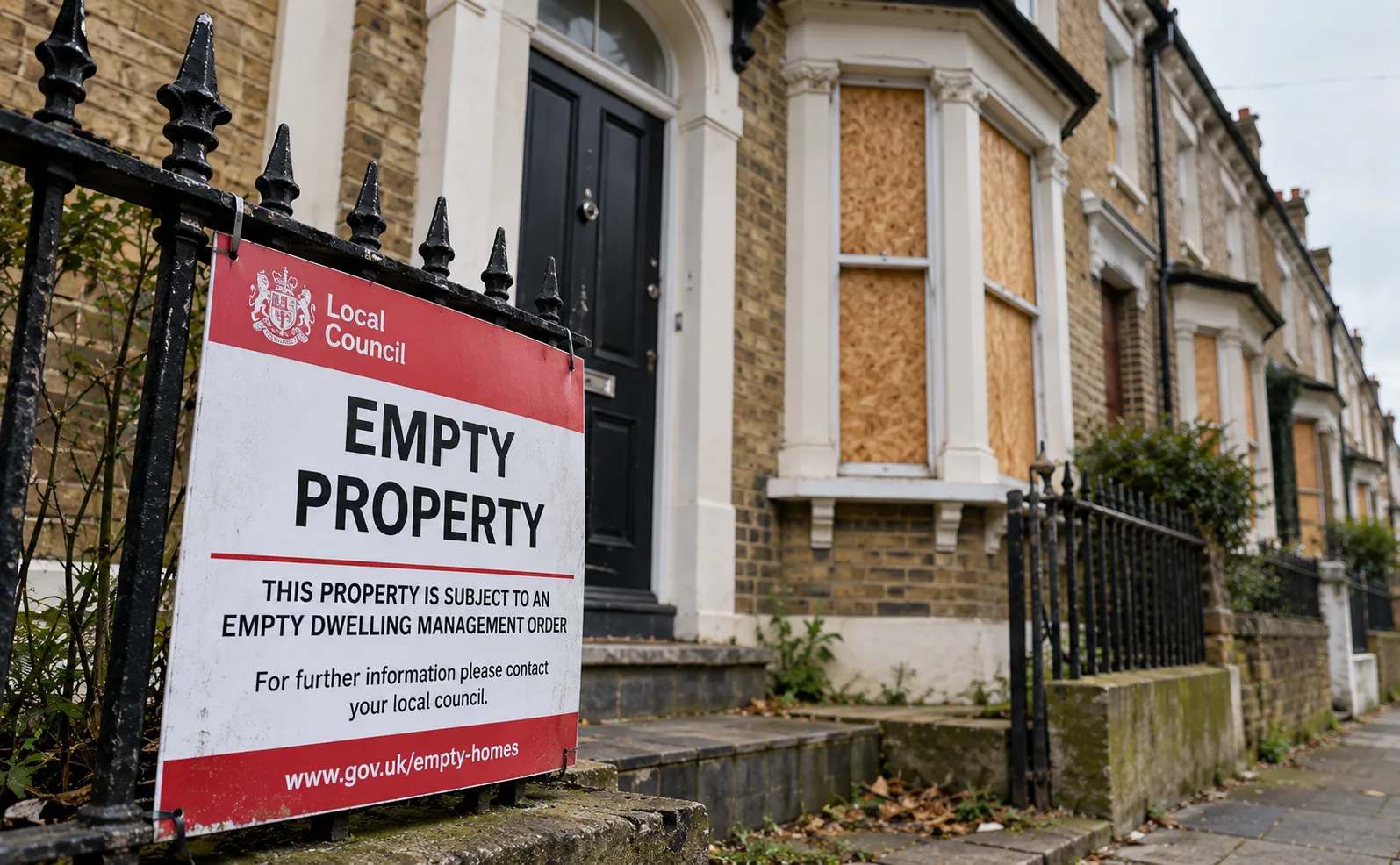
Labour to let councils take over private homes left empty for six months
The government will cut the time a property must stand empty before a council can take control of it from two years to six months.
Ministers announced the reform on Sunday, as Labour’s annual conference opened in Liverpool. The qualifying period for an Empty Dwelling Management Order, known as an EDMO, would fall from two years to six months. Ministers also intend to remove the existing requirements for councils to provide evidence on matters such as anti-social behaviour and community support when they apply to a tribunal for an order. Other statutory tests remain, and a council would still need the approval of the tribunal.
The six-month rule is not yet in force. The present two-year threshold remains the law until ministers lay the necessary regulations and bring them into effect. No commencement date has been announced.
An EDMO does not transfer ownership. The owner keeps the legal title. What changes is control. Once an order is in place, a council can take over the management of the property. Under an interim order, which usually lasts up to 12 months, the authority takes over most management rights but cannot arrange occupation without the owner’s written consent. A final order, which can last for up to seven years, allows the council to manage the dwelling with the aim of securing occupation without needing the owner’s consent to grant occupation rights.
Claire Bullivant, CEO of Great British PAC, said:
“This is a chilling erosion of one of the most basic principles of a free country, the right to own private property without the state deciding it knows better than you how it should be used.
“Let’s be clear about what Labour is proposing. After just six months, a council could seek powers to take over the management of a privately owned home and return it to occupation. You may still own it on paper, but the state will rent it out and control how it is used for years.”
The government says the change will help bring long-term empty homes back into use. Official figures show 303,185 dwellings in England had been vacant for at least six months on 6 October 2025, up 14.5 per cent on the year before and the highest number since 2011. Long-term empty homes make up 1.2 per cent of the country’s housing stock. The figure counts homes empty for more than six months, not the number of properties that would qualify for an order, and it does not record why any individual property is empty.
Housing Secretary Angela Rayner said ministers could not “sit by” while homes stood unused. The housing minister, Matthew Pennycook, said bringing empty homes back into use was “not a silver bullet” but could help solve the housing crisis. The government points to 177,530 children in England living in temporary accommodation, a record high, and to a target of 1.5 million new homes by 2029.
Bullivant also linked the policy to wider pressures on housing demand. Home Office figures show 781 people crossed the Channel in small boats on 23 September, the highest daily total so far this year.
“And there is a staggering contradiction at the heart of all this,” she said. “Labour tells us the housing shortage is now so desperate that councils need sweeping new powers over privately owned homes. Yet this is the same Government that scrapped the Rwanda deterrent just as it was ready to become operational, has still failed to stop the boats, and continues to preside over thousands of additional arrivals who must all be accommodated somewhere. You cannot keep adding to housing demand while simultaneously using a housing shortage to justify greater state control over the homes of British citizens.
“On 23 September alone, 781 people crossed the Channel in small boats, according to Home Office figures.
“That is 781 additional people needing accommodation of some kind in a country Labour simultaneously tells us is suffering an acute housing shortage.
“And the numbers keep accumulating. Those people do not simply disappear once they step ashore. They need somewhere to sleep and live, and those eventually granted the right to remain will need accommodation within the wider housing market, alongside British families already struggling to rent, waiting for social housing or desperately trying to get onto the property ladder.
“You cannot have an honest debate about Britain’s housing pressures while pretending population growth and illegal Channel crossings have no bearing whatsoever on housing demand.
“Yet instead of getting a grip on that side of the equation, Labour is reaching further into the property rights of British homeowners.”
The response from the Conservative benches was blunt. Kevin Hollinrake, the party chairman, wrote on X: “The loony left are always keen to revoke our fundamental rights when it becomes convenient to do so; on this occasion, property rights. Seizing someone’s home because you disapprove of how they use it is classic socialist authoritarianism.”
Katie Lam, appointed shadow housing secretary at the end of August, went further. “Under these rules, if you leave YOUR property, that YOU OWN, empty for just six months, the state can seize it. This is a horrifying attack on private property rights,” she said. Lord Frost, the former Brexit minister, offered a warning of his own. “Don’t risk leaving your house empty. After six months the Government will come for it and rent it to someone else,” he said.
The property commentator Kirstie Allsopp questioned whether councils could use the power at all. “Most councils can’t grant planning permission for a downstairs loo without six months’ notice. The idea that they’ll be seizing properties and renovating them is an absolute fantasy,” she said.
Not everyone in Labour is uncomfortable with the language. Emily Thornberry, the MP for Islington South and Finsbury, welcomed the announcement. “I said it in 2020, and I’ll say it again. If you leave a home empty long-term in the middle of a housing crisis, it should be seized,” she said. The former prime minister Liz Truss responded to the plan’s supporters with a single word: “Commie.”
Bullivant said:
“Kevin Hollinrake is right to call this ‘classic socialist authoritarianism’. There is a world of difference between dealing with a genuinely derelict property abandoned for years and giving the state sweeping powers over someone’s home after just six months.”
The history of the rules shows that some of the safeguards Labour now plans to remove were introduced deliberately in 2012.
Empty Dwelling Management Orders were created by the Housing Act 2004, when the qualifying period was six months. They were rarely used. By the time the coalition government reviewed them, 50 interim orders had been authorised since the regime began in 2006.
In 2012 the threshold was raised from six months to two years, under the regulations that followed. Councils were required to give owners at least three months’ notice, and to provide the tribunal with information about nuisance and community support. Those are among the requirements ministers now intend to remove.
The explanatory memorandum for the 2012 regulations makes instructive reading. It recorded that tribunals had refused applications where councils tried to act against homeowners in circumstances considered inappropriate, “including against people in vulnerable situations”. The new safeguards, it said, were intended “to ensure that responsible homeowners do not face having their properties seized”.
Raising the threshold from six months to two years, it added, was “considered necessary to strike a balance between respecting the civil liberties of responsible home owners and the need to tackle the harm caused to the local amenity when homes are left empty”. Labour now intends to reset that balance by restoring the six-month threshold and removing some of the safeguards introduced in 2012.
Bullivant added:
“People work for decades to buy their homes. They pay mortgages, stamp duty, council tax, maintenance costs and tax on the money they earned to purchase them. Their property does not suddenly become a communal asset because the state believes somebody else could make better use of it.
“Your home is not a spare government asset waiting to be allocated because ministers have failed elsewhere.”
The government says no application for an EDMO has been made since 2021. The proposed reforms would lower the threshold and remove evidential requirements from a power that has not been used for five years.
It is worth being precise about what six months would and would not do. Reaching the threshold would not, by itself, allow a council to take over a home. Other tests would still have to be met, a council would still have to apply, and the tribunal would still have to be satisfied. The rules also provide statutory exceptions. A home is excepted where it is genuinely on the market for sale or letting, where the owner is temporarily resident elsewhere, and where the owner has died and six months has not elapsed since the grant of representation was obtained. Where an owner is carrying out repairs or awaiting a planning decision, the council must give the tribunal reasons why an order is still needed.
The practical change is nevertheless substantial. A property that meets the other statutory tests could become eligible for an EDMO after six months rather than two years, subject to a council application and tribunal approval.
She said:
“Britain desperately needs more homes, so build them. Unlock development. Fix the planning system. Secure our borders. Stop the boats and restore an effective deterrent to dangerous illegal Channel crossings.
“But do not make homeowners pay the price for Labour’s failures elsewhere.
“And we should all be asking where this principle ends.
“Today it is a house that has been empty for six months. Once government accepts the principle that it can override private property rights because politicians believe they have a more socially desirable use for your property, a very dangerous line has been crossed.”
Bullivant said: “At Great British PAC we believe in secure borders and secure property rights. A competent government should be capable of defending both.
“Your home is yours.
“That should not be a controversial statement in a free country.”
The government insists that an EDMO does not transfer ownership of a home to the council. It does, however, allow a local authority to take over its management and, under a final order, arrange for somebody else to live there.