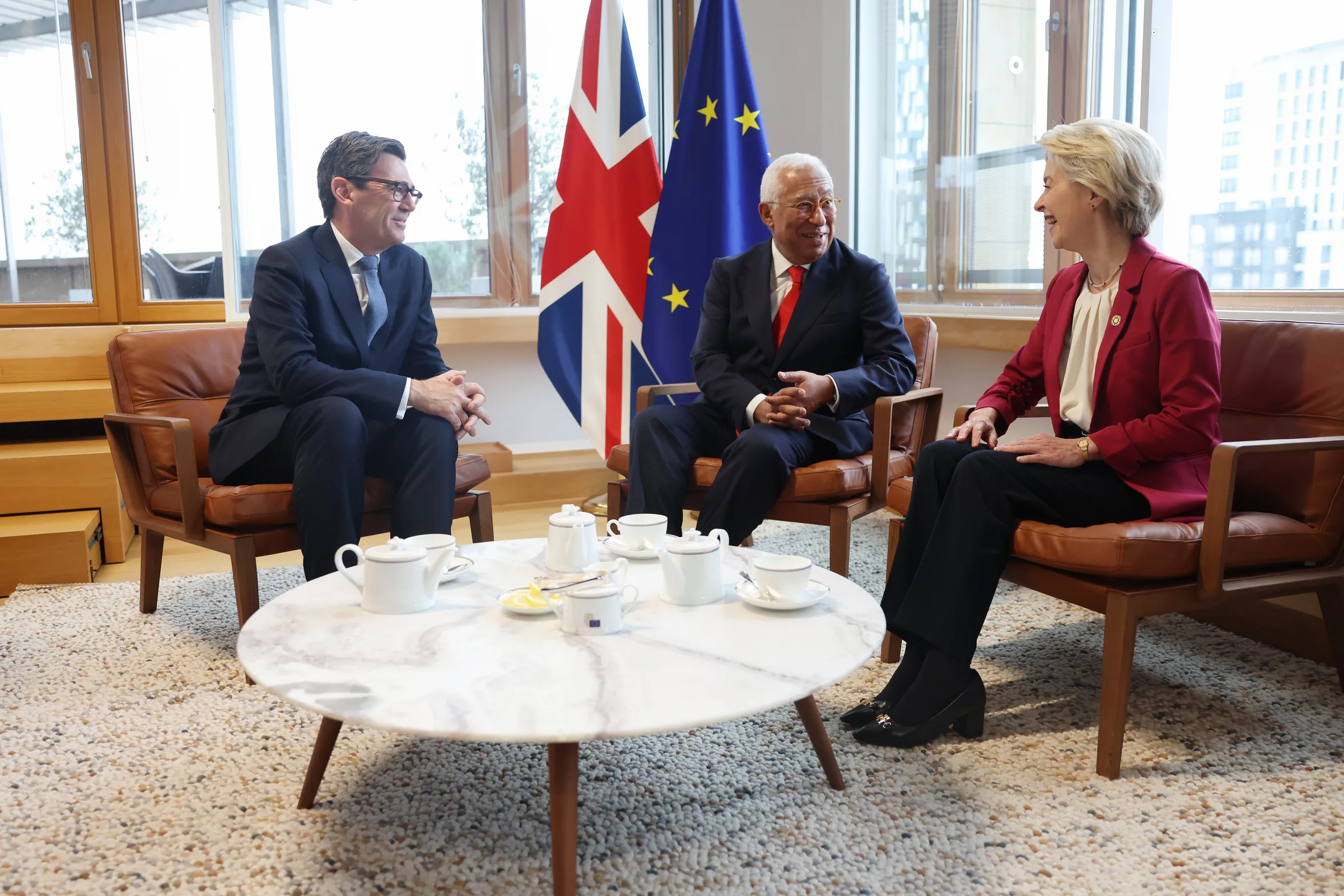
The summit is over. Three agreements were concluded in Brussels: on food and animal health checks, on linking carbon markets, and on youth mobility. Downing Street called it a landmark, and on its own terms it is a substantial piece of diplomatic work.
It is also a package that leaves the most consequential question exactly where it found it. The one element with a plausible, visible benefit for household bills, participation in the European internal electricity market, was not agreed. The European Union has attached a price to it, and that price is British money for the bloc's poorest regions.
This is no longer a matter of briefing and rumour. On 13 November, a week before the summit, the Treasury put the position on the record in a written parliamentary answer: "discussions have begun on the EU's proposal to establish a mechanism for a UK financial contribution towards reducing economic and social disparities between the regions of the Union as part of participation in the Internal Electricity Market."
The same answer states that "no contributions have yet been made or agreed upon". Both halves of that sentence matter. Britain has not yet paid. Britain is, by its own account, discussing how it would.
What the Government has not published is a single figure for that mechanism, a cost assessment of it, or an explanation of what it would refuse.
What was agreed, and what was not
Precision matters here, because ministers are relying on the confusion, and because sections of the press have blurred the difference between a conclusion and a settlement.
Three agreements were concluded at the summit. A sanitary and phytosanitary agreement that removes most plant and animal health checks on British food exports, in return for Britain following EU food safety law, with reduced border controls unlikely to begin before March 2028. A link between the UK and EU emissions trading systems, exempting goods such as steel from each other's border carbon levies. A youth mobility scheme, under which each side admits the other's young people for three years, with Britain accepting a cap of 100,000 after proposing 50,000.
The legal status of those three is more limited than the headline language suggests, and the Government's own words are the best guide. Downing Street said negotiations had concluded, and then added that "as with all international agreements, there is a legal process in each respective country which will now take place". Some reports described the agreements as signed. What No 10 actually confirmed was that the negotiating text is settled and the domestic legal processes lie ahead.
So the accurate description is this. Three agreements have been concluded in negotiation but not ratified, their implementing legislation has not passed, and their entry into force is conditional. A joint statement issued after the summit set out what had been agreed. The full legal texts have not been published.
The conditionality is not a detail. The three deals are on hold until the tuition fee dispute is settled, with both sides giving themselves six months, and the EU aims to begin implementing them on 1 March 2028. Parliament will be asked to legislate. Ratification follows the statutory procedure described below.
And the electricity market was not concluded at all. It could not be done "in the timeframe", according to RTÉ's reporting, and negotiations continue into 2027.
Ministers are entitled to call that progress. They are not entitled to call it a settlement of the financial question.
The admission the Government put in writing
The transparency argument does not now depend on leaks, campaigners or the interpretation of a minister's aside. It depends on a Treasury answer printed on the parliamentary record.
The question, tabled on 10 November, asked whether the Chancellor planned for "the cost to the public purse of annual payment into the EU Cohesion Fund" to be discussed at the summit. The answer, given by Lucy Rigby on 13 November, was this:
"The UK is not currently contributing to EU Cohesion Funds. Whilst discussions have begun on the EU's proposal to establish a mechanism for a UK financial contribution towards reducing economic and social disparities between the regions of the Union as part of participation in the Internal Electricity Market, any UK financial contribution would be subject to negotiations with the EU, and no contributions have yet been made or agreed upon."
Take it slowly, because every clause is doing work.
The Government does not dispute that the EU has proposed a mechanism. It does not dispute that the mechanism is a British financial contribution. It confirms that discussions have begun. It accepts that the purpose of the money is to reduce economic and social disparities between EU regions, which is to say that British taxpayers would be funding regional policy in other countries. And it confirms that the link between that payment and electricity market participation is the EU's own framing.
What it does not provide is the number. Nor a range. Nor an assessment of what the access is worth by comparison. Nor an explanation of what Britain has asked for in return, or what it has offered.
A government prepared to discuss a mechanism for British contributions to EU cohesion policy must be prepared to explain the financial exposure it is negotiating. Yet ministers have published neither an indicative cost range nor a transparent assessment of the potential consequences for British taxpayers.
That absence is now on the record, in the Government's own answer. It is not an inference from silence.
The question the factsheet does not answer
Four days before the summit, the Cabinet Office published a factsheet and mythbuster intended to kill hostile claims. On the charge that British taxpayers will pay into the EU budget, it is categorical:
"No. There will be nothing in the UK Government's Sanitary & Phytosanitary (SPS), Emissions Trading Scheme (ETS) and Youth Experience Scheme (YES) deals that will require UK taxpayers to pay into the EU budget."
Read the list. SPS. ETS. YES. Those are the three agreements concluded in Brussels. The internal electricity market is not on the list, because no electricity agreement exists to put on it.
In the Commons debate on UK-EU relations on 18 November, a Conservative frontbencher went straight at that omission:
"The Cabinet Office recently launched a rather defensive website that featured a 'mythbuster'. The website asks: 'Will British taxpayers have to pay millions of pounds into the EU budget?' The answer is a brisk no, followed by a mention of the sanitary and phytosanitary deal, the emissions trading linkage and the youth experience scheme. How wonderfully lawyers' drafting works, as hon. Members will notice the glaring omission from that list: the EU's internal electricity market."
He then put the question the Government has still not answered at the Dispatch Box: "Will he categorically rule out the UK paying a single penny towards EU regional cohesion funds?"
That is the test, and it is a fair one. A reassurance drafted to cover three named agreements tells the public nothing about the fourth, the one where money is under discussion. The factsheet is not a falsehood. It is a lawyer's answer, published in circumstances where it was always going to be read as a promise.
Two points of accuracy, since they cut both ways. The factsheet does not say that no EU-related payments of any kind will ever be made. It accepts that "both sides will pay proportionate contributions for the running costs associated with the functioning and administration of the agreement", such as shared IT systems. Cost-sharing of that kind is normal in international agreements and is not the issue. The issue is a contribution to cohesion policy, which is a transfer rather than a shared invoice.
Nor is the omission proof of deception. Drafters narrow warranties for a living. But the Government was asked directly, in the House, to extend the same explicit reassurance to electricity, and it has not done so. If ministers are confident no cohesion payment will be agreed, a single sentence would settle the matter. Yet ministers have still not provided that reassurance.
Brussels has named its price
The demand is public, attributed and specific.
Sandro Gozi, the liberal MEP who heads the European Parliament's delegation in the EU-UK parliamentary partnership and is closely involved in the negotiations, told Rapporteur: "It is essential that any agreement on the UK's participation in the European electricity market be accompanied by a financial contribution from the UK to the cohesion policy."
Gozi was not freelancing. A letter dated 6 November, seen by Rapporteur, records the leaders of the Netherlands, Germany, Denmark, Luxembourg and Belgium calling for an "appropriate financial contribution" from London in exchange for energy market access. MEPs were preparing to formalise the same demand in the week of the summit.
Note the alignment of the two ends of this negotiation. The European Parliament's negotiator says the payment is essential. Five governments say it is appropriate. And the British Treasury says in writing that discussions about the mechanism have begun and no contributions have been agreed.
Nobody is denying any part of it. There is simply no number.
What €392 billion has to do with your electricity bill
The budget Britain would be feeding is under strain, which is precisely why the demand is being made now.
The Commission has proposed a Multiannual Financial Framework worth almost €2 trillion for 2028 to 2034. Cohesion funding accounts for €392 billion in the current seven-year budget, roughly a third of the total, and Germany is leading a group of net contributors demanding cuts to the next one. The 27 member states are deadlocked. Britain would be walking into that fight as a new source of cash at the exact moment the existing contributors are refusing to pay more.
The EU's own leaders have stopped pretending otherwise. Asked by Sky News whether he would welcome Britain back, the Czech prime minister, Andrej Babiš, gave an answer of disarming honesty: "Yes, of course. We need more money."
The case for electricity integration is real and should be stated fairly. British households pay among the highest retail power prices in the G7, and linking to the European market would let cheaper French nuclear power into the British system. The Government's own assessment suggests a combined market could cut wholesale electricity costs in Northern Ireland by up to 20 per cent.
That is exactly why the missing number matters. This is the one part of the reset with a direct line to household bills, which means it is the one part where the public is entitled to see the price alongside the benefit.
The rebate is gone and the rules are not divisible
Anyone who imagines Britain can buy back the old terms should read what the EU's former chief negotiator said a fortnight before the summit. Michel Barnier told the BBC there is "not a single market à la carte" and that the four freedoms come as a package. He was equally clear that the British rebate is "off the table".
Now add the constitutional consequence, which the House of Lords European Affairs Committee set out in its report Dynamic alignment: a fundamental change.
The committee's central finding is that the SPS and ETS agreements commit Britain to dynamic alignment with EU law in those areas, and that a third agreement on electricity would do the same. It describes dynamic alignment as something that "will fundamentally alter the post-Brexit relationship between the UK and the EU" that has existed under the Trade and Cooperation Agreement. It notes that the Government intends to legislate for it through a European Partnership Bill.
Its findings are worth quoting at length, because they answer the Government's central claim that this is a pragmatic, low-cost reset.
On influence: "The influence that the UK can expect to exert through participation in 'decision-shaping' is likely to be limited, though, and we urge the Government to be realistic in this respect."
On scrutiny: "Current arrangements for parliamentary scrutiny of EU documents will not be adequate and will need to be reviewed."
On money: any assessment of net benefit "will also need to take account of the UK's prospective financial contributions, towards the costs of the EU's activities in the relevant sectors, and, potentially, towards the aims of EU cohesion policy". And then the sentence that should be printed on every MP's briefing note: "The prospect of the UK making ongoing payments towards the aims of EU cohesion policy raises distinct questions of principle. We recommend that the Government publish the amounts of any proposed contributions, of either kind, before Parliament is asked to approve the corresponding agreement, together with an indication of the source of the funding."
Two matters of accuracy. These are the committee's assessments of prospective agreements, and it is explicit that dynamic alignment "will be a feature of the agreements currently under consideration" rather than an obligation already in force. The SPS and ETS alignments take effect on implementation; the electricity alignment does not yet exist. What is already true is the structure of the commitment: rules made elsewhere, applied here, with limited British say.
A Lords committee has asked for the figures before Parliament approves the agreements. The Government has not supplied them. That is the whole story in two sentences.
The benefits are costed. The costs are not.
Labour's promotional arithmetic is not shy. The factsheet claims up to £5.1 billion a year from the food and drink deal and up to £3.8 billion a year from emissions linking. The Prime Minister put the whole package at 0.5 per cent of GDP.
These are not invented figures, and it would be dishonest to suggest otherwise. The Government has published methodology notes for them. But the Lords committee, having taken evidence, records that those notes "acknowledge that these estimates have a number of caveats and shortcomings", that the results are "positive but small", that they "do not take account of compliance costs falling on firms that do not trade with the EU", and that they ignore "the possible opportunity cost of regulatory choices that dynamic alignment might close off".
So the published modelling covers part of the ledger. It does not cover the compliance burden on domestic-only firms, the cost of rules Britain will not write, the tuition fee concession now under negotiation, or any cohesion contribution. The committee's request for a full impact assessment for each agreement, covering exporters, non-exporters, consumers and the taxpayer, remains outstanding.
Two further cautions on the headline numbers. Each is an annual economic benefit at full effect, not money arriving in a Treasury account and not a saving on a household bill. A GDP effect of half a per cent is not a cheque to anyone. Ministers have consistently presented the two as though they were the same thing.
It is worth noting, briefly, how the wider argument is being conducted, because it illustrates the vacuum. Stay Out, the campaign group chaired by the former Vote Leave official Oliver Lewis, puts the gross cost of rejoining the EU at £39.3 billion a year, about £750 million a week. That is a hypothetical full membership figure, not an estimate of this reset and not an estimate of the electricity arrangement. It is gross, and it is modelled on a budget still being negotiated.
The criticism of that figure is fair. But the reason it dominates is that the Government has published nothing comparable of its own. Ministers have produced the upside in pounds and left the downside to their opponents.
What Parliament will be asked to approve, and when
The constitutional position is more nuanced than the slogan version, and it is worth setting out properly, because the nuance is what makes reform necessary.
Treaty making is a prerogative power exercised by the Government. Under part 2 of the Constitutional Reform and Governance Act 2010, a treaty cannot generally be ratified unless a minister has laid a copy before Parliament, it has been published, and 21 sitting days have elapsed without either House resolving that it should not be ratified. Where the Commons resolves against ratification, a minister may lay a statement explaining why it should proceed anyway, triggering a further 21 sitting days, and the process can in theory repeat. Section 22 allows the requirements to be disapplied in exceptional cases, with a statement of reasons, though not once either House has resolved against ratification.
So Parliament is not powerless. It can object, it can delay, and it can in principle block ratification. Where an agreement needs changes to domestic law, implementing legislation gives MPs a further and more familiar point of leverage, and the European Partnership Bill will be one such instrument. That legislation may also come before ratification, since the Government cannot ratify an agreement it lacks the domestic law to give effect to.
But note what the Act does not do. It does not require a debate. It does not require an affirmative vote of approval. It does not guarantee government time for either. The House of Lords International Agreements Committee concluded that the framework is a "weak and insufficient mechanism for securing meaningful accountability to Parliament", and in December 2025 the Government declined to legislate for parliamentary approval of significant treaties.
That is the machinery into which a permanent cohesion contribution would be fed. The realistic prospect is a text laid before the House, a scrutiny window that may pass without a dedicated debate, and a vote only if the Government chooses to grant one. Implementing legislation may follow, but a vote on how to apply an agreement is not the same as a vote on whether to make it.
Great British PAC's demand is therefore not that Parliament be given powers it lacks. It is that a permanent financial obligation to a foreign institution should carry a dedicated, binding vote of the elected House before it is undertaken. That is a modest constitutional request, and the Government has not offered it.
Why this matters to households and businesses
Three consequences follow, and none of them is theoretical.
The first is money. A cohesion contribution is a transfer from British taxpayers to the budgets of other governments. It would have to be accommodated the way any other spending commitment is: through taxation, through reductions elsewhere in departmental budgets, or through additional borrowing. The OBR's October forecast has public sector net borrowing at £133 billion in 2026-27, or 4.2 per cent of GDP, with debt interest among the fastest-growing lines in the accounts. There is no idle fund from which a new recurring payment to Brussels could be met, and each of the three routes to paying it has a cost that falls on someone.
The second is leverage. If Labour accepts the principle of paying for market access, every subsequent negotiating round risks beginning from that concession. British taxpayers deserve to know whether ministers are prepared to cross that line before they do so. The electricity link has already slipped to 2027. The money has not slipped anywhere.
The third is control. The Lords committee's assessment is that alignment obligations reach across the whole economy, that scrutiny arrangements are inadequate, and that British influence over the rules will be limited. Those constraints may be worth accepting. They may even be cheap at the price. But nobody in government has published the calculation, and the public cannot judge a trade it has not been shown.
It is worth stating plainly what is not being claimed. No cohesion payment has been agreed, and a cohesion payment would not appear as a line on a domestic electricity bill. Cheaper French nuclear power could genuinely lower wholesale prices. The question is whether the net effect, after contributions, compliance and lost policy freedom, is positive. That is an empirical question with an answer, and the Government is withholding it.
GREAT BRITISH PAC REACTION
Claire Bullivant, CEO of Great British PAC, said:
“Britain voted to take back control, not to hand Brussels a blank cheque and ask politely how much we owe.
“British taxpayers are not a cash machine for the European Union. Our people are already struggling with crippling energy bills, rising taxes and the cost of living under this Labour Government. The very last thing they need is Labour now negotiating payments to Brussels to subsidise development in other EU countries.
“The Treasury has now admitted that discussions are taking place about British financial contributions to EU cohesion policy, yet ministers cannot tell us how much they are prepared to pay. That is completely unacceptable.
“And this is not simply about money. It is about sovereignty, democracy and the fundamental principle that the British people, through their elected representatives, must decide how their money is spent and whose laws they live under.
“Andy Burnham has no mandate to quietly surrender the freedoms Britain fought so hard to reclaim. No Prime Minister has the right to negotiate away our independence behind closed doors.
“If Labour believes this deal is good for Britain, let them publish every figure, every condition and every proposed obligation. Let Parliament debate it. Let MPs vote on it. And let the British people see precisely what is being done in their name.
“Britain is a proud, independent nation, not a subordinate province of Brussels. We should be negotiating from a position of strength, not approaching the European Union with our chequebook open.
“Not one penny of British taxpayers’ money should be committed to EU regional subsidies without full transparency and the explicit approval of our elected Parliament. Britain’s interests must come first. Always.”
GREAT BRITISH PAC DEMANDS
The Treasury must publish a complete cost assessment of the EU reset package, including any cohesion contribution, compliance costs and tuition fee consequences, before any payment is agreed or any implementing legislation is laid before Parliament, as the House of Lords European Affairs Committee has recommended.
The Treasury and the Foreign Office must set out in writing the Government's negotiating position on a financial contribution to EU cohesion policy, including the range under discussion, what Britain has sought in return and what it would refuse.
Downing Street must publish the joint statement, the full legal texts and the implementation timetable in full, and must identify which provisions remain conditional and on what.
The Department for Education must publish its estimate of the cost to universities and the public purse of equal treatment for EU students on tuition fees, including the assumptions behind the six-month negotiating deadline.
The Leader of the House must table a motion for a dedicated debate and binding Commons vote before any permanent financial contribution is agreed or any treaty is ratified, rather than relying on the default procedure under the Constitutional Reform and Governance Act 2010.
The Treasury must publish a full impact assessment for each agreement, covering the 0.5 per cent GDP claim, compliance costs for firms that do not trade with the EU, the opportunity cost of alignment, and the treatment of any EU contribution.
The Cabinet Office must publish a complete list of EU rules the UK would be required to match under dynamic alignment, together with the domestic scrutiny mechanism and resources Parliament would need, as the Lords committee has said current arrangements are inadequate.
THE PRICE IS NAMED. THE BILL IS HIDDEN.
The summit produced something real. Three agreements were concluded, on food, carbon and young people, and if implemented they would be the most substantial improvement in Britain's trading terms since 2020. That should be said clearly, because the criticism that follows is not a criticism of the deal's existence.
It is a criticism of what was left out of the accounting. The Government published £5.1 billion and £3.8 billion and half a per cent. It published no comprehensive cost assessment, and no figure at all for the one arrangement where Brussels has named a price. Its factsheet ruled out payments into the EU budget under three named agreements while omitting the fourth, the one where access has been explicitly linked to cohesion money. On 13 November the Treasury confirmed in writing that discussions about the mechanism have begun. It has still not published a range.
The Lords committee asked for the amounts before Parliament is asked to approve the agreements. The Commons was told the reassurance covers three deals and not the electricity market. The European Parliament's negotiator has said the contribution is essential. Five governments have asked for it in writing. The Treasury has confirmed the talks exist and confirmed that no money has yet changed hands.
All of that is now documented. What remains undocumented is the price.
Labour chose this negotiation. Labour has failed to publish the figures. Labour must publish the bill before it asks Britain to pay it.