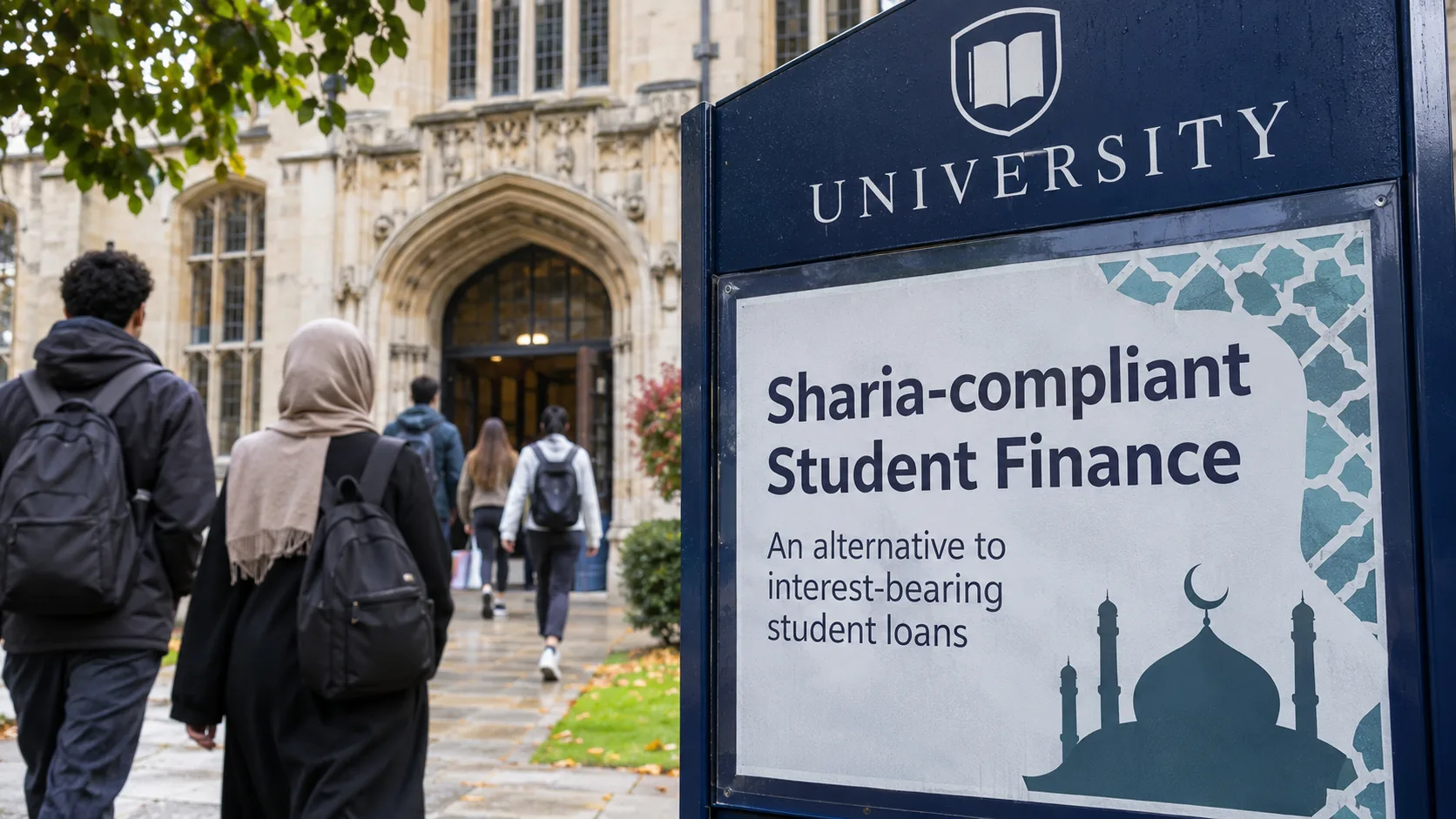
The University of Bristol's student finance pages tell applicants that from the 2026/27 academic year "the UK government will introduce a new alternative student finance". The same page calls it an "interest-free UK government loan" that would be "compatible with Islamic finance principles".
That academic year began in September. Not one student has been able to apply. The statutory powers to create the scheme exist, but the secondary legislation required to implement it is not in force. And when the Department for Education was asked in August for a date, it said it had not "committed to a target implementation date" and would not say more.
Public money has nonetheless been spent on it. The Telegraph reported on 10 November that more than £365,000 of public money has been paid to the Islamic Finance Council UK to devise the scheme, which ministers have described as one of the first state-backed arrangements of its kind anywhere in the world. The report does not break the sum down by year, and no schedule of payments has been published, so the expenditure cannot be attributed to any single administration. The council's own published material states that it has worked with the department on the product since 2017, which points to a programme of work spanning more than one government.
Three things are therefore true at once. Universities are advertising a financial product as though it exists or is imminent. Ministers are describing it in terms that flatter it. And no confirmed implementation timetable has been published, while the publicly available material examined for this article does not provide a comprehensive breakdown of the scheme's projected costs or explain the proposed fund's accounting treatment in sufficient detail. That is not a policy disagreement. It is a failure of delivery and disclosure, and it belongs to the government of the day.
Thirteen years of promises, still no launch
The commitment is not Labour's invention, and honesty about that is the first test of any serious scrutiny.
David Cameron promised in 2013 that no Muslim should be unable to go to university because of their faith. His coalition government consulted in 2014 and found that 94 per cent of nearly 20,000 respondents believed there was demand for a faith-compatible alternative. The power to create "alternative payments" free of interest was written into sections 86 and 87 of the Higher Education and Research Act 2017, under Justine Greening as Education Secretary. The 2022 review of post-18 funding, concluded under Boris Johnson, mentioned the policy only to say ministers would consider "if and how" it could be delivered. Rishi Sunak's government published the detailed design paper in July 2023 under Gillian Keegan and left office without a launch.
Thirteen years later, the product still does not exist in force.
What Labour inherited in July 2024 was a design, a certification body and an unresolved delivery problem. What it has produced since is a restatement, a gloss and a further delay. Bridget Phillipson, Education Secretary until July this year, published updated guidance in June 2025 confirming the model and noting that some people feel "unable to use existing student loans for university or college, due to their faith or conscience". The scheme was then tied to the Lifelong Learning Entitlement, the wider rebuild of post-18 funding. That entitlement was originally due in 2025 and slipped to the 2026/27 academic year, with the new system applying to courses and modules from January 2027. Alternative Student Finance was pushed behind it.
Lucy Powell was appointed Education Secretary on 20 July when Andy Burnham replaced Keir Starmer as Prime Minister, after Starmer announced his resignation as Labour leader on 22 June. She now owns the timetable. Neither she nor her department has published one.
The date that will not be given
In April the department published a pre-tender market engagement notice whose contractual timetable pointed to the system being live in August 2027. Hyphen reported that officials had been working towards the 2027/28 academic year. The department then declined to confirm any of it.
The consequence is not abstract. Oxford, Cambridge and most medicine, veterinary and dentistry courses closed applications on 15 October. The remainder close on 13 January. Applicants are being asked to commit to three years of fees and living costs on the basis of guidance that cannot tell them whether the finance they need will exist by the time they arrive.
The department's own guidance is explicit that secondary legislation is still required to set the amount of finance students will receive and how their contributions will be calculated. Until that instrument is laid and approved, the scheme cannot open, whatever a university page says. A petition demanding a firm launch date has passed 1,400 signatures.
Ministers cannot expect taxpayers and students to accept vague assurances in place of a published timetable. A government that can legislate, tender, certify and publicise a scheme has no excuse for being unable to say when it will start.
What £365,000 bought, and what it did not
The financial transparency around this policy is poor, and it is poor in a specific, checkable way.
The department's guidance confirms that the Islamic Finance Council UK was appointed as secretariat to certify the product through an Islamic Finance Supervisory Board. The Telegraph reports that more than £365,000 of public money was paid to the council to devise the scheme. A detailed breakdown of the payments by year, purpose and deliverable has not been established in the sources reviewed, and no schedule of how much went on certification, how much on consultancy and how much on the supervisory board's running costs has been published.
The published material examined for this article does not provide a complete breakdown of those costs, nor of the following:
The cost of building the system at the Student Loans Company, which must run two parallel funding systems.
The projected annual operating cost once the scheme opens.
The expected size of the ringfenced Takaful fund and how it will appear in the departmental accounts.
How the long-term cost to the Exchequer is expected to compare with conventional student loans on a like-for-like basis.
The ongoing cost of certification, supervision and compliance.
Whether the ringfenced contributions sit inside or outside the Consolidated Fund, and what happens to any surplus.
The ringfence is not in itself proof of an additional subsidy, and it should not be presented as one. The stated design is that a student choosing this route pays the same amount, on the same dates, as a student on a conventional loan, and suffers "no detriment nor experience any advantage". What the ringfence does do is create a separate stream of public money, outside the general pot, recycled only into this programme. The documents examined do not establish the fund's expected size or explain its accounting treatment in sufficient detail for Parliament or the public to judge it.
Identical repayment terms do not by themselves establish identical fiscal costs, and the department has published no assessment of the difference. What can be said is that because contributions are calibrated to loan repayments, the design implies a comparable exposure to unpaid balances. The Institute for Fiscal Studies puts the share of borrowers who clear their balance in full at around half, and the Telegraph notes that official forecasts expect almost half of student debt to be written off. Whether that expected shortfall is carried in the same way under the alternative scheme is one of the questions ministers have left unanswered. No publicly available estimate has been identified in the material reviewed for this article.
"Interest-free" is doing a great deal of work
The second problem is the phrase universities are using.
The model avoids interest in the legal sense. Students receive payments for fees and living costs rather than an interest-bearing loan. After graduating they make "contributions" into a Takaful fund, a structure of group mutual support in Islamic finance, rather than repaying principal plus interest. The government's own wording refers to graduates paying "an equivalent alternative to interest".
Read that phrase again. The obligation is designed to be financially equivalent to the thing it replaces. Hyphen reported in August that an alternative charge equivalent to the value of interest is applied to the total contribution, benchmarked against the interest charged on conventional loans precisely so that the two routes remain identical in cost. The department has not published the methodology, and it should.
None of this means the scheme is secretly charging conventional interest. It is not. The legal structure differs, and for a student whose objection is to the form of riba rather than to the arithmetic, that distinction may be the whole point and entirely sufficient.
But describing the scheme simply as an "interest-free government loan", without explaining that its repayment obligations are designed to mirror those of conventional student loans, risks giving applicants a misleading impression of its financial effect. A seventeen-year-old reading a university website will not parse the difference between legal form and economic effect, and she should not have to. If the amount a graduate ultimately pays is designed to mirror the conventional system, ministers must explain why the alternative is being advertised as interest-free without that explanation attached.
Shaista Mukadam, a senior lecturer at Birmingham City University, put the case for a bolder design to Hyphen: "This was an opportunity for them to create a level playing field, write off the interest from the loans and just get them to pay back the principal."
Under Plan 5, the system this product is intended to mirror, graduates repay 9 per cent of earnings above £25,000 and balances are written off after 40 years. Interest is set at the Retail Prices Index rate, which is 4.1 per cent for the period from 1 September 2026 to 31 August 2027. Those are the terms being replicated, and the exact contribution mechanics must remain provisional until the implementing regulations are made. Universities advertising the product should say so.
What the universities are actually telling applicants
The picture is more varied than a single list of names suggests, and the distinction matters to any fair reading of it.
Bristol states that the government "will introduce" the new finance from 2026/27 and describes it as an "interest-free UK government loan". It does not tell applicants that applications are open, but it does attach the scheme to the academic year now under way. The Telegraph reported that Leeds likewise advises students the loans could be available in 2026/27, that University College London and City St George's tell applicants the loans "would not be interest-based", and that Newcastle describes them as "non-interest bearing" and "sharia-compliant finance".
De Montfort is the honest counter-example. Its own page states plainly that Alternative Student Finance is "in the planning stage" and that "the aim is to introduce Alternative Student Finance as soon as possible after LLE is introduced". That is a materially more cautious description than the confident billing found elsewhere, and it shows that accurate wording was available to institutions that wanted it.
Universities are publishing information that appears inconsistent with the Department for Education's refusal to confirm a launch date. Ministers must explain what steps they have taken to ensure prospective students receive accurate information, and whether any guidance has been issued to the sector at all.
Who is answerable
Precision matters here, and the record is specific.
Cameron made the pledge and set the expectation. The Conservative governments that followed consulted, legislated and then failed to commence. The 2017 Act gave ministers the power and they did not use it for eight years. The 2023 design paper was thorough and was never implemented.
Labour's responsibility is different, and it is current. Since July 2024 it has held the department, the pen and the prerogative. It chose to chain the product to a Lifelong Learning Entitlement that has itself slipped. It restated the commitment in June 2025 without attaching a date. It ran a procurement process whose timetable pointed to 2027 and then declined to confirm it. It has published no costings. And it has allowed a position to develop in which several universities, including Bristol, are telling applicants that a scheme exists or is imminent when the secondary legislation to bring it into force has not been made.
A department spokesman told the Telegraph it would be "completely false to assert that Alternative Student Finance arrangements would give favourable treatment to Muslim students", adding that "all graduates will be repaying their loans in full regardless of which system they use, including an equivalent alternative to interest". That answers a charge about favouritism between students. It does not answer a single question about the timetable, the ringfenced fund, the costings or the accuracy of what universities are telling applicants.
Equal treatment, honestly stated
Some of the criticism levelled at this policy does not withstand scrutiny, and the public deserves an accurate account.
Suella Braverman, Reform UK's education spokesman, called the scheme "outrageous" and "anti-British", said it "creates a two-tier education system and divided society" and warned of "creating parallel institutions that are incompatible with the British way of life".
The scheme is open to any undergraduate eligible for student finance, whatever their faith. A Muslim student and a non-Muslim student on the same income will pay the same amount on the same dates. There is no discount, no separate qualification and no preferential rate. Any suggestion that Muslim students are receiving better financial terms is not supported by the published rules, and this publication will not make it.
The legitimate questions are different ones, and they are serious. Does creating a second financing architecture inside the Student Loans Company add cost and complexity that a single system would not? Can ministers demonstrate that students on the two routes will be treated genuinely equivalently, including on write-off, deferment and hardship? If the ringfenced fund accumulates a surplus, who benefits? And would a government serious about equal treatment have designed a single, interest-free system open to everyone, as Mukadam suggests?
Framing this as a question about transparent public policy, not about the faith of the students it is meant to help, is both fairer and more effective.
The students who are actually waiting
The case for doing something is strong, and it rests on evidence rather than sentiment.
A Muslim Census survey of 38,821 British Muslims found four in five students who had taken a conventional loan felt they had compromised their faith, 71 per cent considered the existing system discriminatory, and an estimated 12,000 students a year were either forgoing university or self-funding in order to avoid interest.
Rahma Hegy, vice president of student affairs at the Federation of Student Islamic Societies, told Hyphen that students needed "clarity on the timeframe so they can plan their futures with confidence". She added that "a great deal is dependent on this for students, their education and progression".
Thirteen years of announcements have not given them that. Another cohort has now applied without it, on the strength of university pages describing a scheme Parliament has not yet brought into force. The remedy is not a seventh restatement of intent. It is a date, a laid statutory instrument, published costings for the ringfenced fund, and an honest description on every university page of what the product is and when it will open.
GREAT BRITISH PAC REACTION
More than two years into Labour's time in government, ministers still cannot tell students when this scheme will begin or provide taxpayers with a complete account of its financial implications. Announcements are not delivery, and public money demands public accountability.
A statutory power has sat unused since 2017. A design was completed. A certification body was appointed. More than £365,000 of public money has reportedly been spent. And still there is no date on which a single student can apply. That is not misfortune. It is a failure of stewardship, and it sits with the department that holds the pen.
This is what we mean when we say that a minister who can claim credit for a world-first scheme can also publish a date, a cost and a repayment model. The continued absence of those answers is a failure for which the current Labour Government must be held accountable, whatever the failures of the governments before it.
We also say plainly what we will not do. We will not attack Muslim students for wanting to study without compromising their faith, and we will not pretend the eligibility rules give them a better financial deal than anyone else, because they do not. The failure here is one of competence, candour and stewardship of public money, and it is the government's.
Great British PAC demands that ministers:
Set a confirmed implementation timetable, naming the date secondary legislation will be laid, the date applications will open and the date the first payments will be made.
Account transparently for every pound spent, including the £365,000 reportedly paid to the Islamic Finance Council UK broken down by year, purpose and deliverable, and the cost of building the system at the Student Loans Company.
Disclose projected costs in full, including annual running costs, certification and supervision fees, and an estimate of the long-term cost to the Exchequer against conventional loans.
Explain the repayment model in plain English, stating whether the total contribution is designed to equal the total cost of a conventional loan, and publishing the method used to calculate the interest-equivalent charge.
Publish the terms of the ringfenced Takaful fund, including its expected size, its accounting treatment, what happens to any surplus and how it will be reported to Parliament.
Guarantee equal treatment for every eligible student, with published assurance that no student on either route is advantaged or disadvantaged on repayment, write-off or hardship support.
Ensure applicants get accurate information, requiring consistent wording across the sector and explaining how a scheme without the necessary secondary legislation in force came to be advertised by universities as available this academic year.
Submit the financing and administrative arrangements to parliamentary scrutiny before the scheme opens, not after the money has been committed.
Taxpayers are entitled to know what they are underwriting. Students are entitled to know when, or whether, the finance they have been promised will exist. Parliament is entitled to the full available cost estimates, the assumptions behind them and a transparent explanation of the financial risks before it is asked to approve the arrangements.
Claire Bullivant, Chief Executive Officer of Great British PAC, said:
"More than £365,000 of taxpayers' money has reportedly been spent developing this scheme, universities are advertising it, and yet not a single student can apply. You couldn't make it up.
"Whether you support this scheme or oppose it, there is one principle that should unite us all: public money must be accounted for, every student must be treated equally, and no government should be allowed to hide behind grand announcements while refusing to provide the figures.
"The British taxpayer is not a bottomless cash machine, and a press release is not a substitute for competent government.
"Publish the figures, explain the repayment system and give students a date. If Labour ministers cannot answer those three simple questions, they have absolutely no business congratulating themselves on this policy."