
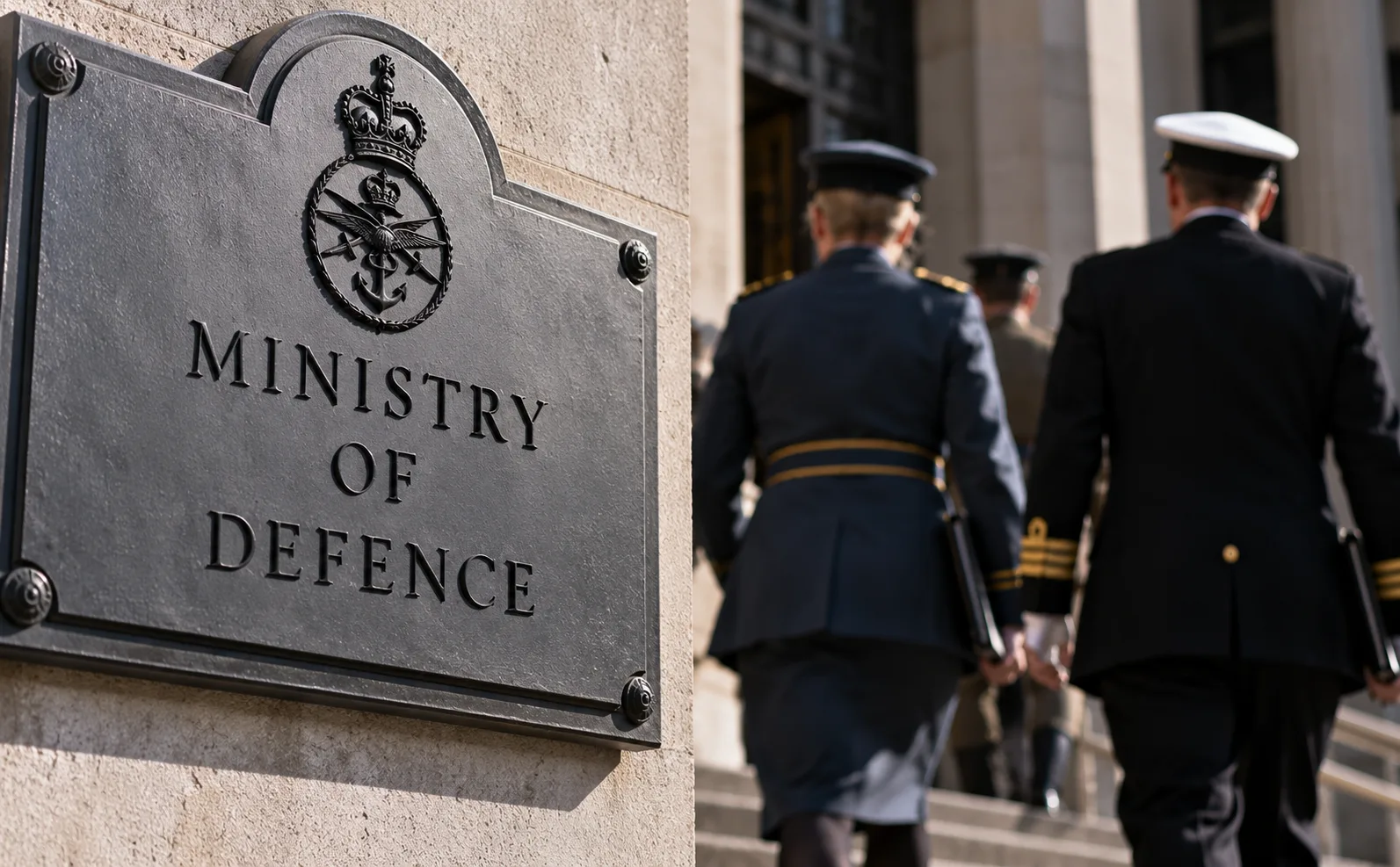
Fifty-three Ministry of Defence posts with diversity-related job titles carry an estimated annual salary bill of £2.7 million, according to a Daily Mail analysis of material obtained under Freedom of Information laws.
The posts include two RAF wing commanders, a Royal Navy commodore and an RAF squadron leader. Their job titles were recorded on the MoD's human resources systems as of 31 March 2026, twenty-one months after Labour took office. The tally is a keyword count, not a headcount of diversity workers: the disclosed material does not establish how many of the 53 spend all or most of their time on equality, diversity and inclusion, and the Mail's estimate of £2,736,740 is reached by multiplying the number of staff in each role by the median salary band for that job, a calculation that takes no account of employer costs such as pensions and National Insurance.
The department's response is unambiguous. "The Ministry of Defence does not recognise these figures. They are based on a keyword search of job titles and do not represent the number of staff working exclusively on diversity and inclusion," a spokesperson said. "Our priority is delivering value for taxpayers and ensuring Defence has the best people and skills to keep Britain safe, which is why we are investing almost £300 billion over the next four years." Read closely, the objection is to how the figures have been interpreted, not to the recorded job titles' existence. The department has not provided an alternative figure in its published response.
The row lands a day before a Budget in which the Conservatives have issued Chancellor John Healey a stark ultimatum: set out a fully funded plan to reach 3 per cent of GDP on defence by 2030 on Wednesday 28 October, or resign.
What the figures show
The data, first reported by the Daily Mail on Monday 26 October, records the job titles held on the MoD's human resources systems on 31 March 2026. Its £2,736,740 estimate is a salary-band calculation, not an audited employment cost. Neither the published material nor the department's response states how many of the 53 work on diversity and inclusion full time, or what they are actually paid.
That gap cuts both ways. The MoD is right that a title search cannot distinguish a dedicated diversity post from a personnel officer whose role includes inclusion duties. The department's rebuttal, however, does not say how many of the posts are diversity jobs in any ordinary sense of the phrase, and the response reported in this article does not supply a corrected figure. Until the department publishes one, the only numbers in the public domain are the Mail's.
The Budget test
The Autumn Budget, delivered after Prime Minister's Questions on Wednesday 28 October 2026, is the first of Healey's tenure at the Treasury. The Financial Times reports that he will allocate £15.4 billion to the National Wealth Fund and £5 billion to the British Business Bank, which City A.M., citing Sunday Times reporting, describes as £20.4 billion of additional support to the two funds from 2028-29, with drone manufacturers and artificial intelligence firms among the expected beneficiaries.
Three distinctions must be held. This is investment through public financial institutions, expected to flow as loans, equity stakes and guarantees to defence manufacturers and technology firms, not direct Ministry of Defence expenditure. Its financing through long-term borrowing rather than spending cuts, which City A.M. reports is possible because funding via public financial institutions is treated differently from conventional departmental spending, rests on the Treasury's own reading of the fiscal rules. And the reported claim that such funding would count towards NATO's defence spending targets is the Government's interpretation as reported, not an independent confirmation that the full £20.4 billion qualifies as military expenditure.
Whitehall has briefed the package as a "down payment" towards spending 3 per cent of GDP on defence by 2030, POLITICO reports. The full pathway to NATO's separate target of 3.5 per cent by 2035 will wait until next year's spending review, according to the same report. On existing plans defence spending rises to 2.7 per cent of GDP next year and stays flat until 2030. An Office for Budget Responsibility estimate, reported by City A.M., puts the additional cost of reaching 3 per cent at £17.3 billion in 2029-30. POLITICO also reports a £4.7 billion gap in the funding of this year's Defence Investment Plan, the blueprint for overhauling the armed forces and improving readiness.
Andrew Griffith, the Shadow Chancellor, set the test on Saturday 24 October: "By the end of his Budget statement, John Healey must have fully funded three per cent defence spending, or resign." He added: "We are living in an era of extraordinary threats, and yet the Chancellor is dithering over finding the money to pay the country's insurance premium."
The Prime Minister, Andy Burnham, told ITV's Good Morning Britain that Healey would set out the path to meeting Britain's NATO commitments, and confirmed this meant 3 per cent of GDP by 2030 as well as 3.5 per cent by 2035. "It is, and we will set out a plan as to how we think is the right way to do that," he said.
Conservative leader Kemi Badenoch seized on the distance between the Prime Minister's words and his Defence Secretary's position: "I don't think Andy Burnham realises he commits to spending 3% of GDP on defence by 2030 in this interview… his Defence Secretary won't even make that commitment!"
Where the responsibility sits
The staffing snapshot of 31 March 2026 falls within John Healey's own tenure at the Ministry of Defence. He served as Defence Secretary from July 2024 until June 2026, when he resigned in the final weeks of Sir Keir Starmer's government over a funding row, arguing that it had failed to commit sufficient resources to the armed forces after demanding a timetable to reach 3 per cent of GDP by 2030. The man who resigned over defence funding now controls the purse strings as Andy Burnham's Chancellor.
The department itself answers to Defence Secretary Wes Streeting, who warned at the weekend, in comments reported by City A.M., that Britain has "a little over 1,000 days" to prepare for the possibility of conflict by 2030 as Russia expands its military capabilities.
Why the Government can identify, fund and maintain these posts while a fully costed timetable for its defence commitments remains under scrutiny is the accountability question at the centre of this story. The answer is not arithmetic. Scrapping 53 posts would not close a multibillion-pound gap in the defence budget, and nothing in this reporting suggests the individuals concerned perform no useful work. The comparison concerns priorities and transparency: what the ministry chooses to employ, what it chooses to account for, and what it has still not told the public.
The political row
Shadow Cabinet Office Minister Mike Wood said: "Andy Burnham and John Healey can't find the money to fund our armed forces, yet there is apparently enough spare cash lying around at the MoD to fund woke EDI jobs.
"This absurd imbalance tells you everything you need to know about Labour's priorities.
"Getting us to 3 per cent of GDP on defence can wait, it seems, as long as we have a legion of taxpayer-funded diversity officers.
"In an increasingly dangerous world, it seems ministers care more about identity politics than geopolitics.
"Labour are not serious about keeping our country safe. The Conservatives are the only party that will put our national security first."
James Cartlidge, the shadow defence secretary, welcomed the reported investment while warning that money for emerging technologies would not remove the need for funding for military training, equipment and ammunition: "I welcome Labour copying our idea, particularly if that means getting more cash to UK start-ups and defence tech businesses."
Streeting, defending the Government's record, accused the Conservatives of leaving the armed forces underfunded: "Kemi Badenoch's Conservatives shrunk the British Army to its smallest size since the Napoleonic era and left a £17 billion hole in the equipment plan. Their fantasy economics won't keep Britain safe, just as their reckless hollowing out of our armed forces didn't when they were in power."
The test of Wednesday
When the Chancellor sits down on the evening of 28 October, Parliament will know how the proposed investment through the National Wealth Fund and the British Business Bank is to be financed, how the Treasury accounts for it, how much of it the Government claims under NATO's defence spending definitions, and whether a funded pathway to 3 per cent by 2030 now exists. What will not have changed is the unanswered question of transparency at the ministry where the Chancellor once served.
Fifty-three job titles and an estimated £2.7 million salary bill will not determine Britain's military readiness. But they raise a legitimate question about how the Ministry of Defence accounts for its priorities when the Government has yet to publish a fully funded pathway to its own defence commitments. The Chancellor must now show Parliament not merely where money is being directed, but what it will deliver for the forces expected to defend this country.
Great British PAC reaction
Claire Bullivant, Chief Executive Officer of Great British PAC, said:
“The Ministry of Defence has one overriding duty, to defend Britain. It is not there to win awards for political correctness or to keep Whitehall bureaucrats in comfortable jobs.
“At a time when our Armed Forces face growing threats and serious questions remain over defence funding, the public has every right to question reports of 53 diversity-linked job titles carrying an estimated £2.7 million annual salary bill.
“The MoD disputes the figures. Fine. Then publish the actual numbers, explain what these roles deliver and let taxpayers judge whether they represent value for money.
“But there is a much bigger principle at stake here.
“I'm sure most people do not care whether the person defending this country is a man or a woman, black or white, gay or straight, or what religion they follow. We care whether they are the best person for the job. Can they lead? Can they fight? Can they make the right decisions when lives are on the line?
“Everyone deserves an equal opportunity to serve their country, but appointments and promotions must always be earned through ability, character and merit. That is true equality.
“Our soldiers don't stop bullets with diversity targets. Our sailors don't defend British waters with spreadsheets. And our RAF pilots don't deter hostile aircraft with PowerPoint presentations.
“They need ammunition, equipment, training, strong leadership and a government prepared to back them.
“You cannot stop a missile with a diversity policy. You cannot win a war by ticking boxes. And you certainly cannot defend Britain on good intentions alone.
“I want the best soldier, not the right statistic. The best pilot, not the right percentage. The best commander, not the right box ticked.
“This is not an attack on the individuals doing these jobs. It is a challenge to those in charge of spending taxpayers' money and setting our national priorities.
“Britain should be building the most formidable Armed Forces possible, recruiting the very best people from every background and giving them everything they need to succeed.
“Our enemies will judge us by our strength, not our slogans. By our capability, not our committees. And by our readiness to fight, not our ability to tick boxes.
“Put merit before ideology, firepower before paperwork and national security before Whitehall bureaucracy.
“Because when Britain's security is on the line, there is only one standard that matters: excellence.”