
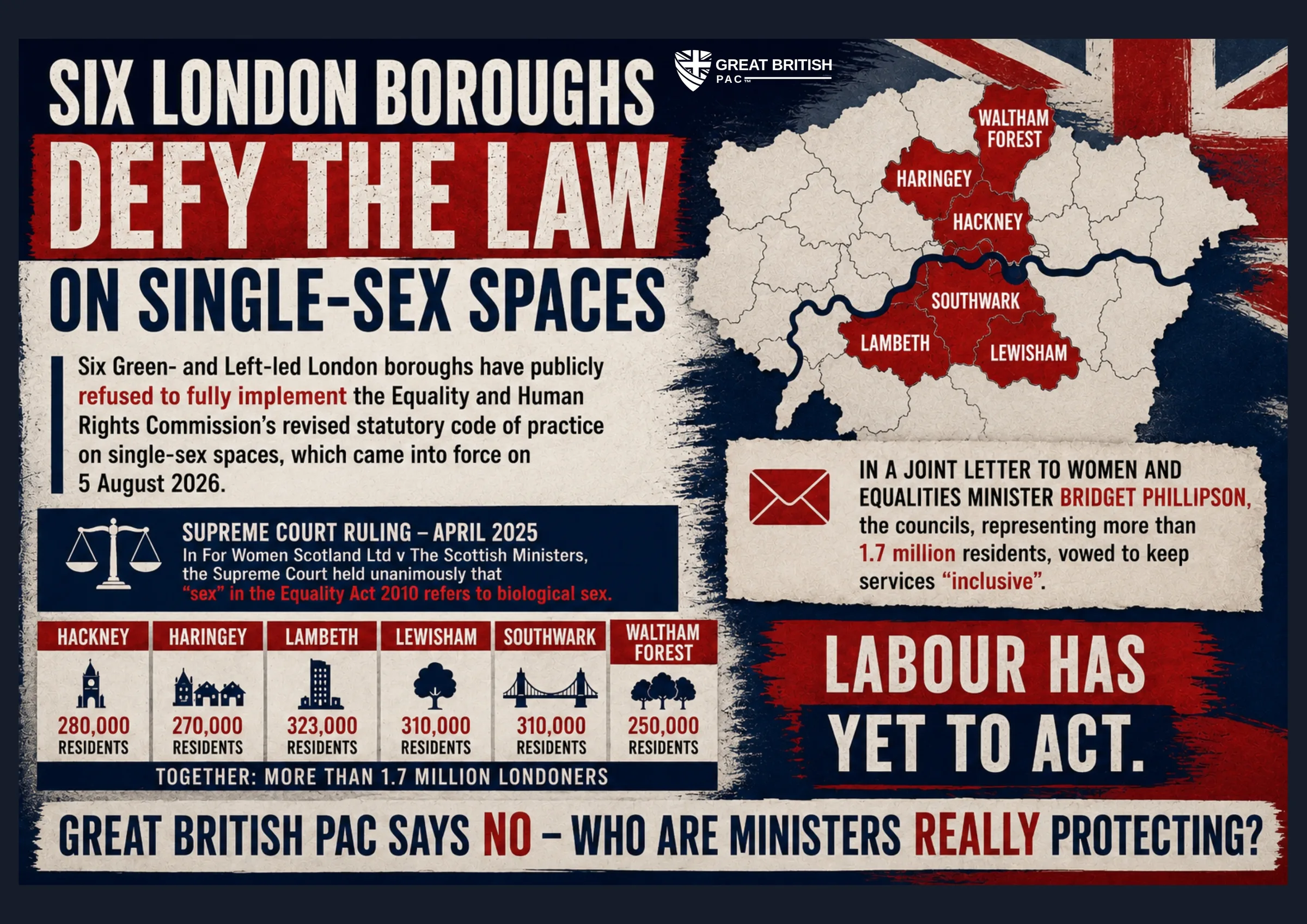
For a government that claims to believe in the rule of law, Labour is showing a striking tolerance for public bodies that appear determined to test its limits. Six London boroughs, Hackney, Haringey, Lambeth, Lewisham, Southwark and Waltham Forest, have openly declared that they will keep their services “inclusive” in defiance of new statutory guidance on single-sex spaces. The real question now is not only whether these councils are right or wrong, but why a Labour government seems so reluctant to say so plainly. If ministers insist they stand for equality, for women’s safety, and for legal clarity, who exactly are they protecting when councils announce that they will not fully implement guidance grounded in the law as now interpreted by the courts? Waltham Forest Council Haringey Council
The facts of the dispute are not especially murky, even if the politics are. On 5 August 2026, the revised statutory code of practice on services, public functions and associations, issued by the Equality and Human Rights Commission, came into force. Statutory is the key word. This is not a social media spat, not a culture war press release, and not a set of optional talking points for councils to pick over according to ideological taste. The code is intended to help courts, employers, service providers, lawyers and public authorities interpret and comply with the Equality Act 2010. It arrived after the UK Supreme Court’s ruling in
For Women Scotland Ltd v The Scottish Ministers
, which held unanimously that the terms “man”, “woman” and “sex” in the Equality Act refer to biological sex, and warned that any other interpretation would make the Act “incoherent and impracticable to operate”. The Supreme Court of the United Kingdom
That judgment matters because the Equality Act is not an activist pamphlet, it is the central anti-discrimination statute for Britain. As the government’s own guidance on the Equality Act 2010 states, the Act legally protects people from discrimination in the workplace and in wider society, and it replaced earlier anti-discrimination laws with a single framework. That framework contains nine protected characteristics, including sex and gender reassignment. In other words, the law already recognises that rights can coexist, collide, and require careful balancing. It was precisely to clarify that balance that the court ruled, and precisely to operationalise that ruling that the EHRC updated its code. GOV.UK legislation.gov.uk
That is why the position taken by the six boroughs is so politically consequential. In a joint letter to Bridget Phillipson, the Women and Equalities Minister, published on the official Haringey Council website and echoed by Waltham Forest Council, the leaders said, “Trans women are women, trans men are men, and non-binary identities are fundamentally valid.” They argued that the new code would make exclusion from public life “more likely, not less”, and that they would not put staff in the “impossible position of policing entry to public spaces”. They further said they were reviewing internal practices to ensure that “no Trans+ person is excluded on the basis of our actions”. Those are not off-the-cuff remarks, they are official declarations of political intent by councils responsible for services used by more than 1.7 million Londoners. Haringey Council Waltham Forest Council
That population figure alone should dispel the lazy fiction that this is some obscure Westminster parlour game. These boroughs are not tiny experimental districts. They are major local authorities, collectively serving over 1.7 million people according to their own official statement, and several of them are among the most politically influential local councils in the capital. When they tell ministers, in public, that they intend to interpret a new legal regime according to their own moral and political convictions, rather than according to the plain direction of the courts and the statutory code, they are not merely lobbying, they are testing the boundaries of state authority. Waltham Forest Council
Fact Box
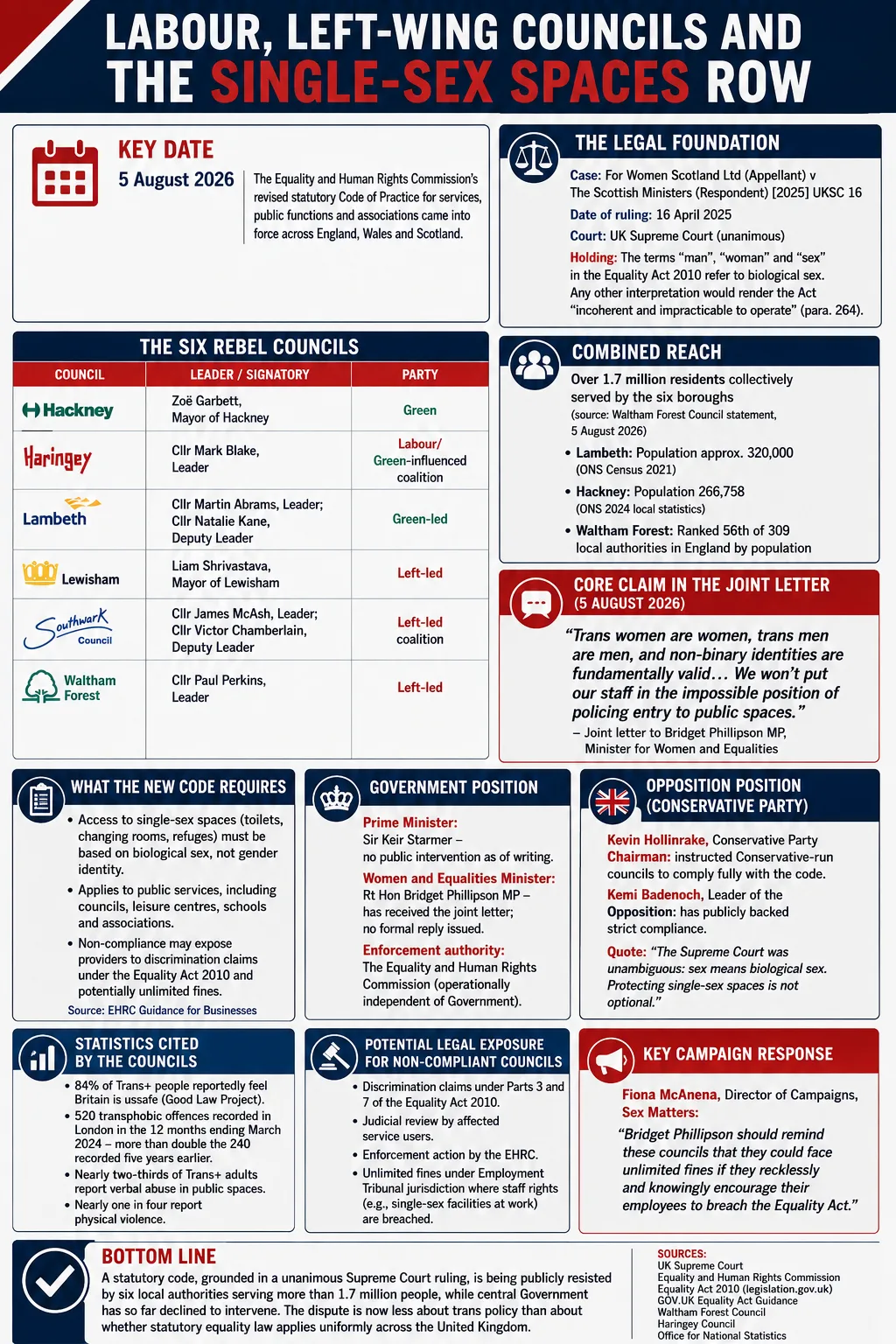
The most charitable reading is that these councils are motivated by concern for vulnerable residents. Their letter stresses that trans people already face hostility, cites a claim that 84 per cent of Trans+ people feel Britain is unsafe, and says that 520 transphobic offences were recorded in London in the year ending March 2024, up from 240 five years earlier. Any serious observer should acknowledge that intimidation, abuse and violence against trans people are real and unacceptable. A decent society does not answer one vulnerability by mocking another. But that is exactly why clarity matters. If public authorities believe the law is inadequate, they should campaign to change it through Parliament. What they should not do is imply that they can simply reinterpret its practical effect on the ground because they dislike its implications. Haringey Council
This is where Labour’s silence becomes politically revealing. Ministers know the distinction between sympathy and enforcement, yet they seem unwilling to draw it. The EHRC is independent, yes, and its code is intended to guide compliance rather than perform political theatre. But the government is hardly powerless. Ministers can remind councils of their legal duties, clarify expectations, and make unmistakably clear that local authorities are not sovereign republics. Instead, Labour appears to be indulging a familiar ambiguity, speaking the language of law in Westminster while tolerating the language of resistance in town halls it is reluctant to confront. That is not leadership. It is strategic evasion.
The consequences of that evasion are not abstract. Single-sex spaces exist for reasons Parliament has long recognised as legitimate, privacy, dignity, safeguarding, and, in some settings, trauma-informed protection. The legal architecture of the Equality Act was never designed to erase sex-based distinctions altogether. It was designed to regulate when they are justified and how they operate fairly. Once the Supreme Court ruled that “sex” in the Act means biological sex, and once the EHRC turned that interpretation into statutory guidance for services, the burden shifted. Councils and service providers were no longer free to act as if the law remained unsettled. The Supreme Court of the United Kingdom Equality and Human Rights Commission
And yet the rhetoric from the councils suggests a deliberate attempt to turn a legal question into a moral panic of a different kind. Nobody is asking a receptionist to become a bathroom bouncer. Nobody is demanding that leisure centre staff conduct interrogations at the changing-room door. That caricature is politically useful because it makes the guidance sound absurd before the actual legal principles are even discussed. The issue is not whether staff should “police” public spaces in some theatrical sense. The issue is whether councils will write lawful policies, train staff properly, designate facilities clearly, provide appropriate alternatives where necessary, and treat every resident with dignity while still complying with the law. That is hard administration, not persecution.
There is also a constitutional principle at stake here. Britain does not function on the basis that each ideological bloc within the state gets to decide which judgments it finds emotionally persuasive. The Supreme Court is not a focus group, and statutory codes are not mood boards. If Green-led or Left-leaning boroughs are free to treat legal obligations as negotiable when they clash with activist orthodoxies, what moral or constitutional argument remains when a different set of councils decides to improvise on other equality duties, housing duties, asylum duties, or race discrimination duties? The rule of law is either a discipline on everyone, or it becomes a slogan deployed only against one’s opponents.
That is why the government’s passivity invites suspicion. Why does Labour let these councils edge so close to working outside the intended legal framework? Why is the instinct to placate internal factions rather than insist on legal compliance paired with humane delivery? Why, when the law seeks to balance protected characteristics, does the political class so often talk as if defending sex-based rights must automatically be recast as hostility to trans people, or as if refusing to clarify the law is somehow the more compassionate course? In trying to avoid angering activists, Labour risks alienating a much broader public, women who want clarity about single-sex provision, public servants who need workable rules, and ordinary voters who expect ministers to say what the law is and mean it.
This matters especially because the Equality Act itself is built on balance, not absolutism. It protects gender reassignment, yes, but it also protects sex. It requires public bodies to eliminate discrimination, advance equality of opportunity, and foster good relations. Those duties are not served by pretending conflicts do not exist. They are served by acknowledging them honestly. The government’s own Public Sector Equality Duty guidance makes clear that public bodies must consider all individuals in shaping policy and delivering services. “All” is the operative word. If Labour allows councils to behave as though one set of sensitivities automatically overrides every concern about female-only spaces, then it is not balancing rights, it is ducking the balancing exercise altogether. GOV.UK
A serious government would say three things now. First, trans people deserve safety, dignity and freedom from harassment. Second, women and girls are entitled to lawful single-sex spaces where the law provides for them. Third, councils do not get to declare ideological opt-outs from statutory guidance built on a Supreme Court ruling. None of those propositions negates the others. In fact, stating them together is the only mature way through this dispute.
The temptation in Britain’s exhausted culture wars is to treat every argument as a test of tribal loyalty. But local government is not a student union, and central government is not meant to be a spectator when the legal order becomes politically inconvenient. The six boroughs have every right to lobby for legislative change. They do not have the right to act as if the law’s present meaning is merely advisory. Labour, meanwhile, has every right to express concern about community cohesion and the welfare of trans residents. It does not have the right, politically or morally, to hide behind studied vagueness when public authorities signal resistance to a statutory regime.
So who do they actually protect, these ministers who say little while councils grandstand loudly? Not women, who are told that demands for clarity are somehow cruel. Not trans people, who are used as symbols in a confrontation that could instead be handled with legal precision and practical decency. Not staff, who are handed mixed messages and then expected to carry the risk. And not the public, who are entitled to know whether the law means what the Supreme Court says it means, or only what powerful local authorities are willing to tolerate.
If Labour wants to prove it governs for the whole country, rather than for the loudest ideological networks within it, it should stop sitting on the fence. Ministers should state clearly that the Equality Act 2010, as interpreted by the Supreme Court and implemented through the EHRC’s statutory code, must be followed. They should then insist that councils deliver compliance in a way that is calm, lawful, practical and humane. Anything less looks like a government hoping the law will enforce itself while politics takes the blame elsewhere.
That may be clever party management. It is not credible government.
See also: While Labour hesitates over rebel councils, Great British PAC is building the case, JK Rowling is funding it, and NHS Trusts have been put on notice.