Great British PAC condemns Barnet Council's decision to hand taxpayer money to a primary school enforcing a "compulsory" hijab rule on girls as young as seven, warning it betrays British children, British values, and the Christian foundations of our education system.
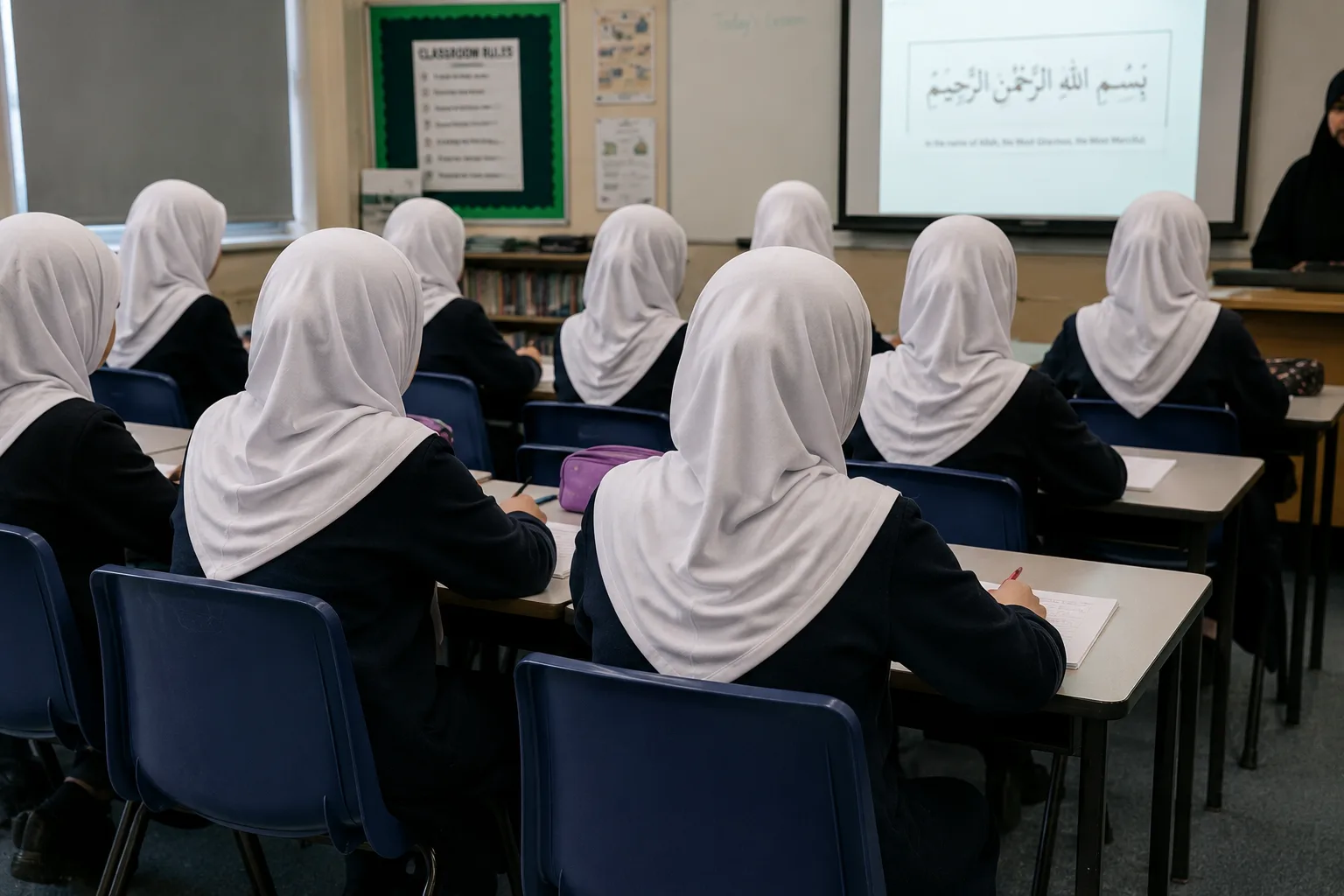
A north London Islamic primary school that compels girls from the age of seven to wear the hijab is to be absorbed into the state sector, in a decision that has provoked a fierce backlash from secularists, Christian campaigners and child welfare advocates. We at the Great British PAC are deeply unhappy about this outcome, and we say plainly: this should never happen in a British state school.
Barnet Hill Academy, an independent Islamic faith school operating in north London since 2006, will convert to voluntary-aided (VA) status from the start of September 2026, following approval by the Labour-led London Borough of Barnet on 4 August. Under the VA model, the local authority foots the bill for running costs and teacher salaries, while the governing body retains substantial control over admissions, employment and the ethos of the school. In effect, the British taxpayer will now fund an institution whose published uniform policy states that a white hijab is "compulsory" for every female pupil from Year 3 upward.
The National Secular Society has written formally to John Anthony, Barnet's executive director for children and families, demanding that the decision be paused and subjected to genuine public and democratic scrutiny. Stephen Evans, the society's chief executive, did not mince words. "It is appalling that taxpayers are being asked to fund a school that forces girls as young as seven to wear the hijab," he said. "Women should be free to choose religious dress, young girls should not have it imposed upon them." Evans added that state-funded schools "should bring children together, not divide them by faith and, by extension, ethnicity."
The school currently teaches 158 pupils aged three to eleven, against a listed capacity of 400, according to the Department for Education's Get Information about Schools register. Until now, parents paid annual fees exceeding £6,500 for the privilege of enrolling their daughters in an institution where covering the head and neck is treated as a non-negotiable condition of attendance from Year 3. From September, that same policy will be sustained by public money.
A policy that sexualises childhood
The hijab, as understood in classical Islamic jurisprudence, is a garment worn from puberty as a marker of modesty before unrelated men. Imposing it on girls of seven, still in the early years of primary education, therefore carries a troubling implication, that a child's body is already an object requiring concealment. Child protection campaigners, including feminist scholars and former Muslims, have argued for years that this practice sexualises girls prematurely and normalises the idea that female bodies are inherently shameful. It is a message that no British state school, funded by the public purse, should be sending to a seven-year-old.
Research published by the National Secular Society in 2017 identified eight state-funded Islamic schools in England, three of them primaries, that enforced compulsory hijab rules. The Telegraph has reported that a handful of such schools are still operating this policy in 2026, despite years of warnings from safeguarding experts. Barnet Hill Academy's conversion will add another name to that list, and it will do so with the explicit blessing of a Labour-run council.
An imbalance dressed up as inclusion
Barnet Council has defended the move by pointing to its pride in "the diverse nature of our school landscape," insisting that the uniform policy is "legally compliant and non-compulsory for non-Muslim pupils." The council also noted that no objections were received during the statutory four-week consultation and that representations were "overwhelmingly in support."
That framing collapses under even light scrutiny. According to the 2021 Census, 37 per cent of Barnet residents identified as Christian, making Christianity by far the largest faith group in the borough, followed by Jewish residents at 15 per cent and Muslim residents at 12 per cent. Yet the borough currently maintains 15 voluntary-aided Church of England schools, 14 Catholic schools, 22 Jewish schools and one Greek Orthodox school. The addition of Barnet Hill Academy will make it the borough's first state-funded Muslim school. Diversity of provision is a reasonable aim. The question is whether the price of that provision should be the coerced veiling of seven-year-old girls.
The council's own written judgment described the school's "inclusive policies" as supporting the "elimination of discrimination" and the "advancement of equality of opportunity." It is difficult to reconcile that language with a uniform rule that singles out girls, and only Muslim girls, for a religiously mandated head covering while their male classmates face no equivalent obligation. Equality of opportunity does not begin with a compulsory headscarf at the age of seven.
The consultation that no one saw
The claim that "no objections were received" during the four-week statutory period deserves particular attention. Statutory consultations of this kind are routinely buried on council microsites, publicised only through legal notices, and closed before most residents realise a decision is on the table. That a proposal to convert a fee-paying Islamic primary into a taxpayer-funded institution generated no public opposition tells us far more about the opacity of the process than about the settled will of Barnet residents. Stephen Evans is right to demand that the council pause implementation and reopen the question to proper democratic scrutiny.
The Great British PAC position
We at the Great British PAC believe in a country whose schools reflect the Christian heritage that shaped its laws, its liberties and its safeguarding culture. We believe that childhood is a protected stage of life, that seven-year-old girls are children rather than junior adults, and that the state has no business subsidising the religious veiling of primary school pupils. This decision is a failure of nerve, a failure of safeguarding, and a failure of the Labour council that waved it through.
Solutions rooted in Christian principle
There is a better path, and it does not require hostility toward any community. It requires clarity, courage and a willingness to place children first.
First, Parliament should legislate a minimum-age standard for compulsory religious dress in every state-funded school, aligning it with the age of criminal responsibility or, better still, the end of secondary education. A child in Year 3 cannot lawfully consent to a tattoo, marriage, or a social media account, and should not be compelled to signal religious modesty either.
Second, Ofsted's inspection framework must be strengthened to treat coerced religious dress on primary-age pupils as a safeguarding concern, not a cultural quirk. The Ofsted handbook already recognises the sexualisation of children as a serious matter. It should apply that principle consistently, without fear or favour.
Third, councils should be required to publish faith-provision impact assessments before granting voluntary-aided status, showing how proposed schools serve the whole community rather than a single group. Barnet's own figures show a borough that is 37 per cent Christian. A council that funds 15 Church of England schools while failing to defend Christian children from the drift toward parallel education systems is not serving its residents.
Fourth, we call on Christian parents, clergy and school governors to speak up. The Church of England, the Catholic Bishops' Conference of England and Wales, and independent Christian networks have a moral duty to defend the Judeo-Christian foundation of British schooling, and to insist that state education remain a shared civic space, not a patchwork of separate identities enforced on infants.
The children of Barnet deserve a school system that unites them, protects them, and honours the country's Christian inheritance. What Barnet Council has approved does none of these things. It should be paused, reconsidered, and, if the compulsory hijab policy remains, rejected.
What is your opinion?
Should British taxpayers fund a school that makes seven-year-old girls wear the hijab? Tell us in the comments below or send us an email to info@advanceuk.org.uk .