
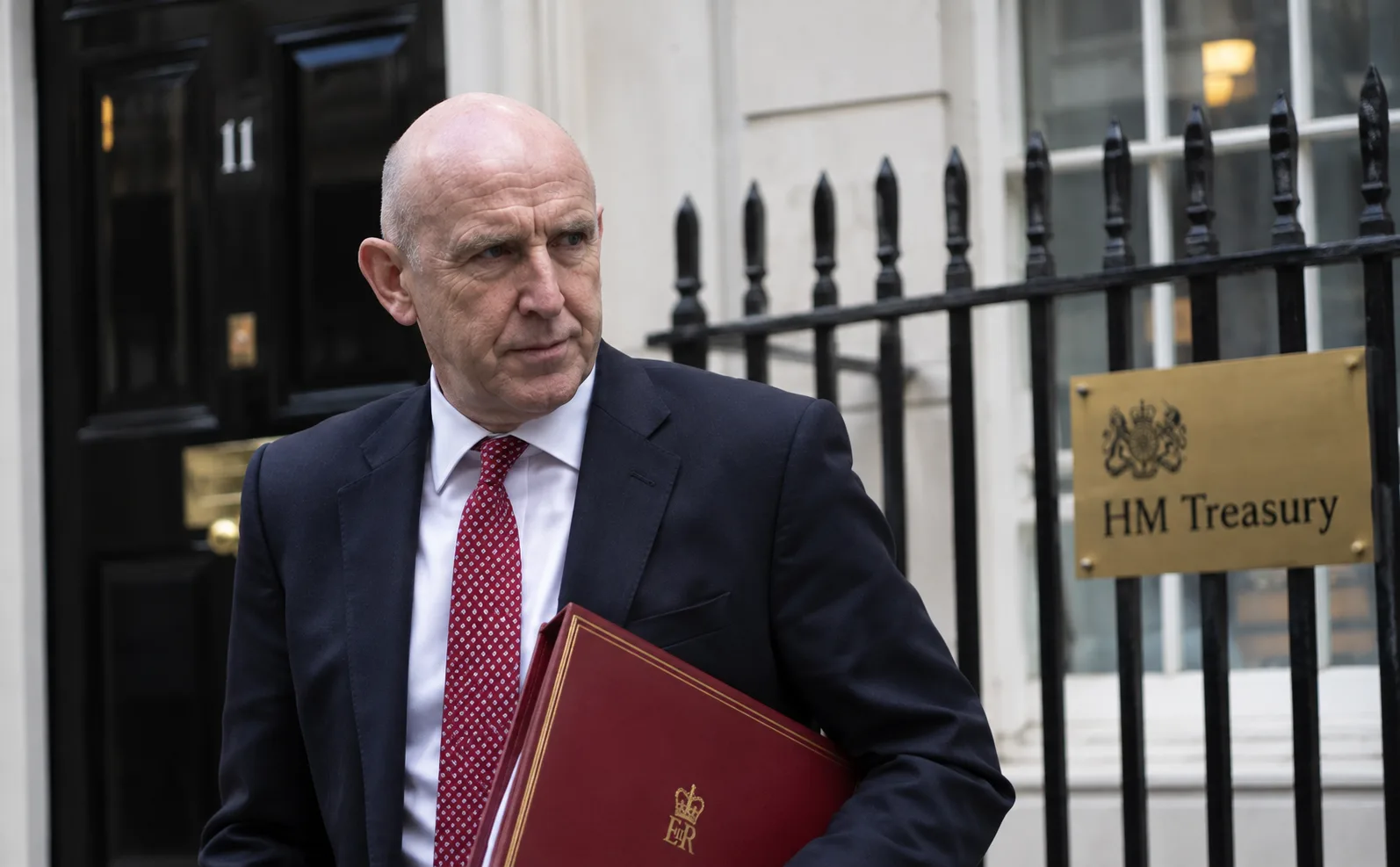
John Healey is considering changes to the tax treatment of certain company transactions that could have significant consequences for British family businesses passing ownership to the next generation.
The Chancellor is examining proposals, put out for consultation by HMRC over the summer, that would charge income tax on transfers of family companies where owners use redeemable shares or a holding company structure to pass the business to their children. Capital gains tax at 24 per cent would give way, in the affected cases, to income tax at up to 45 per cent. In a simplified illustration, a £1m taxable amount charged at 24 per cent would produce a £240,000 liability, compared with £450,000 if the same amount were subject to income tax at 45 per cent. The actual treatment would depend on the transaction, applicable reliefs and the final legislation, and the figures were first reported by the Telegraph.
The timing is the tell. HMRC's consultation on modernising the taxation of distributions opened on 23 June and closed on 14 September. The Budget is on 28 October. That leaves just six weeks between the close of the consultation and a Budget at which the measure could be announced.
What the Treasury is actually proposing
The consultation is not, on its face, about family businesses. It is a technical review of rules that, in the department's own words, have "remained largely unchanged since the introduction of Corporation Tax in 1965".
Its central proposal concerns the point at which a shareholder takes value out of a company through a return of capital rather than a dividend. At present, an owner can restructure through a new holding company so that the capital on the shares reflects the market value of the business at the point of transfer, not the amount originally subscribed. When the company later buys those shares back, a large part of the payment is treated as capital and taxed at capital gains rates.
HMRC wants to freeze the capital on the shares at the original subscription amount. On the department's own worked example, a shareholder extracting £2m from a company worth £4m would see the amount charged as a distribution rise from £1m to £1,999,950. The gain chargeable to capital gains tax falls to nil. The same money, taxed at a higher rate.
For us at Great British PAC, the question is simple: why should a British family face a potentially higher tax bill for passing a business to the next generation than for selling it to an outside buyer? We believe family firms should be encouraged to survive across generations, not placed at a disadvantage by tax rules that fail to distinguish genuine succession from avoidance.
That is a coherent anti-avoidance argument. The difficulty is that the same structure is how a great many family groups are organised, and the same share buyback is how a great many parents hand the firm to their children when they retire. HMRC says the proposals are "not intended to impact legitimate commercial restructurings" and that it will only proceed after consultation where doing so is consistent with the government's objectives, with the impact on growth and investment "fully considered". Those are assurances about intention. They are not drafting.
Whether a straightforward succession, in which the parent gives up control entirely, is protected depends on detail the Treasury has not published. KPMG said it had "significant concerns" that the plans risked "discouraging intergenerational transfers of ownership". That warning goes to the heart of the distinction the government now has to make, in public, before 28 October.
Why the Treasury has gone looking here
The Chancellor did not arrive at the distributions code by accident. He arrived there because the obvious doors were closed.
He has ruled out equalising capital gains tax with income tax, a measure that allies of the Prime Minister had pushed and that the Treasury had allowed to be briefed for months. He has promised to meet the government's fiscal rules without extra borrowing. He faces a £35bn shortfall if he wants to maintain existing spending plans and fund the 3 per cent of GDP defence commitment, according to the Institute for Fiscal Studies.
Steve Wright, Campaign Lead for Campaign Brexit at Great British PAC, said:
"It is reported that the UK Chancellor will have a £35bn gap in the UKs finances to fill in the upcoming budget - that gap would be significantly worse, if the UK also had to find over £35bn a year in EU budget contributions, were it to look at rejoining“
Helen Miller, the IFS director, set out the consequence in terms that read now like a description of this policy. "The risk of having taken the big taxes off the table is that you end up fiddling with smaller, more damaging taxes and therefore doing more damage than you would need to do," she said.
That is the shape of this Budget. A raid on high street banks that the lenders say will feed through into mortgage rates. A rise in machine games duty that the Telegraph reports would raise £500m, with industry estimates closer to £460m. A consultation on share buybacks, closed quietly in September, capable of raising hundreds of millions from people who are not in a position to restructure their affairs at a week's notice.
The Treasury's response to the reporting was that tax decisions are "a matter for the Chancellor to set out at fiscal events, rather than routinely commenting on rumour, speculation or proposals". It is a standard line. It is also, in this case, a refusal to say whether a measure consulted on in June will appear in the Finance Bill in November.
The arithmetic, and its limits
The £240,000 and £450,000 figures describe a taxable amount, not the market value of a company and not a bill that every family will face. They assume the full sum is charged at a single rate, with no Business Asset Disposal Relief, no annual exempt amount, no losses and no other relief. They also assume the whole of the £1m is taxable, which will rarely be true: what is taxed is the distribution or gain, calculated after the capital originally subscribed is taken into account.
Two further variables will determine the real outcome. The first is how the transaction is structured, because a share buyback, a gift of shares, a sale to a family trust and a sale to a trade buyer are treated differently. The second is the drafting, which does not yet exist. Anyone presenting a precise saving or cost for a particular firm before the Finance Bill is published is guessing.
The comparison is nevertheless the right one for understanding the direction of travel: the same economic event, the same family, the same business, potentially taxed at a higher rate because of the legal form the handover takes.
There is a second distortion, and it is the one that ought to worry ministers most. A qualifying sale to a third party could remain subject to capital gains tax, while certain company-funded family succession arrangements could face income tax treatment under the proposals. Andrew Griffith, the shadow chancellor, put it plainly: "These changes are set to make it easier to sell a family business than to pass it on to your own children."
Griffith's wider charge, that the government is "punishing the people who take risks, create jobs and build businesses for future generations", is a political judgement, and voters will weigh it as one. The narrower point about the relative treatment of a sale and a succession is a question of tax design, and the Treasury has not answered it.
A second raid on the same firms
This is not the first time this Parliament has asked family businesses to pay for the public finances.
Rachel Reeves used her first Budget to cut inheritance tax relief on business and agricultural property. From 6 April 2026, the 100 per cent relief that owners had relied on has been capped: the first £2.5m of combined agricultural and business property receives full relief, with 50 per cent relief above that, an effective rate of 20 per cent on the excess. The original plan, set out in the 2024 Budget, put the combined threshold at £1m; the government raised it to £2.5m in December 2025 after sustained protest from farmers. The changes are expected to raise about £300m a year.
The same owners are now in the middle of adjusting to that settlement. John Endacott, a partner at PKF Francis Clark, said the new consultation appeared to have been "timed to facilitate an autumn Budget announcement". He warned: "Long-standing family companies are still adjusting to the inheritance tax changes. Further taxes on passing businesses to the next generation risk taxing them to extinction."
That is the practical objection, and it does not depend on sympathy for the wealthy. A family firm is not a liquid asset. The value is tied up in plant, stock, property and the goodwill of a customer base that may not survive a change of owner. An owner facing a larger tax bill on succession has three options: find the cash, borrow it, or sell to someone who can. The first two weaken the business. The third defeats the purpose of the relief.
The economy Healey is taxing
The case for caution is not theoretical. EY-Parthenon's latest profit warnings report, published on Monday, records 65 profit warnings from UK-listed companies in the third quarter, up from 59 in the previous three months and the highest quarterly total since the end of 2024.
The detail matters more than the headline. Policy change and geopolitical uncertainty was the leading cause for the sixth consecutive quarter, cited in 54 per cent of warnings, the highest proportion in more than 25 years of the analysis. Rising costs featured in 35 per cent, the highest since 2022. Jo Robinson, EY-Parthenon's UK and Ireland financial restructuring leader, said the pace of policy change was "making forecasting, investment and capital allocation much harder".
Listed companies can issue a profit warning. A fourth-generation builder with forty employees cannot. It absorbs the cost, delays the investment, or closes. The absence of a warning is not evidence of health.
The questions the Chancellor has not answered
Four matters remain unresolved, and each of them is answerable before 28 October.
First, whether a genuine succession, in which the parent's stake is substantially reduced and control passes, will be exempt from the new charge. The consultation's language about "legitimate commercial restructurings" is not the same as a carve-out for succession, and the difference will be measured in millions of pounds for individual families.
Second, whether transfers already in progress will be protected. Succession planning takes years. An owner who began restructuring in 2025 on professional advice, in reliance on the law as it stood, should not discover in November that the ground has moved beneath the transaction.
Third, whether the consultation responses will be published. The government promised a summary of responses. Publishing it alongside the Budget, after the decision has been taken, is not scrutiny. It is a receipt.
Fourth, whether this is a revenue measure or an anti-avoidance measure. The two justifications point to different designs. An anti-avoidance measure can be narrowly drafted around artificial structures that retain control. A revenue measure needs a broad base, and a broad base catches the ordinary family handover. Ministers should say which they intend.
Great British PAC reaction
Great British PAC's concern is not that the Treasury should leave avoidance untouched. Our concern is that a measure with such significant consequences for family businesses could be announced in the Budget before the Government has fully addressed the concerns raised during consultation.
Family firms are the backbone of the British economy. They employ people in every constituency, train apprentices, sustain high streets and keep supply chains running. They are built slowly, over decades, by people who put their own capital and their own working lives at risk. A tax system that makes it easier to sell such a business to an outside buyer than to pass it to the next generation is a tax system working against the very continuity it should reward.
Those answers are set out above and none of them has been given. Until they are, no family should be asked to plan its future around a tax that has been briefed to newspapers but not set out in legislation.
Transparency is not a concession to business. It is the minimum condition for a tax change of this scale, and it is owed to the people who will pay it.
The wider question is one the Great British PAC has pressed throughout this Parliament. Labour told voters that the burden would fall on those with the broadest shoulders. In practice, the search for revenue has moved from the taxes Labour promised not to touch to the smaller, more targeted charges that fall on people who cannot reorganise their affairs through a City adviser: farmers, owner-managers, savers, drivers and, now, parents handing on a business they spent a working lifetime building.
On 28 October the Chancellor will have to put a number on it. The OBR will publish the costings. The consultation responses will either be published or they will not. And the owners of Britain's family firms will find out whether the promise to protect "legitimate" successions was a safeguard or a slogan.
We will continue to demand full transparency over the proposed changes, meaningful protection for genuine family business succession and an explanation from the Chancellor of why passing a business to the next generation should risk attracting a heavier tax burden than selling it.
Britain's family businesses are built to last generations. Government policy should not make that harder.