
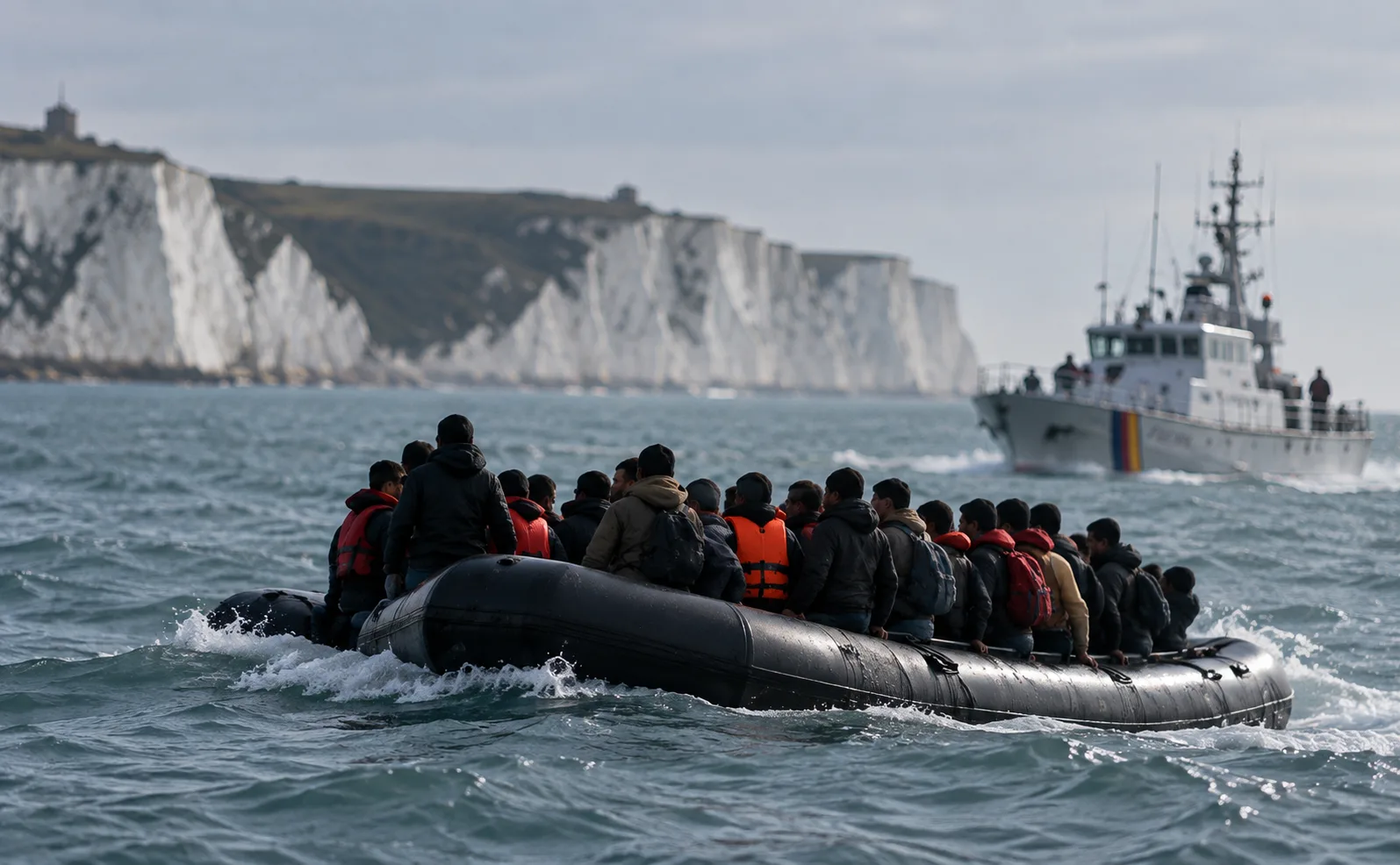
The Home Secretary has said Britain is ‘not in control’ of the Channel border, and that criminal gangs are conducting the ‘sifting’ of migrants who reach northern France ready to make the crossing.
Shabana Mahmood made the comments on The Rest Is Politics podcast, telling the former Conservative minister Rory Stewart and Alastair Campbell, Tony Blair’s one-time adviser, that almost every woman waiting in northern France to cross was likely to have been raped on her journey.
Her assessment that nearly every woman there has ‘probably been raped’ was not presented as a published statistic in the interview. It was her own judgement.
‘We’re not in control of this border,’ Mahmood said. ‘The sifting of the people that end up in the north of France and are about to get on a dinghy is done by criminal gangs who are also, by the way, people traffickers.
‘You can almost guarantee that every woman that’s in the north of France has probably been raped along the journey. Some of the men too, they’ve certainly been abused and threatened. That is not the model that should decide whether somebody gets to come to the UK, make this their place of sanctuary and ultimately become one of us.’
Successive governments have promised to stop the crossings. Mahmood’s description focuses on an earlier stage of the journey: she says the ‘sifting’ of people who reach northern France ready to board small boats is being carried out by criminal gangs. Those who reach Britain are detained, checked and processed by UK officials.
On Sunday evening the argument moved from the studio to the Hampshire coast. A group of 149 migrants was brought ashore at a marina in Gosport after a mid-Channel rescue involving two RNLI vessels and a French vessel, according to Home Office figures reported by the BBC. They were taken by coach to a processing centre in Kent. Ship-tracking data indicated the dinghy had set off from near Utah Beach in Normandy that morning.
About 150 anti-migrant demonstrators gathered near Haslar Marina in Gosport. Some flares were set off and there were a few scuffles with police, which lasted into the early hours of Monday. Hampshire Police said it deployed officers to ‘support our partners in the event of an emergency at sea’, and imposed conditions under the Public Order Act. The county’s police and crime commissioner, Donna Jones, called on the Home Secretary to intervene, saying UK Border Force needed the capacity to move people on the water to Dover.
A government spokesperson said: ‘The Border Security Command works around the clock to monitor the Channel and protect our border. It is vital we continue to detain, check and process every small boat arrival.’
The Home Office has refused to explain why Gosport was chosen, saying it does not comment on operational processes.
Imran Hussain, a director at the Refugee Council, welcomed the Home Secretary’s acknowledgment of widespread sexual violence, but questioned why safe and legal routes that could keep asylum seekers out of the traffickers’ hands had been closed.
‘We know from our services that women and girls fleeing war and persecution face sexual violence both in the conflicts they have escaped and on the journeys they are forced to make in search of safety,’ he said.
‘Last year the government closed family reunion, the safe route for refugees which overwhelmingly benefits women and children. It is entirely right to talk about the dangers women face on these journeys but we should not be closing the safe routes that could keep them out of harm’s way. Protecting women means more safe routes, not fewer.’
The family reunion route has been suspended to new applications since September 2025, rather than permanently abolished, with ministers saying a stricter system will follow. Last month the government reopened the UK Resettlement Scheme for new referrals, with about one in four referrals reserved for Afghan women and girls and Palestinian refugees. The scheme is run with the UN refugee agency and the International Refugee Assistance Project. The government expects total arrivals across resettlement and its new community sponsorship routes to number in the hundreds at first, growing into the low thousands, with a cap set each year.
The status offered under the two routes differs. People admitted through the resettlement programme are placed on a five-year path to settlement. Under the new asylum system, adults who claim asylum and are granted protection receive an initial 30 months of leave, subject to review if they continue to need protection. Under the Government’s Core Protection model, settlement can take up to 20 years unless they switch to another eligible legal route.
Madeleine Sumption, director of the Migration Observatory at Oxford, said the impact of the reopened route would depend on the numbers allowed to enter. The Refugee Council’s chief policy analyst, Jon Featonby, said safe and legal routes ‘only work if they operate at scale. That means thousands of places, not hundreds.’
Mahmood’s interview ranged well beyond the Channel. She said she considered herself ‘part of the pro-Palestinian cause’ and felt ‘very uncomfortable’ about the arrest of 82 people outside the Labour party conference in Liverpool. Merseyside police detained demonstrators on suspicion of wearing or carrying articles in support of Palestine Action, a proscribed organisation. She defended enforcing the ban regardless.
‘You’ve got to be able to apply your principles, even when it’s uncomfortable for you,’ she said.
Asked about balaclava-wearing protesters who have praised her policies while shutting down ports, she said they should ‘sod off’. She added: ‘They’re just troublemakers. You know, they’d kill me in a minute if they could, and they’d definitely kick me out of my own country. So let’s just be really clear about who and what they are. They don’t think I’m a true Brit and they hate the fact that I’m a Muslim.’
Richard Thomson, a former Royal Marine and National Director of Great British PAC, said:
‘She let it slip. Britain is not in control of its borders. Those are the Home Secretary’s own words. Shabana Mahmood sat there and admitted that criminal gangs decide who gets on a dinghy, who crosses the Channel, and who is dumped in a town near you. Labour has no control. She said so.
‘Then she told us almost every woman waiting in northern France has probably been raped on the journey. What she did not say is who is committing this alleged crime. It is the men also making that journey. The same men she is processing, housing and spreading through every community in this country.
‘And we are meant to believe this government cares about British women and girls. Their answer was a pamphlet. A Home Office booklet explaining that rape is illegal, that a woman does not need a man’s permission, that you cannot have sex with someone who is asleep.
‘If you must hand that out at the border, you already know what you are importing. A leaflet is not a safety measure. It will not protect a single British woman. Control will. Deportation will. She has admitted she has neither the control nor the appetite.’
The booklet Thomson refers to is Understanding behaviours and expectations in the UK: a guide for asylum seekers, a nine-page Home Office guide issued to asylum seekers in August. It states that rape is a serious crime, that women do not need permission from a husband, father, brother or any other man, and that someone who is asleep, drunk or unable to respond cannot consent.
For a decade the argument about the Channel has focused largely on how many people cross. Mahmood has now framed the problem differently: in northern France, she says, the ‘sifting’ of those preparing to make the journey is being done by criminal gangs.