A Case Study in Policy Failure: The link between rising arrivals and the growing numbers of people bedding down on Britain's streets is becoming increasingly difficult to ignore, raising uncomfortable questions about policy priorities, fiscal responsibility and the direction of the Labour Government.
On a warm weekday evening on Hounslow High Street in west London, a small group of rough sleepers gathers outside Holy Trinity Church. Conversation is sparse. Most drink or smoke quietly, or scroll through videos on their smartphones as darkness settles over the pavement. A few begin arranging strips of cardboard and unrolling sleeping bags. All but two are men, and the overwhelming majority were born outside the United Kingdom. The scene, replicated in doorways and underpasses across the capital, has become the visible expression of a policy failure that is now measurable in the hundreds of millions of pounds and in an increasingly stark demographic shift.
In his first speeches as Prime Minister, Sir Andy Burnham addressed the crisis directly, pledging "to end rough sleeping in our country" and announcing that an additional £340 million would be earmarked to tackle the problem. To have any realistic prospect of honouring that pledge, however, the new Government will have to confront a politically sensitive reality: how much of the current homelessness emergency is being driven by the failures of Britain's asylum and migration system, and why, at a moment when British citizens are sleeping on pavements, the taxpayer is continuing to fund hotel accommodation for tens of thousands of migrants.
The Numbers Behind the Crisis
According to data analysed by the Centre for Social Justice (CSJ), the number of non-UK nationals sleeping rough across England has risen by 92 per cent in the four years since 2021. One in four rough sleepers nationwide is now a foreign national. In London, the proportion climbs to 51 per cent, meaning that more than half of those bedding down on the capital's streets were not born in Britain.
Figures published by the Ministry of Housing, Communities and Local Government recorded 4,793 people sleeping rough on a single night in England last autumn, a record high and an increase of 171 per cent since 2010. Between 2021 and 2025, the CSJ found, the number of EU nationals sleeping rough in England fell, a shift analysts attribute in part to the post-Brexit settlement. Over the same period, the number of non-UK nationals from countries outside the EU sleeping rough rose by an extraordinary 396 per cent.
The financial dimension is no less striking. According to the National Audit Office, the Home Office is currently spending an estimated £4.7 billion a year on asylum accommodation, of which more than £8 million a day is allocated to hotel contracts alone. That expenditure is set against a rough sleeping budget that, even with Burnham's additional £340 million, remains a fraction of the funds directed towards accommodating new arrivals.
Case Study: The London Borough of Hounslow
Hounslow offers a concentrated illustration of how these pressures interact. Rough sleeping in the borough surged by 53 per cent in the year to March 2026, the sharpest rise recorded in any London borough. More than two-thirds of rough sleepers in the area are thought to be foreign nationals. The borough sits adjacent to Hillingdon, home to Heathrow Airport, and hosts one of the largest concentrations of asylum seekers in Home Office contracted accommodation in the country. As of June 2025, official figures recorded 1,536 people staying in asylum hotels within the borough, a figure exceeded only by Hillingdon itself.
Local outreach teams report that the Hounslow High Street corridor, running between the Treaty Centre and Holy Trinity Church, has emerged as a focal point for the borough's rough sleeping population. Council data indicates that of those enumerated in the borough's most recent single-night count, a majority had entered the United Kingdom within the previous three years, and a significant proportion had been resident in Home Office accommodation immediately prior to becoming homeless.
The Hounslow case is not isolated. In Manchester, rough sleeping has doubled since the end of the pandemic. In Birmingham, the number of non-UK nationals sleeping rough has risen by more than 300 per cent since 2021, according to CSJ analysis of local authority returns. What Hounslow demonstrates in miniature, and what other urban centres are now replicating, is the direct pipeline between asylum accommodation exit and street homelessness.
The Move-On Cliff Edge
The mechanics of that pipeline are well understood. When an asylum seeker is granted leave to remain, they are required to vacate their Home Office accommodation within 42 days. According to the charity Homeless Link, in the 12 months to March 2026, more than one in five new rough sleepers in London had been staying in asylum accommodation immediately before becoming homeless, a rise of 10 per cent on the previous year. Nationally, an estimated 34 per cent of asylum decision-recipients experience some form of homelessness within eight weeks of receiving their status, according to research compiled by the Refugee Council.
Imran Hussain, the charity's director of external affairs, notes that many of those affected have limited English, no established support network and often significant mental health needs, factors which render the 42-day window inadequate for securing employment and accommodation. The move-on period was 28 days until March 2026, when it was extended by ministerial order. Advocacy groups, including Crisis, are now pressing for a further extension.
Crisis also identifies a secondary structural factor: the Right to Rent scheme, introduced in 2015 under the Immigration Act, which requires private landlords in England to verify tenants' immigration status. Independent research by the Joint Council for the Welfare of Immigrants has found that 51 per cent of landlords surveyed said the scheme made them less likely to consider tenants without a British passport, a finding that has fuelled arguments about its unintended consequences for legally resident migrants.
The Broader Migration Picture
Beyond the specifics of move-on procedures, there is the underlying question of volume. According to the Office for National Statistics, net migration to the United Kingdom reached 906,000 in the year to June 2023 and remained historically elevated through 2024 and 2025. Small boat arrivals across the English Channel, tracked by the Home Office, have added a further 130,000 individuals since 2022, of whom fewer than 5 per cent have been returned to their country of origin, according to figures compiled by the Migration Observatory at the University of Oxford.
Josh Nicholson, head of housing at the CSJ, argues that the compounding effect of these numbers is central to the crisis. Between 2022 and 2024, the volume of new arrivals combined with a slow-moving asylum decision system produced what he describes as "a pool of people being basically trapped between temporary shelters run by charities, and life on the streets." Many of those affected have "no recourse to public funds" status and are therefore ineligible for housing assistance or disability benefits, leaving charities and church-run night shelters as the last available safety net.
The Fiscal and Political Question
The arithmetic invites uncomfortable questions of the Labour Government. Local authority housing waiting lists in England now stand at 1.33 million households, according to the latest returns to the Department for Levelling Up, Housing and Communities. In London alone, more than 336,000 households are on the waiting list, and the average wait for a two-bedroom social property in the capital now exceeds seven years. British nationals in temporary accommodation number in excess of 117,000 households, a figure that has more than doubled over the past decade.
Against that backdrop, the continued expenditure of £4.7 billion a year on asylum accommodation, much of it in hotels operated by private contractors on multi-year contracts, has begun to attract political scrutiny from across the spectrum. The three largest asylum accommodation contractors, Serco, Mears Group and Clearsprings Ready Homes, are collectively projected by the Public Accounts Committee to earn combined profits of £383 million from their Home Office contracts over their ten-year duration, a figure that has drawn cross-party criticism.
Why the Labour administration, elected on a platform of restoring fairness in public services, has not moved more decisively to reconcile these competing claims on the public purse is a question that ministers have thus far declined to answer in detail. The Prime Minister's £340 million pledge, while substantial, represents approximately 7 per cent of the annual asylum accommodation bill. Critics on both the left and the right of the political spectrum have observed that a durable solution to street homelessness cannot be delivered without addressing the volume of arrivals feeding into it.
Housing First and the Reconnection Debate
Nicholson advocates a "Housing First" strategy, providing immediate accommodation to rough sleepers coupled with individualised support. Pilots of the model in Greater Manchester, Liverpool and the West Midlands have reported tenancy sustainment rates of between 74 and 88 per cent, according to independent evaluations commissioned by the previous administration. However, Nicholson argues that Housing First must be balanced with "reconnection" work, assisting foreign-born rough sleepers to return voluntarily to their countries of origin, an approach that remains controversial within the sector but which he describes as capable of being carried out with dignity when properly resourced.
Bob Blackman, the Conservative MP who has campaigned on homelessness for more than a decade, points to the precedent of the Everyone In programme during the Covid-19 pandemic, which offered emergency accommodation to 37,000 rough sleepers. He notes that any durable solution will require the Government to exert greater control over irregular arrivals, and to ensure that those without a legal right to remain in Britain are returned.
An Emergency Measured in Millions
The evidence assembled by charities, think tanks and government statisticians converges on a single conclusion: the growth in rough sleeping in England is now inseparable from the operation of the asylum and migration system. Without addressing the volume of arrivals, the brevity of the move-on period, the operation of the Right to Rent scheme and the fiscal balance between accommodating new arrivals and supporting existing residents, the Prime Minister's pledge to end rough sleeping is unlikely to be met.
Outside Holy Trinity Church in Hounslow, the men and women preparing for another night on the pavement are the visible outcome of a set of policy choices made in Whitehall. Whether the Labour Government is prepared to answer for those choices, and to explain to a domestic electorate why British households wait years for social housing while hotels remain filled at public expense, may prove to be the defining political question of Burnham's first year in office.
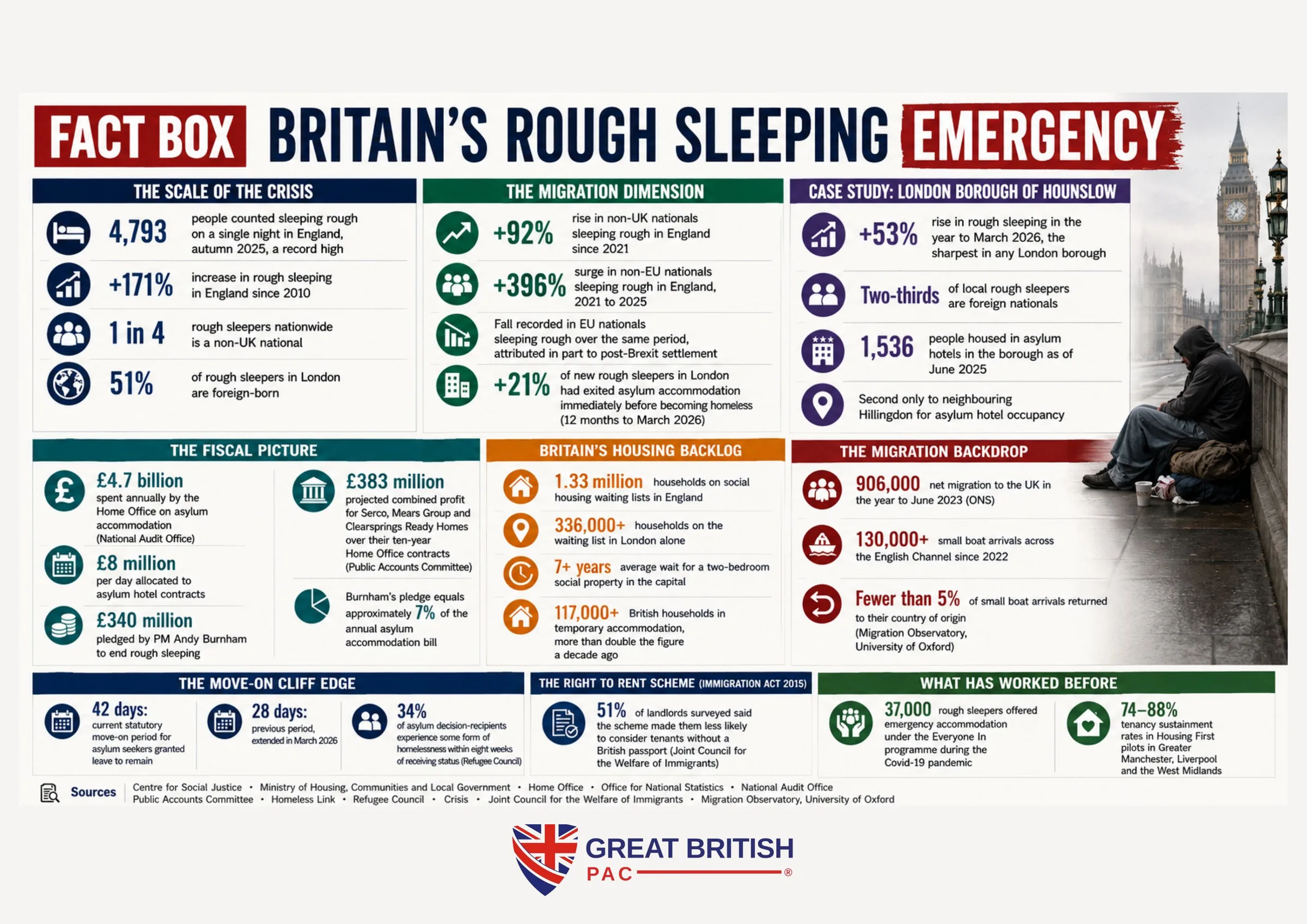
Britain's Rough Sleeping Emergency
The Scale of the Crisis
4,793 people counted sleeping rough on a single night in England, autumn 2025, a record high
+171% increase in rough sleeping in England since 2010
1 in 4 rough sleepers nationwide is a non-UK national
51% of rough sleepers in London are foreign-born
The Migration Dimension
+92% rise in non-UK nationals sleeping rough in England since 2021
+396% surge in non-EU nationals sleeping rough in England, 2021 to 2025
Fall recorded in EU nationals sleeping rough over the same period, attributed in part to post-Brexit settlement
+21% of new rough sleepers in London had exited asylum accommodation immediately before becoming homeless (12 months to March 2026)
Case Study: London Borough of Hounslow
+53% rise in rough sleeping in the year to March 2026, the sharpest in any London borough
Two-thirds of local rough sleepers are foreign nationals
1,536 people housed in asylum hotels in the borough as of June 2025
Second only to neighbouring Hillingdon for asylum hotel occupancy
The Fiscal Picture
£4.7 billion spent annually by the Home Office on asylum accommodation (National Audit Office)
£8 million per day allocated to asylum hotel contracts
£340 million additional funding pledged by PM Andy Burnham to end rough sleeping
£383 million projected combined profit for Serco, Mears Group and Clearsprings Ready Homes over their ten-year Home Office contracts (Public Accounts Committee)
Burnham's pledge equals approximately 7% of the annual asylum accommodation bill
Britain's Housing Backlog
1.33 million households on social housing waiting lists in England
336,000+ households on the waiting list in London alone
7+ years average wait for a two-bedroom social property in the capital
117,000+ British households in temporary accommodation, more than double the figure a decade ago
The Migration Backdrop
906,000 net migration to the UK in the year to June 2023 (ONS)
130,000+ small boat arrivals across the English Channel since 2022
Fewer than 5% of small boat arrivals returned to their country of origin (Migration Observatory, University of Oxford)
The Move-On Cliff Edge
42 days: current statutory move-on period for asylum seekers granted leave to remain
28 days: previous period, extended in March 2026
34% of asylum decision-recipients experience some form of homelessness within eight weeks of receiving status (Refugee Council)
The Right to Rent Scheme (Immigration Act 2015)
51% of landlords surveyed said the scheme made them less likely to consider tenants without a British passport (Joint Council for the Welfare of Immigrants)
What Has Worked Before
37,000 rough sleepers offered emergency accommodation under the Everyone In programme during the Covid-19 pandemic
74–88% tenancy sustainment rates in Housing First pilots in Greater Manchester, Liverpool and the West Midlands