

The number of foreign offenders living freely in Britain despite being earmarked for deportation has surged to a record high since Labour came to power, a damning new study has found, laying bare a Government that has lost control of one of its most basic duties, removing dangerous criminals from our shores.
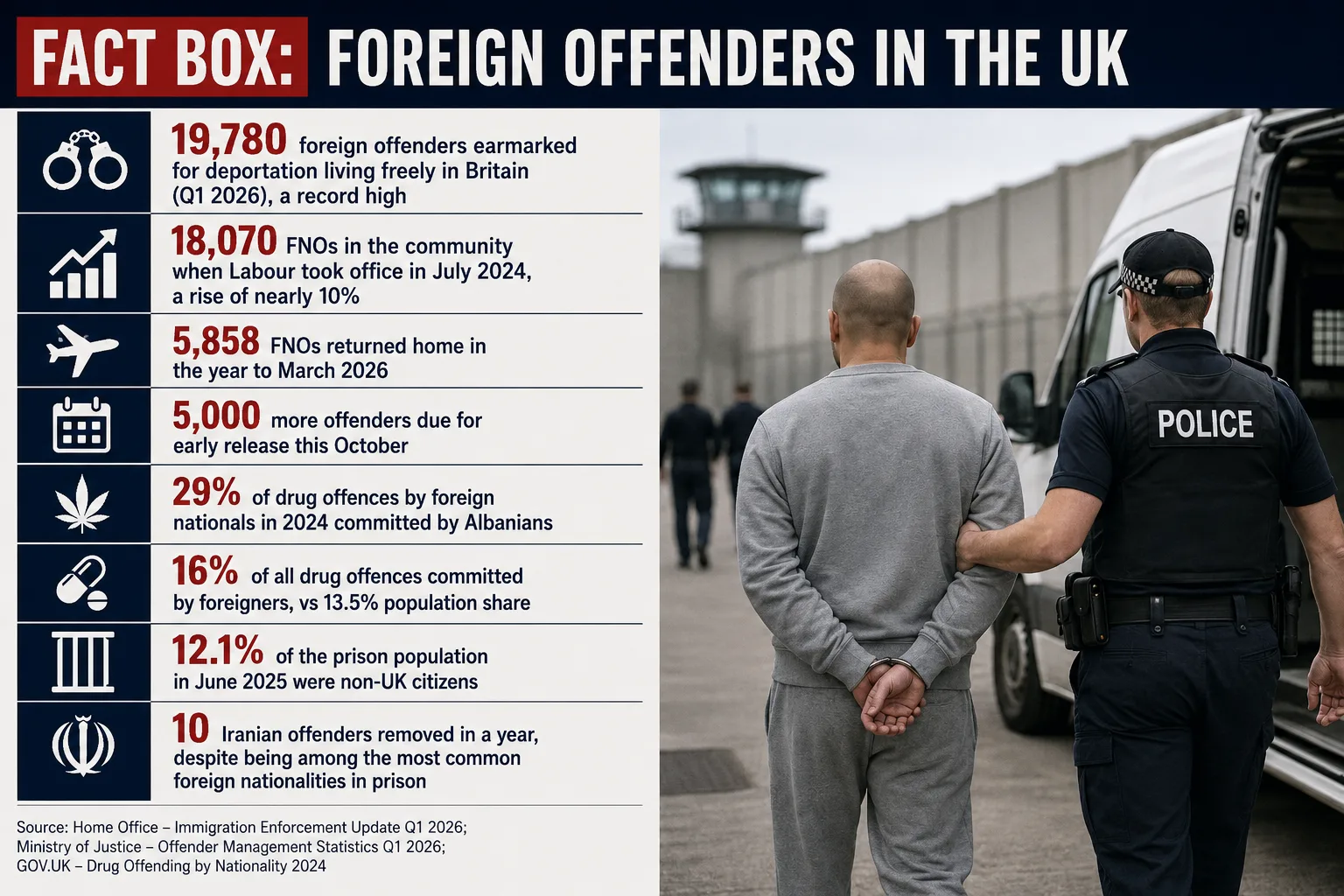
Just over 18,000 foreign national offenders, known as FNOs, were living in the community after serving their sentences when Labour won the election in July 2024. By the first quarter of this year, that figure had climbed to 19,780, an increase of nearly ten per cent, according to research by the Migration Observatory at the University of Oxford.
The scale of the failure becomes starker still when set against the number actually being removed. Just 5,858 foreign national offenders were returned to their country of origin in the year to March 2026, official Home Office figures show. In other words, for every three foreign criminals marked for deportation and living among us, barely one was sent home in an entire year.
Early release scheme 'pouring fuel on the fire'
Experts warn the crisis is being made worse by Labour's own policies. The Government's first early release scheme, launched in September 2024 to ease prison overcrowding, has let tens of thousands of offenders out before their sentences were served, potentially adding to the backlog of FNOs awaiting removal. Under the SDS40 scheme, eligible prisoners are automatically released on licence after serving just 40 per cent of their sentence, rather than half, as the Ministry of Justice has confirmed.
The problem could deepen further this October, when the latest tranche of 5,000 offenders is let out early under a similar scheme. Among them, in a case that has horrified the nation, are set to be two of PC Andrew Harper's killers, Albert Bowers and Jessie Cole, a prospect that has left Prime Minister Andy Burnham scrambling to find a way of blocking their release.
Under the law, the Government must deport FNOs sentenced to 12 months or more in prison unless they successfully lodge a human rights or other appeal against removal, a duty set out in the UK Borders Act 2007. Offenders with shorter sentences can also be deported where ministers deem it beneficial for Britain. Yet the gap between the legal obligation and the lived reality has never been wider. Those awaiting removal are typically released on immigration bail at the end of their sentences, free to walk the same streets as the rest of us, until their deportation can be arranged, if it ever is.
Conservatives and campaigners react with fury
The Tories' shadow home secretary Chris Philp said: "Nearly 20,000 foreign criminals are now living free in Britain's communities, a record high, up almost ten per cent since Labour took office.
"These are offenders the Government has marked for deportation, and Labour cannot get them out of the country.
"Labour's early release scheme has only added to this problem, and a further tranche of early releases later this year could give more foreign offenders their freedom.
"The Conservative Party would deport all foreign criminals, enabled by leaving the European Convention on Human Rights and any other obligation that gets in the way."
Alp Mehmet, chairman of Migration Watch UK, said: "There is absolutely no evidence that this Government, this new Prime Minister Andy Burnham, has any more of a grip than his predecessor on the issue of controlling our borders, or more widely immigration given more boats keep on arriving.
"I'm afraid at the moment all we can do is look forward to the problem getting worse, not better.
"A small percentage of foreign offenders are being removed and it's clear that early release schemes are making it worse."
The Great British PAC, the political action committee campaigning on border security, goes further still. It refuses to accept these numbers as anything other than a national disgrace. Its position is unequivocal: every single foreign criminal who is free today should be deported to their home country, not left to walk free on Britain's streets, and not left to cost British taxpayers a fortune by lingering in British prisons, where each place costs the public purse tens of thousands of pounds a year. A Government that cannot remove convicted foreign criminals, the PAC argues, has forfeited one of the most fundamental contracts between the state and the people who fund it.
The drug crime dimension
The study also shines an uncomfortable light on the nature of offending. Albanians were found to be nearly four times more likely to commit drug offences than any other foreign nationality, accounting for more than a quarter, 29 per cent, of all drug offences for which foreigners were convicted in 2024. The next largest foreign group were Poles, on 8 per cent.
Overall, foreigners accounted for 16 per cent of all drug offences in 2024, the latest year available, despite making up 13.5 per cent of the overall population. More broadly, non-UK citizens made up 13.1 per cent of people given cautions or convictions in 2024, and 12.1 per cent of the prison population in June 2025, roughly in line with their share of the adult population. It is not known what nationalities make up the nearly 20,000 earmarked for deportation, nor what crimes they committed, a transparency gap that itself raises questions about what the public is being told.
Dr Ben Brindle, senior researcher at the Migration Observatory and author of the report, said: "Even though the number of foreign national offenders being deported has increased, the number living in the community has also risen. This suggests that removals have not kept pace with releases from prison."
He added: "One challenge the government faces in deporting foreign offenders is that some countries do not cooperate with removals. Countries are legally obliged to take back their own citizens, but this does not always happen in practice. For example, 10 Iranian offenders were removed in the year ending March 2026, despite Iranians being among the most common foreign nationalities in England and Wales prisons."
A test of sovereignty
That last point cuts to the heart of the matter. If foreign states can simply refuse to take back their own citizens, and if human rights appeals can endlessly delay removal, then Britain's deportation system exists more on paper than in practice. The Government's own migration transparency data tracks these figures quarter by quarter, and the direction of travel is unmistakable.
The numbers are no longer a warning. They are a verdict. Nearly 20,000 foreign criminals at liberty, removals stuck below 6,000 a year, and another 5,000 offenders about to walk out of prison early. For a Government elected on promises of competence and control, the question is no longer whether it can get a grip, but whether it even intends to.