
Labour politician says councils are concerned about the "practical implication" of the rules, as questions mount over whose rights take precedence in Britain's single sex spaces
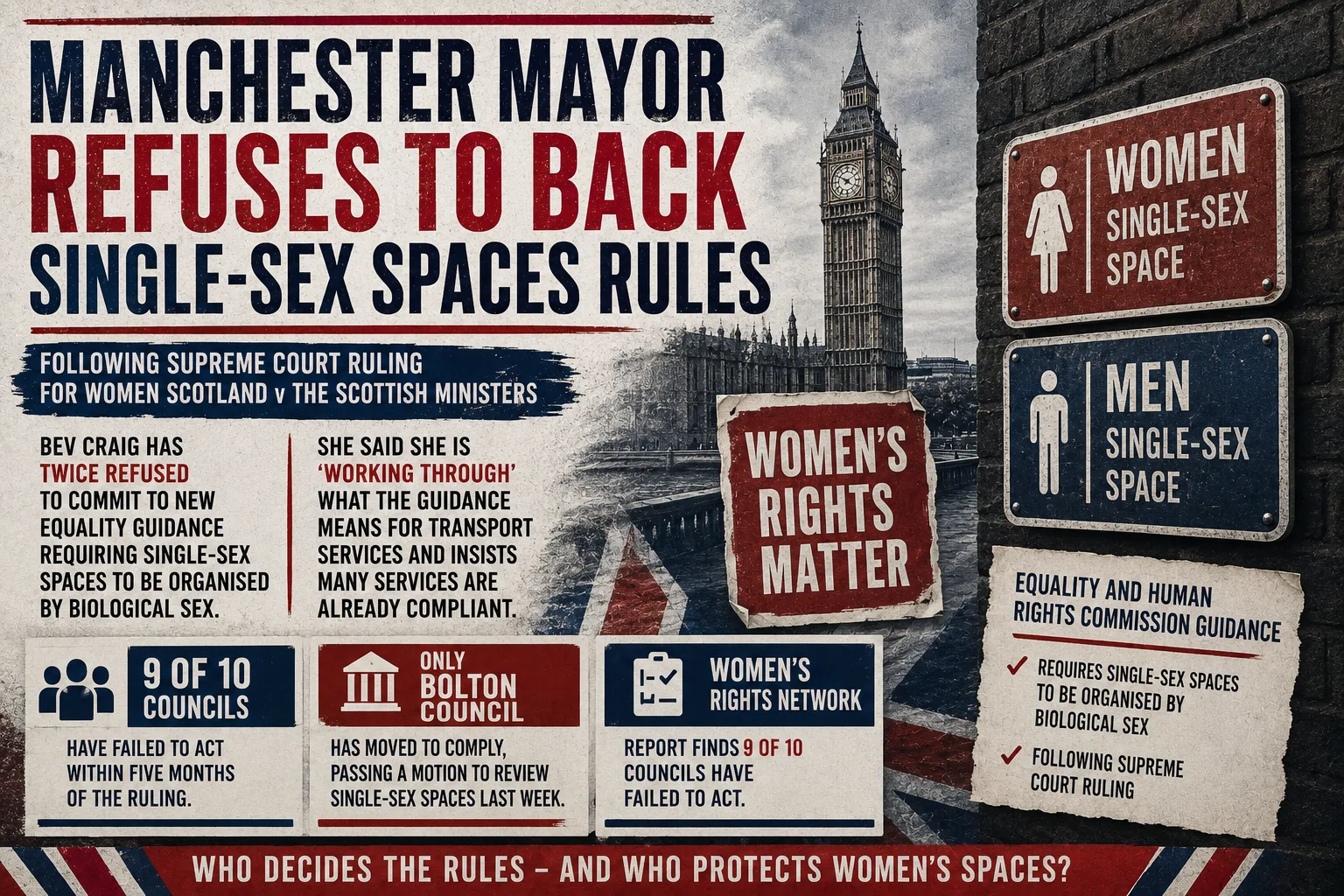
The Mayor of Greater Manchester has refused, twice, on live radio, to say whether she will implement statutory guidance designed to protect single sex spaces, setting up what could become one of the most consequential confrontations between local government and equalities law since the Supreme Court settled the meaning of the word "woman" last year.
Bev Craig, who replaced Andy Burnham as mayor last month, declined on two separate occasions during an interview with Times Radio to commit to imposing guidance issued by the Equality and Human Rights Commission, which states that transgender people should use either gender neutral bathrooms or facilities intended for their biological sex.
The guidance, which came into force last week, follows the landmark Supreme Court ruling in
For Women Scotland Ltd v The Scottish Ministers
, in which the court confirmed that the terms "woman" and "man" in the Equality Act 2010 refer to biological sex, rather than a person's chosen gender identity. As the House of Commons Library has summarised, references to "sex", "man" and "woman" in the Act mean a person's sex at birth. The ruling was not ambiguous. It was not advisory. It was the highest court in the land stating what the law is, and what, arguably, it always had been.
As Mayor of Greater Manchester, Ms Craig has direct oversight of the city region's transport network, while decisions on public toilets, schools, parks and libraries fall to Greater Manchester's ten constituent councils. Asked whether she would oversee the "full imposition" of the EHRC guidance, she told Times Radio, "I am working through what the guidance means in terms of the transport services that I am in control of."
Pressed a second time on whether this meant working through it with the intention of implementing the single sex guidance, she replied, "Well, with the intention of understanding what would be different to what we do now. Actually many of our services are compliant. The reality here is that we are probably talking about a handful of public toilets. Am I as the Mayor going to be checking people's bits on the way into the toilet? Absolutely not."
Ms Craig later clarified that single sex spaces would be "legally compliant", a formulation that commits her to precisely nothing, since legal compliance is the floor of public office, not a policy choice. Yet she refused to say whether she would advise Manchester's councils to adopt the guidance, arguing instead that authorities should be given time to implement changes, and noting that some had raised concerns about the "practical implication" of the rules.
A pattern of defiance
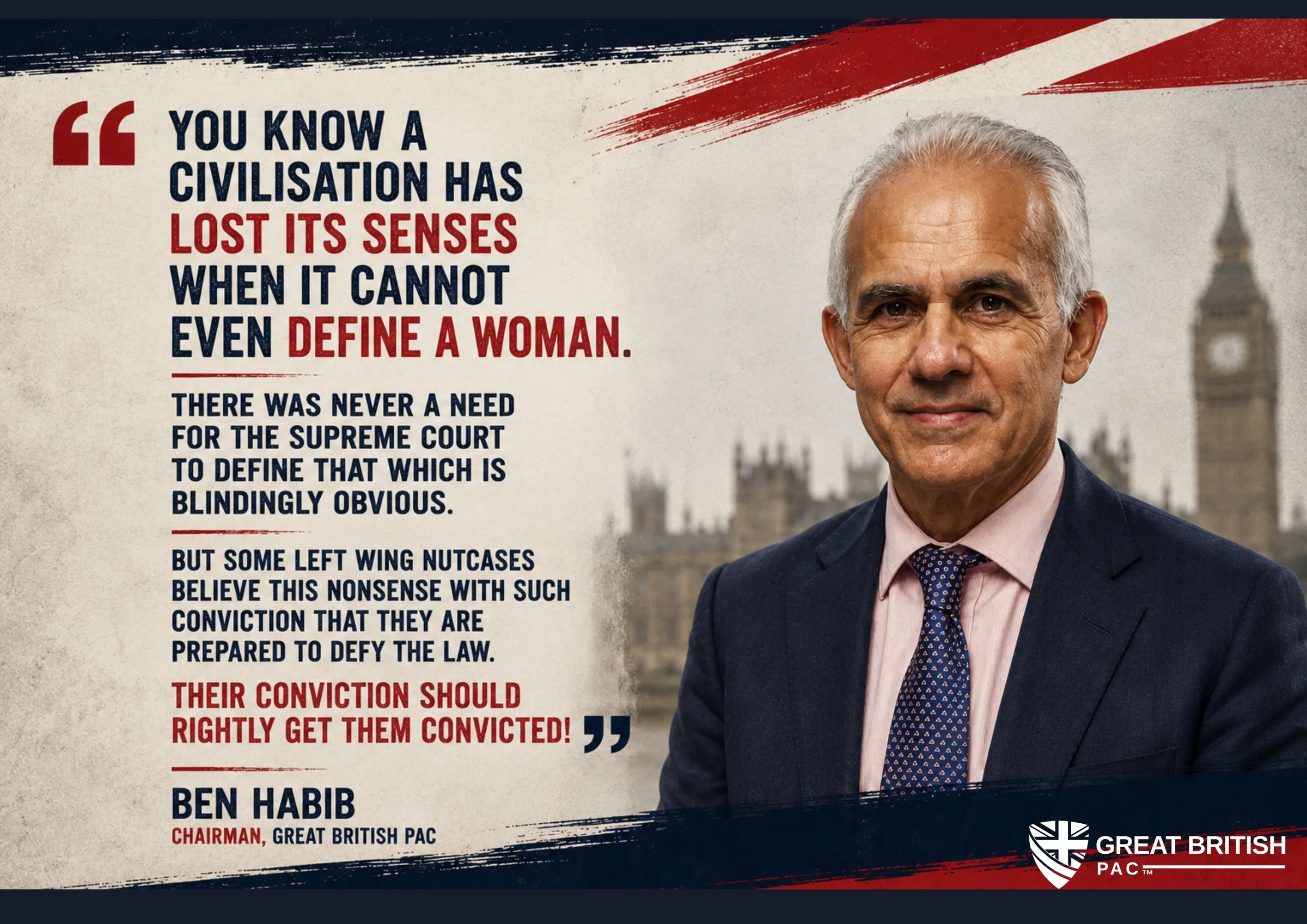
Ms Craig's reluctance does not exist in a vacuum. Last week, a coalition of Left wing councils in London, including Lambeth, Hackney, Haringey, Lewisham, Southwark and Waltham Forest, pledged openly to defy the new rules, describing them as "an attack" on transgender and non binary residents and committing to keep their services "inclusive" The Telegraph. The spectacle of elected councillors announcing their intention to disregard the law, as interpreted by the Supreme Court and codified by the statutory equalities regulator, has drawn remarkably little comment from a political class ordinarily quick to invoke the rule of law.
Meanwhile, evidence suggests the foot dragging predates the new guidance entirely. A report by the Women's Rights Network found that nine of Greater Manchester's ten councils had failed to take any action to amend their single sex spaces in the first five months following the Supreme Court ruling. The same organisation's research has previously found that around 30 per cent of local authorities across the UK provide no single sex changing or showering facilities at all for swimming pool users WRN, and that in England a staggering 86 to 88 per cent of sexual crimes in public swimming pool changing rooms occur in mixed sex changing villages, compared with 14 per cent in single sex facilities. These are not abstract concerns. They are safeguarding statistics, and they raise an uncomfortable question that Ms Craig, and politicians like her, seem determined not to answer.
The questions that will not go away
Why does a newly elected mayor believe she is entitled to look over, work through, and effectively sit upon guidance that flows directly from a Supreme Court judgment? Where, in this hierarchy of compassion, are the rights of women and girls who do not wish to share a locker room, a changing room, or a restroom with a male bodied person who identifies as a woman? Where is the safeguarding of biological women, and why, in 2026, must we even qualify the word "woman" with the word "biological" at all, as though the original term had somehow become insufficient?
Where, one is entitled to ask, are the feminists of previous generations, the women who marched, campaigned and, in the popular imagination at least, burned their bras to carve out sex based rights, separate spaces, and legal recognition of the female sex as a class worthy of protection? Much of that organised feminist establishment is now conspicuously silent, or worse, aligned with the position that those hard won rights should be surrendered on request.
And there is a final question, one being asked in living rooms and at school gates across the country even if it is rarely asked in council chambers. Does a man who cannot compete against other men, or who simply declares himself a woman, now carry more rights than your daughter? On the evidence of the past week, in Manchester's town halls as in London's, the answer being given by omission is yes.
"Fought for LGBT rights"
During the by election campaign to replace Mr Burnham, Ms Craig, the former leader of Manchester city council, said she had "fought for LGBT rights" throughout her career and would not "pit minority against minority". She said, "I believe in a world where the two can go hand in hand. I've shown that you can stand up for single sex spaces, like women's refuges that are important, but also not throw our trans communities under the bus."
Under her leadership, the council passed a motion in 2022 declaring that "trans men are men, trans women are women, non binary people are non binary and trans rights are human rights", a position the Supreme Court has now, in the relevant legal sense, rejected.
Last year, the Greater Manchester Combined Authority, led by the mayor and the leaders of each local authority, spent £179,827 on diversity, equity and inclusion initiatives. Freedom of Information documents showed that figure included £112,000 for the LGBT Foundation, an organisation that supports puberty blockers, to deliver "non binary inclusion" training and equality programmes The Express. Taxpayers, in other words, have been funding the very ideological framework the Supreme Court has now ruled incompatible with the Equality Act.
Ms Craig said she had not yet met the leaders of Greater Manchester's councils to understand how they intend to adopt the guidance. "I think it will be for the town councils to decide how they wish to approach that," she said. "But I do know there are many that have raised some concerns about the practical implication. I think there is a period of time for a lot of our bodies to work through how they would seek to implement it."
Not all authorities are hesitating. Last week Bolton Council, one of the ten, passed a motion to review its single sex spaces so that it could comply with the updated guidance BBC News. One council out of ten, moving to follow the law fifteen months after the Supreme Court spoke.
The women and girls of Greater Manchester might reasonably ask their new mayor what, exactly, the other nine are waiting for, and whose interests, in the end, her "working through" is designed to serve.