
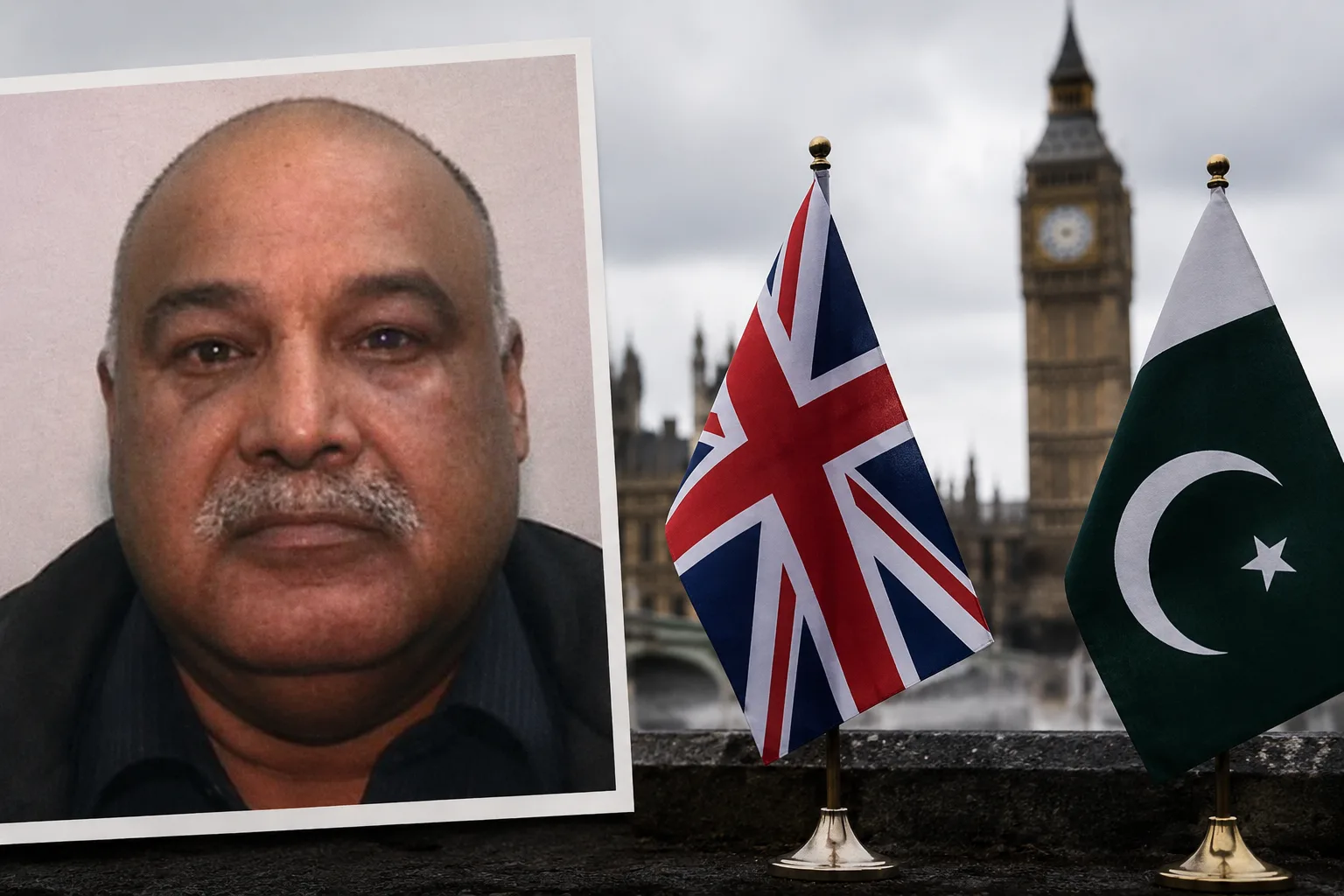
Pakistan has warned it could stop taking back illegal migrants from Britain after the UK pressed Islamabad to accept deported Rochdale grooming gang ringleader Shabir Ahmed, a dispute that now threatens intelligence sharing, security cooperation, and thousands of returns a year.
Pakistan has threatened to stop accepting the return of illegal migrants from Britain, in an extraordinary escalation of the diplomatic row over the fate of Shabir Ahmed, the convicted ringleader of the Rochdale grooming gang, whose deportation has become one of the most politically charged disputes between the two countries in recent memory.
Senior government officials in Islamabad have made clear that Britain's insistence on sending Ahmed back to the country of his birth, despite the fact that he left Pakistan as a child nearly six decades ago, risks collapsing what they describe as a "gold standard" cooperation arrangement on returns, and could poison far wider collaboration on intelligence, security, and organised crime.
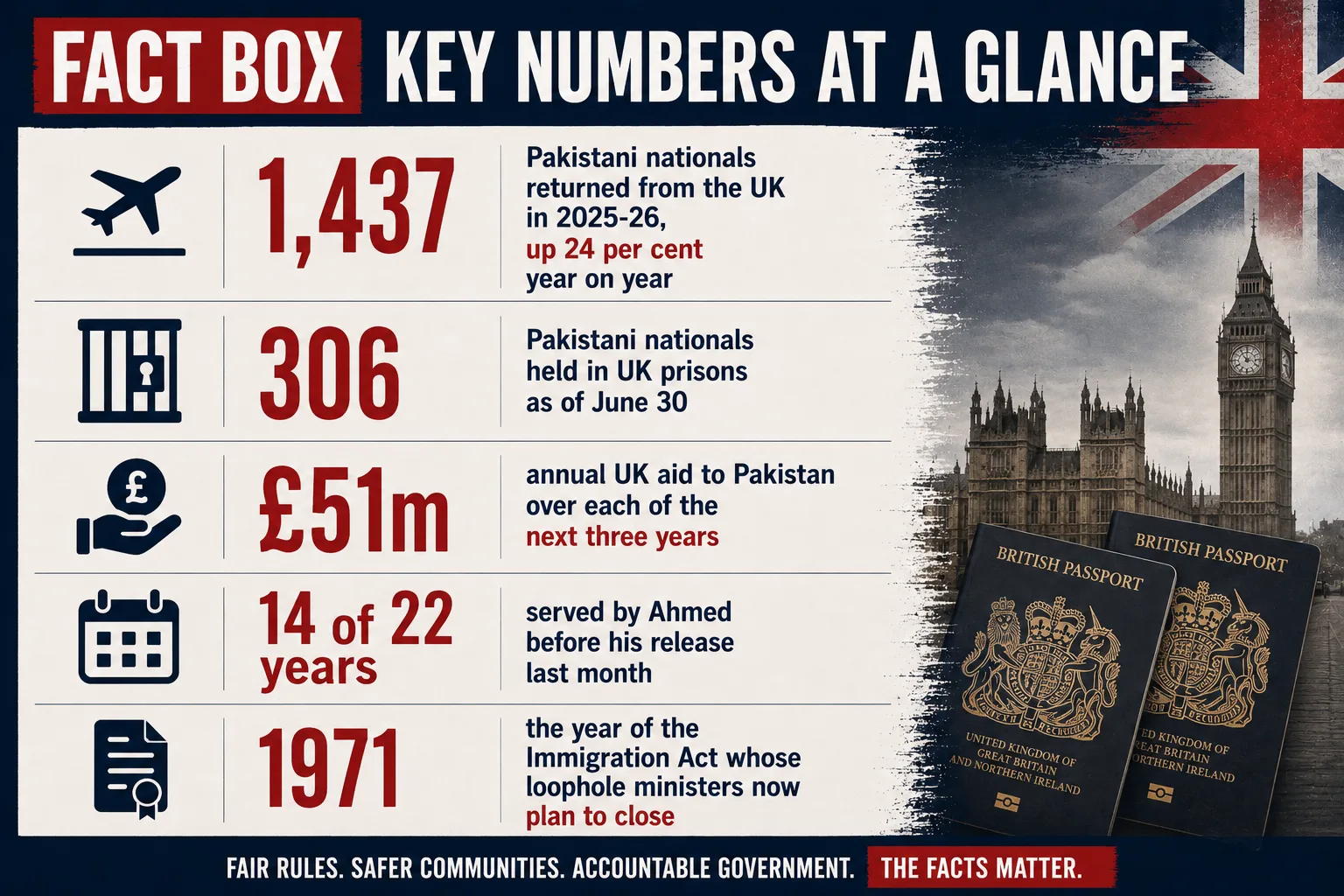
The standoff, first reported by The Telegraph, comes at a moment of acute political sensitivity in Westminster. Andy Burnham, who is set to replace Sir Keir Starmer as prime minister, has made the deportation of foreign national offenders a centrepiece of his strategy to relieve England's overcrowded prisons and reduce the need for the early release of domestic criminals. There were 306 Pakistani nationals held in UK jails as of June 30, and Ahmed's case has become the symbolic test of whether the government can actually deliver on its promises.
A rapist Britain cannot remove
Ahmed, 73, was freed from prison last month after serving 14 years of a 22-year sentence for 30 child rape offences. He was the leader of a gang of nine men from Rochdale and Oldham who were convicted in 2012 of exploiting girls as young as 12 and 13, victims who were plied with alcohol and drugs at takeaway restaurants before being passed between abusers. The case became emblematic of the grooming gang scandals that have scarred towns across northern England and prompted years of national soul searching about institutional failure.
Ahmed held dual British and Pakistani citizenship, but was stripped of his UK passport following his conviction. Yet deportation has proved impossible, blocked by a provision of the Immigration Act 1971 that exempts Commonwealth citizens who arrived in Britain before 1973, and who have lived in the country for at least five years, from removal. Ahmed arrived in the late 1960s.
Home Secretary Shabana Mahmood has now announced she will amend that 55 year old law to close the loophole, arguing that the Act "should not be used as a bar against removal in cases like that of Shabir Ahmed," according to the BBC. Ministers insist the fix can be crafted without endangering the rights of other long settled Commonwealth citizens, including the Windrush generation. The announcement was timed to coincide with the second reading of the immigration and asylum bill, and The Guardian reported that a government source admitted the domestic legal fix was only half the battle: "It is now down to the FCDO negotiations with Pakistan that will decide if he stays in the UK."
"Very much the UK's internal problem"
Islamabad's position has hardened into outright refusal. Tahir Andrabi, a spokesman for Pakistan's Ministry of Foreign Affairs, told the BBC that Ahmed is "a British national who spent his entire adult life in the UK and was duly convicted by a British court for reprehensible offences committed on British soil," adding that his "heinous crimes demand serious introspection rather than the quest to search for extraneous causes."
One senior Pakistani official put it more bluntly, telling The Telegraph that Ahmed was "very much the UK's internal problem" and describing him as "a product of British society," a man of 75 who has lived for more than 60 years in Britain. "It is therefore difficult to understand why the UK expects Pakistan to take responsibility for someone who was raised, lived and committed his crimes in Britain," the official said, "instead of addressing the matter within its own jurisdiction."
Islamabad also maintains that Ahmed renounced his Pakistani citizenship decades ago, a claim London disputes, pointing to evidence that he never completed the full legal process of renunciation. Pakistani officials stress there is no treaty obliging them to accept foreign criminals who have severed their ties to the country.
Cooperation held hostage
What elevates this dispute beyond a bilateral irritant is the explicit threat now attached to it. Pakistani officials say they have provided Britain with "gold standard" cooperation on returns, accepting nearly 1,500 rejected asylum seekers, visa overstayers, and immigration offenders in the past year alone. According to figures cited by officials, returns of Pakistani nationals rose 24 per cent year on year, from 1,158 to 1,437 in 2025-26, including a 74 per cent increase in failed asylum seekers, from 279 to 486, and an 8 per cent rise in non-asylum returns, from 879 to 951.
Official Home Office data confirms the broader trend of rising removals: there were 9,382 enforced returns in the year ending September 2025, up 22 per cent on the previous year, alongside 27,075 voluntary returns, with Pakistani nationals among the most common nationalities in asylum-related returns at 395, according to GOV.UK immigration statistics.
"These relations could be affected in all areas if the issue of Shabir Ahmed was forced upon Pakistan," one official warned. "It cannot be one way traffic." Another said Britain's pressure "appears to be driven by domestic political pressures rather than by an appreciation of the legal and diplomatic complexities involved," adding pointedly: "Let's not play politics with each other's security and be honest."
Sanctions on the table
Pakistani officials are particularly aggrieved by suggestions from government sources that Britain is prepared to impose sanctions if Islamabad refuses to cooperate, including visa bans on Pakistani nationals and the withholding of foreign aid. Those options have been publicly aired by the Conservative shadow home secretary Chris Philp, who told Radio 4 that ministers should consider suspending bilateral aid and applying visa sanctions at "the most extreme level," arguing: "If a British citizen commits a crime somewhere else, we would accept them back, and I would expect other countries to do the same when the boot's on the other foot."
Government data shows Britain is due to give Pakistan £51 million in aid in each of the next three years, though Downing Street has insisted those payments, which do not go directly to the Pakistani government, will not feature in negotiations.
The domestic pressure cooker
The political stakes at home are considerable. Some of Ahmed's victims have said they are "frightened" and feel "unsafe" since his release, and the Ministry of Justice is spending thousands of pounds accommodating him under strict conditions, electronic GPS tagging, geographical exclusion zones covering Oldham, where he lived, and Rochdale, where he committed many of his crimes, round the clock supervision at a staffed bail hostel, and a ban on contacting associates.
Campaigners have been unsparing. The Great British PAC has condemned what it calls Pakistan's "audacious behaviour," arguing that Islamabad should take Ahmed back along with other convicted grooming gang members, and questioning why Pakistan refuses to accept and deal with its own nationals. The pressure has cut across party lines: Robbie Moore, the Conservative MP for Keighley and Ilkley, told the Commons that deportation legislation would "probably get support from across parliament," while Home Office minister Alex Norris replied that "all of those options are on the table," according to the Hansard record.
With 10,737 foreign nationals held in custody in England and Wales as of September 2025, representing 12 per cent of the prison population according to the Ministry of Justice, the capacity to deport foreign offenders is now central to the government's entire prisons strategy. Burnham himself has called Ahmed a "vile criminal" whom he wants deported.
What happens next
The immediate future of the dispute rests on negotiations between the Foreign, Commonwealth and Development Office and Islamabad, talks that Downing Street confirms are continuing. But the trajectory is unpromising. Pakistan has framed the affair as a test of whether decades of security cooperation can be held hostage to "political challenges facing the UK Government at home," while ministers face a public, and a cohort of victims, who will accept nothing less than Ahmed's removal.
For now, a 73 year old child rapist sits in a bail hostel under electronic surveillance, at the taxpayer's expense, while two allied governments argue over whose problem he is. The answer to that question may well determine not only the fate of one man, but the architecture of returns, intelligence sharing, and diplomatic trust between London and Islamabad for years to come.