
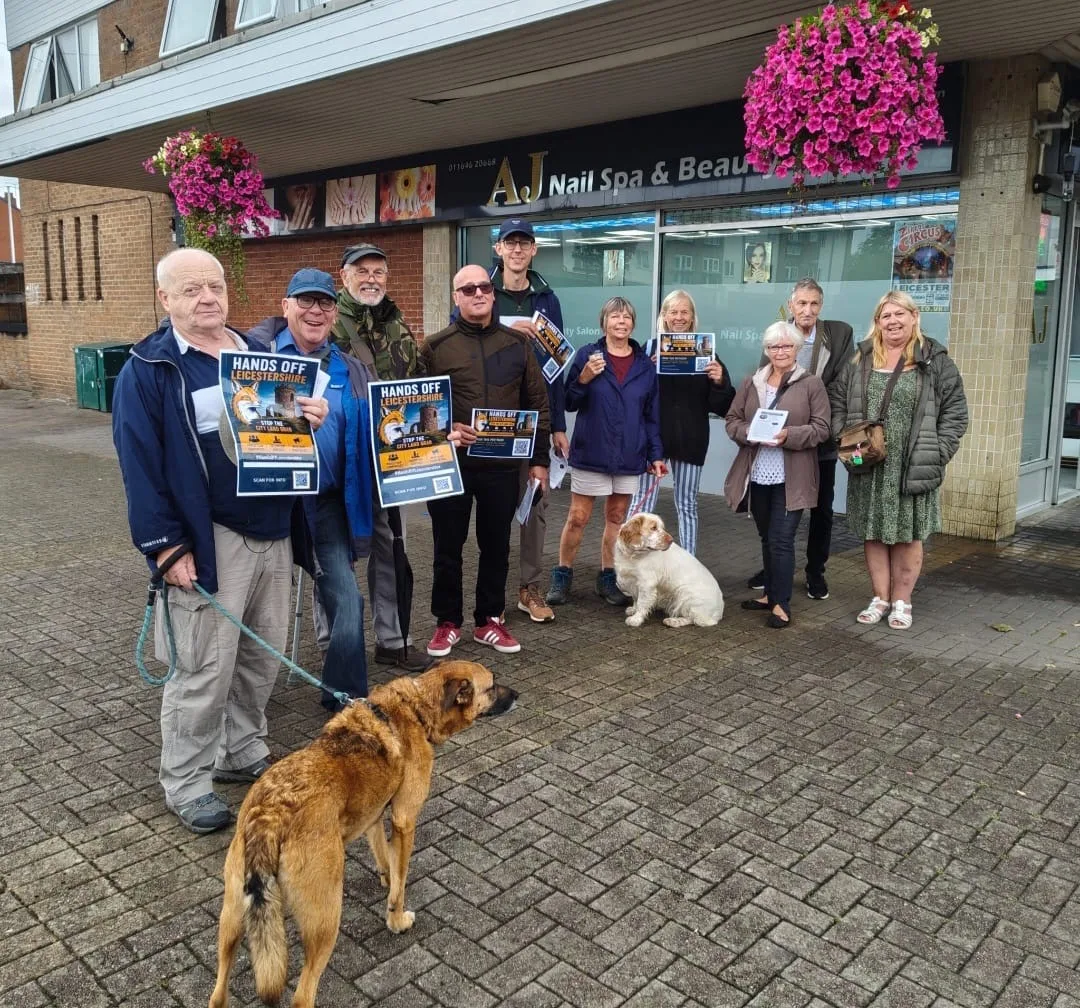
A government drive to reorganise local government has sparked one of the largest grassroots campaigns Leicestershire has seen in years, with residents, parish councils and county politicians uniting against plans they say would hand rural towns and villages to the Labour run city authority. Great British PAC is now supporting the local action, and parallel campaigns are taking shape in Derbyshire and Nottinghamshire.
The Battle for the Boundary: How a Quiet Reform Set Off a Countywide Revolt
When the Government invited councils to submit proposals for local government reorganisation, few residents of the villages ringing Leicester imagined the exercise would redraw the community maps they had known for generations. Yet that is precisely what is now on the table, and the response from the county has been swift, organised and, by the standards of local politics, extraordinary.
Under proposals advanced by Leicester City Council, the city's boundaries would be extended to absorb the whole of Oadby and Wigston, together with large parts of the districts of Blaby, Charnwood and Harborough. The list of affected communities, published by the Leicestershire and Rutland Association of Local Councils, reads like a roll call of the county's commuter belt, including Blaby, Braunstone Town, Cosby, Countesthorpe, Enderby, Glenfield, Glen Parva, Huncote, Kirby Muxloe, Narborough, Whetstone, Birstall, Syston, Thurmaston, Great Glen and Scraptoft, with the association noting that other parishes not listed may also be affected.
The city's preferred structure would create two unitary authorities covering Leicestershire and Rutland, an enlarged Leicester City and a reduced Leicestershire County Council combined with Rutland. A more conservative "base proposal", compliant with government guidance that whole districts be used as building blocks, would still see Blaby, Oadby and Wigston and Harborough absorbed into the city authority, leaving Hinckley and Bosworth, North West Leicestershire, Charnwood, Melton and Rutland as the second authority.
"Every signature sends a clear message that South Leicestershire residents do not want boundaries to be redrawn against their wishes." — Alberto Costa, MP for South Leicestershire
The political response has crossed party lines. Alberto Costa, the Conservative MP for South Leicestershire, has launched a parliamentary petition urging the Government to reconsider, which he intends to present in the House of Commons. Communities in his constituency facing transfer to the city include Blaby, Enderby, Narborough, Whetstone, Countesthorpe, Cosby, Huncote, Thorpe Astley, Glen Parva and New Lubbesthorpe, according to his campaign page on local government reorganisation. Mr Costa campaigned throughout the process for the alternative "North, City, South" proposal, which, he argues, would have delivered the reform ministers want without forcing South Leicestershire communities into an expanded city authority. Parallel petitions have been launched by Neil O'Brien in Harborough, Oadby and Wigston, Alicia Kearns in Rutland and Stamford and Peter Bedford in Mid Leicestershire.
For campaigners on the ground, the issue goes beyond lines on a map. Critics of the city council's plan characterise it bluntly as a "land grab" by a Labour run authority, arguing that an enlarged city would draw in the council tax base of prosperous rural and suburban communities. The city council, which has faced well documented financial pressures, disputes that characterisation and maintains that boundary reform is a rational response to the mismatch between Leicester's tightly drawn boundaries and the true economic footprint of the city. Campaigners remain unconvinced, and it is here that the dispute has taken on a harder political edge, with local activists linking the proposals to wider grievances over taxation and spending priorities, including, in the view of many county campaigners, the cost of accommodating migration in the cities. The city council does not accept that framing, and no official submission makes such a case, but the perception has proved a potent recruiting tool on the doorstep.
What is not in dispute is the scale of the mobilisation, nor the organisation now behind it. Great British PAC, that has built a national network of local campaign chapters, is supporting the local action, helping to coordinate logistics, literature and volunteer rotas across the affected districts. Weekly meetings and weekend street stalls are now a fixture of village high streets, and organisers describe attendances as consistently strong. The regional effort is being coordinated by Danuta Jeeves Great British PAC's East Midlands Regional Director, who says the Leicestershire fight is only the beginning. Similar reorganisation battles are now under way in Derbyshire and Nottinghamshire, where county and district councillors have raised parallel objections to city centred proposals.
That cross county dimension matters. Local government reorganisation is being pursued across England as ministers seek to replace the two tier system of county and district councils with unitary authorities, a policy the Government argues will save money and simplify accountability. In Leicestershire, however, the practical effect of the city's submission would be to transfer hundreds of thousands of residents from the county's orbit into the city's, a shift opponents say has been decided without meaningful consent. Parish and town councils, the tier of government closest to the villages affected, have been among the loudest voices in opposition, and the county and district councillors who represent the affected wards are, by all accounts, overwhelmingly hostile to the plans.
Veterans of local campaigns see precedents. Organisers point to Piddington, the Northamptonshire village whose residents refused en masse to pay the community charge, becoming a symbol of the resistance that helped bring down the poll tax at the end of the 1980s. The lesson they draw is simple, that determined, visible, locally rooted opposition can force Whitehall to think again.
"People power can win. Look at Piddington and the poll tax in the 80s." — East Midlands campaign organiser
The timetable is now the campaign's central focus. Leicester City Council's Overview Select Committee considered the final submission in November, with Full Council approval following shortly after, meaning the window for influencing the outcome lies principally with ministers and with Parliament. That is why campaigners are pouring effort into the petitions, which, once presented in the Commons, will place the objections of county residents directly before the Government.
Whether that pressure succeeds remains to be seen. Boundary reviews historically favour administrative logic over local sentiment, and the financial arguments for larger unitary authorities are not easily waved away. But the organisers of the Leicestershire campaign, now backed by the national machinery of Great British PAC, are betting that numbers, persistence and the sheer visibility of weekly stalls on village high streets will count for more than consultants' spreadsheets. As similar campaigns gather pace in Derbyshire and Nottinghamshire, the East Midlands is becoming an early test of how far the Government's reorganisation agenda can run ahead of public consent.
Do you live in one of the communities affected by the boundary proposals, and do you believe local government reorganisation is being done with residents, or to them?
Tell us in the comments below or send us an email to info@greatbritishpac.com.