The Prime Minister is enjoying his political honeymoon, but those urging him to seek his own mandate should be careful what they wish for
Andy Burnham has wasted little time cultivating his image as the approachable, ordinary bloke in Number 10.
There have been pies, pasties, Greggs preferences and matey social media videos designed to remind voters that this is not a politician who intends to appear remote from everyday life.
It is clever politics. After the exhaustion and turmoil of Sir Keir Starmer's premiership, Burnham's deliberately upbeat, distinctly Northern style has given Labour something it desperately needed: a change of mood.
But governing Britain requires considerably more than good vibes and a well chosen sausage, bean and cheese melt.
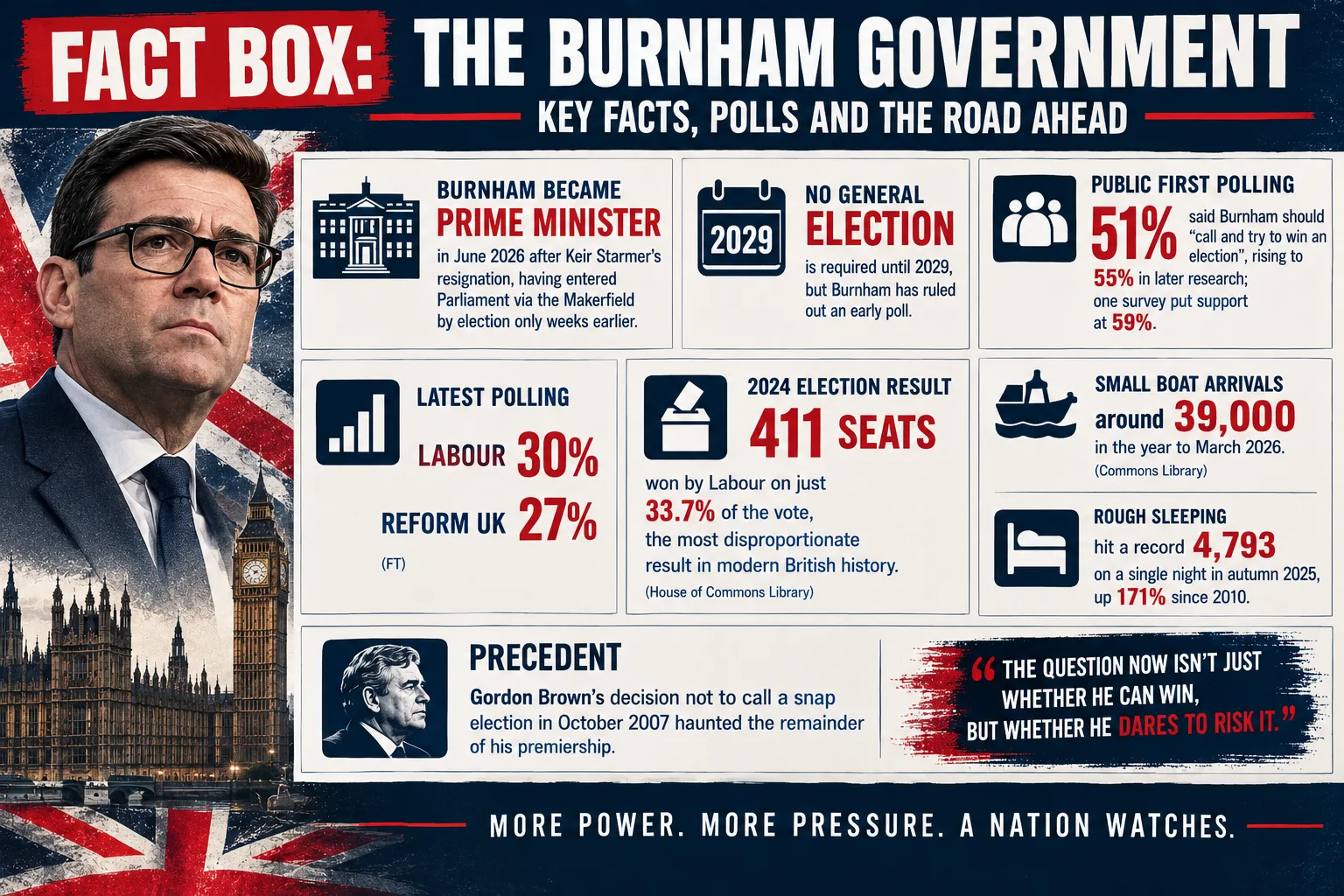
The problems confronting the country are enormous. Around 39,000 people arrived in the UK by small boat in the year ending March 2026, after some 41,000 crossings were recorded during 2025, with small boats now accounting for around 90 per cent of detected irregular arrivals. Rough sleeping is another increasingly visible failure. The Government's annual snapshot recorded 4,793 people sleeping rough on a single night in England in autumn 2025, the highest figure since records began, while in London nearly 13,000 people were seen sleeping rough during 2025/26.
Then there is the wider inheritance: strained public finances, struggling high streets, social care, creaking infrastructure, young people outside employment and education, pressure on public services and a country increasingly sceptical that Westminster has answers to any of it.
These are not problems that can be solved by presentation. Sooner or later, Burnham has to govern.
The Burnham bounce will soon give way to burning Burnham. Why? Because he is just another politician, in a long line of politicians, who has turned his back on the country and its people. No amount of the cuddly teddy bear act will make up for his failures. He has no vision and no mandate. But do not expect an election any time soon - turkeys do not vote for Christmas! - Ben Habib, Chairman Great British PAC
The pressure to go to the country
That is why an intriguing argument is beginning to develop around the new Prime Minister: should he call an early general election and seek a mandate of his own?
Burnham is under no constitutional obligation to do so. Following the repeal of the Fixed term Parliaments Act, a general election does not have to be held until 2029. But there is an obvious political vulnerability.
Britain did not elect Andy Burnham as Prime Minister.
He entered Parliament only weeks ago through the Makerfield by election, before Sir Keir Starmer announced his resignation on 22 June. Burnham now leads a government elected in July 2024 on a manifesto written under a different prime minister and in markedly different political circumstances.
That gives his opponents an obvious line of attack whenever he attempts something substantial: where is your mandate?
It is therefore understandable that some inside and around Westminster will look at Burnham's current honeymoon and conclude that, if he is ever going to risk an election, now might be the moment. But what looks tempting from inside Downing Street could prove considerably more dangerous than it appears.
An election would be a gamble
Labour's 2024 majority looks formidable on paper. The party won 411 seats.
Yet it achieved that extraordinary parliamentary landslide with only 33.7 per cent of the vote. That matters.
Labour's huge majority was not built on overwhelming public enthusiasm for the party. It was delivered in large part by the mechanics of Britain's first past the post electoral system and a deeply fractured opposition vote, with Conservatives and Reform UK competing for many of the same voters.
That fragmentation has not disappeared. If anything, the picture has become more complicated, with Restore Britain now entering an already crowded field on the Right. The result is that Labour could once again benefit enormously from its opponents fighting one another rather than Labour itself.
Reform UK remains a formidable campaigning force under Nigel Farage, while the Conservatives are seeking to rebuild after their catastrophic defeat in 2024, with Kemi Badenoch gaining ground and showing signs of growing support in the polls. The Greens could also take votes and seats in particular areas.
For Burnham, therefore, the electoral calculation is complicated. If an election were held while his opponents remained fractured, Labour strategists might conclude that the mathematics still favoured them. But politics can change remarkably quickly.
The great unresolved question on the Right is whether Conservatives, Reform and their respective voters will continue fighting one another while Labour reaps the dividend of their division. In dozens of constituencies, the consequences of vote splitting could be decisive.
That is why those encouraging Burnham to seek an early mandate should perhaps be careful what they wish for. An election would not simply be an opportunity for the Prime Minister to legitimise his premiership. It would open the entire political settlement again. And once an election campaign begins, nobody controls what happens next.
What do voters think?
There is nevertheless evidence that the public itself is uncomfortable with a Prime Minister taking office without facing the electorate.
A Public First poll reported by POLITICO found that 51 per cent of respondents believed Burnham should call and try to win an election to give his government legitimacy. Subsequent Public First research put the figure at 55 per cent. Another survey put support for an election within a year at 59 per cent.
That presents Burnham with an awkward dilemma.
Calling an election would give him the opportunity to secure something he currently lacks: an explicit personal mandate. Winning would potentially give him years in which to pursue his own programme rather than governing beneath the shadow of Starmer's 2024 manifesto. Losing, however, would make him one of the shortest lived prime ministers in British history. And even a significantly reduced Labour majority could transform the balance of power at Westminster.
The question for Burnham is therefore not simply whether he can win an election. It is why he would risk one when he already possesses a huge parliamentary majority.
The ghost of Gordon Brown
There is an obvious historical comparison, and it is one Burnham's allies will know well.
Gordon Brown entered Downing Street in June 2007 after succeeding Tony Blair and initially enjoyed a substantial polling bounce. Speculation about an early election became intense. Then, on 6 October, Brown decided against it.
The election that never happened subsequently became one of the defining stories of his premiership. His opponents accused him of bottling the contest once the political weather began to change, and he never entirely escaped the impression that he had allowed his moment to pass.
Burnham will naturally want to avoid the same fate. He has reportedly ruled out an early general election, with Labour insisting it has no plans to go to the country, a position that has already prompted petitions demanding he seek a mandate.
But that will not stop the speculation. Every favourable opinion poll will produce another argument that he should capitalise on his honeymoon. Every difficult decision will produce warnings that his popularity may not last. And every significant departure from Labour's 2024 programme will revive questions about his mandate.
That does not mean calling an election would be wise. It means Burnham faces exactly the sort of political trap that has caught prime ministers before him. Wait too long and the opportunity may disappear. Go too early and he could discover that the country is considerably less enthusiastic than Westminster imagined.
How long can the Burnham bounce last?
That may ultimately be the most important question.
Burnham's early political advantage is that he is not Keir Starmer. He sounds different. He looks more comfortable communicating with voters. His public persona is warmer and more optimistic. After a deeply unpopular period for the Government, simply changing the face at the top was always likely to produce some relief.
But political honeymoons end. Eventually there will be budgets, tax decisions, spending cuts or increases, immigration figures, NHS waiting lists, economic statistics, international crises and all the other uncomfortable realities that confront governments. The Prime Minister will have to make decisions that upset people. That is when popularity becomes considerably harder to maintain.
Polling reported by the Financial Times has suggested a Burnham led Labour Party would secure around 30 per cent of the vote, with Reform UK on 27 per cent. Whatever the precise numbers at any particular moment, such polling hardly suggests an impregnable political position. It suggests a country whose politics remain extraordinarily volatile.
And that should concern Labour strategists contemplating an unnecessary trip to the ballot box.
Hope is a word, not a policy
Burnham has spoken repeatedly about bringing hope back to Britain. It is an attractive message. It is also one of the oldest currencies in politics.
Margaret Thatcher invoked hope on the steps of Downing Street in 1979 when she quoted the prayer associated with St Francis of Assisi: "where there is despair, may we bring hope". Bill Clinton famously spoke of "a place called Hope", while Barack Obama's 2008 campaign turned the word itself into one of the most recognisable political images of the modern era.
There is nothing wrong with hope. Britain could certainly use some. But hope only survives politically when people begin to see results.
Voters hope for borders that are controlled, streets that are safe and clean, public services that work, children who have opportunities to prosper, taxes that are spent responsibly and politicians who actually deliver what they promise.
That is the test Burnham now faces. Not whether he can appear relatable in another social media video. Not whether Westminster commentators think he is enjoying a bounce. And not even whether opinion polls suggest he could win an election tomorrow. The real test is whether he can govern.
There will undoubtedly be voices urging Burnham to seize his moment and call an election before the political weather changes. Perhaps that temptation will grow.
But from Downing Street's perspective, there is another question worth asking. Why gamble a commanding parliamentary majority on an electorate that has become notoriously difficult to predict?
And from the perspective of those who want a different direction for Britain, the lesson is equally obvious. Rather than encouraging Andy Burnham to choose the most advantageous moment to go to the country, the parties and movements opposing Labour should concentrate on getting their own house in order.
Because if an election does come sooner than expected, Britain's divided Right may discover that its greatest opponent is not Andy Burnham at all.
It is itself.