
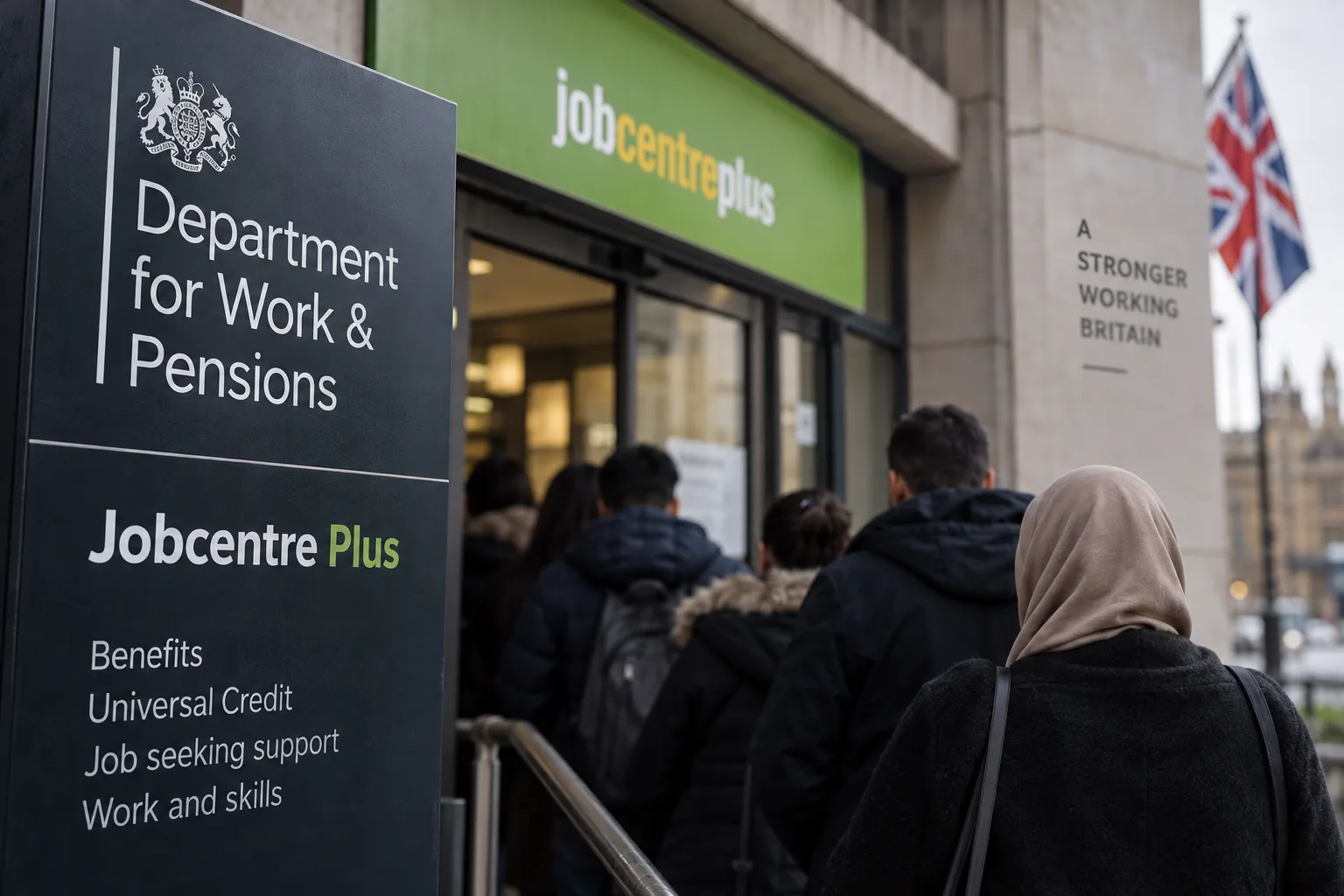
Households with at least one foreign national received £11.9bn in universal credit last year, a record, and a quarter more than the year before.
Department for Work and Pensions figures obtained under freedom of information laws by the Centre for Migration Control show the total rising from £9.5bn in 2024 to £11.9bn in 2025. In 2023 it was £7.5bn. Just under two thirds of last year's money, £7.7bn, went to households where the claimant was out of work.
The figures were reported by The Telegraph on Sunday, on the eve of a decision by Andy Burnham on whether to soften the settlement reforms drawn up by Shabana Mahmood, his Home Secretary.
Foreign nationals can claim universal credit only where their immigration status carries recourse to public funds. That covers refugees, EU citizens with settled status and holders of indefinite leave to remain. People in the country unlawfully cannot claim, and the Department for Work and Pensions says around half of foreign national claimants are in work. Its own immigration status breakdown, published in August, put 57.4 per cent of claimants with EU settlement scheme status in employment in April.
Those are households, not individuals. They include British partners and children, so the £11.9bn is not money paid personally to foreign nationals.
The argument is therefore less about eligibility than about the scale of the payments.
One number behind the headline has had less attention. Households with at least one foreign national accounted for 15.6 per cent of universal credit payments last year, a share close to where it has sat for several years. Earlier figures released under freedom of information laws put the same measure at 16.5 per cent in 2024, 16.3 per cent in 2023 and 15.5 per cent in 2022.
Full Fact, examining the number of claimants rather than the value of payments in August, found the proportion of people on universal credit who were not British or Irish had been falling since June 2024, from 17.5 per cent to 15.2 per cent in January. That dataset counts individual claimants, not households or payment values, so it is not directly comparable with the 15.6 per cent figure.
The share has barely moved in years. The total has gone up by nearly 60 per cent in two.
The decision waiting in Downing Street
Ms Mahmood has proposed lifting the standard wait for indefinite leave to remain from five years to 10. Under the proposals, workers sponsored for lower-skilled roles, including many on the Health and Care route, could face a 15-year baseline wait. Anyone who has relied on benefits for more than 12 months could face a 20-year qualifying period. Whether and how the changes will apply to people already on a pathway to settlement remains under consideration.
The changes would not affect people who already hold settlement. They could, however, affect people already living here, among them workers who arrived expecting to qualify for permanent residence after five years and who are now approaching that point.
That is where the political problem sits. Up to 100 Labour MPs, Angela Rayner among them, want care workers exempted, arguing it is unfair to apply the rules retrospectively. The Trades Union Congress passed a motion this month calling for any change affecting workers already in the UK to be withdrawn, and Unison has said the proposals would render migrant workers second class citizens. Ministers have received 200,000 responses to their consultation, and Ms Mahmood told the Commons home affairs committee that the technical detail is being worked on, with policy to be announced later this year.
The Home Office's own arithmetic is on the table. Its published forecast puts the number of people expected to settle between 2026 and 2030 at between 1.3 million and 2.2 million. Of that total, 462,000 are estimated to have originally come on the health and care route, 189,000 as main applicants and 274,000 as dependants. In a methodology note, the department estimates the net lifetime fiscal cost of the care workers and their adult dependants expected to settle in that period at £9.5bn, or £10bn to the nearest billion.
That number is contested, and the two figures being compared do not measure the same thing. The Home Office says its £10bn was not put forward as a savings estimate but as an illustration of the lifetime cost of the cohort due to become eligible in the absence of the reforms. A separate Guardian analysis of government figures in April, based on data obtained from the Migration Advisory Committee, put the direct saving from restricting access to benefits over the 10-year delay at approximately £600m. That measures a narrower policy effect over a different period. The academic who obtained the data argued the lifetime fiscal profile was strongly age dependent, with net negative contributions typically arising later in life through pensions and social care.
What the parties say
Chris Philp, the shadow home secretary, called the figures shocking and said British taxpayers should not be paying billions in benefits to foreigners, particularly when over half of the payments go to people out of work. "Paying unemployed foreigners is an insult to hard-working taxpayers," he said. He warned that an about-turn on the settlement reforms would mean more low wage and unemployed foreigners qualifying for benefits. The Conservatives want to bar foreign nationals from claiming benefits altogether, with an exception for qualifying EU citizens, and to require unemployed and low paid foreign citizens to leave when their visas expire.
Robert Jenrick, Reform's treasury spokesman, blamed the change to the minimum salary requirement for migrants under Boris Johnson. "If Burnham bottles ILR changes, the Boriswave risks becoming permanent and will cost taxpayers tens of billions more," he said.
Robert Bates, research director at the Centre for Migration Control, said the figures "make a mockery of the suggestion that mass legal migration has been a boon for Britain's economy" and called for serious consideration to be given to scrapping indefinite leave to remain.
A government spokesman said net migration is down by 82 per cent from its 2023 peak, that only people in the UK legally can claim taxpayer funded benefits, and that around half of those claimants are in work. "Last November, we set out proposals to reform settlement which will double the standard qualifying period to 10 years for most migrants, with shorter routes for those who contribute most to the UK," he said.
That 82 per cent figure is broadly consistent with the latest Office for National Statistics estimates, which provisionally put net migration at 171,000 in the year to December 2025, against a revised peak of 944,000 in the year to March 2023. At the end of 2024, around 4.2 million people held valid temporary visas in the UK, according to the Migration Observatory, around 3.6 million of whom had arrived since 2021 under the post-Brexit immigration system. Among those on routes leading to settlement, many who arrived during the peak years are now moving closer to the point at which settlement becomes relevant.
Richard Thomson, National Director of Great British PAC, said:
"£11.9 billion in Universal Credit paid to households containing a foreign national, with almost two thirds going to those without work. Meanwhile, British taxpayers are told to accept higher bills, higher taxes and declining public services.
"Now Andy Burnham is considering weakening even the modest settlement reforms proposed by his own Home Secretary.
"A country that cannot control access to its borders and welfare system has surrendered control of both. Welfare must be a safety net for those who have contributed, not an international entitlement funded by the British taxpayer."
The settlement decision is about the people who have not yet settled. These figures are about the ones who already have. The three-year run goes £7.5bn, £9.5bn, £11.9bn.