
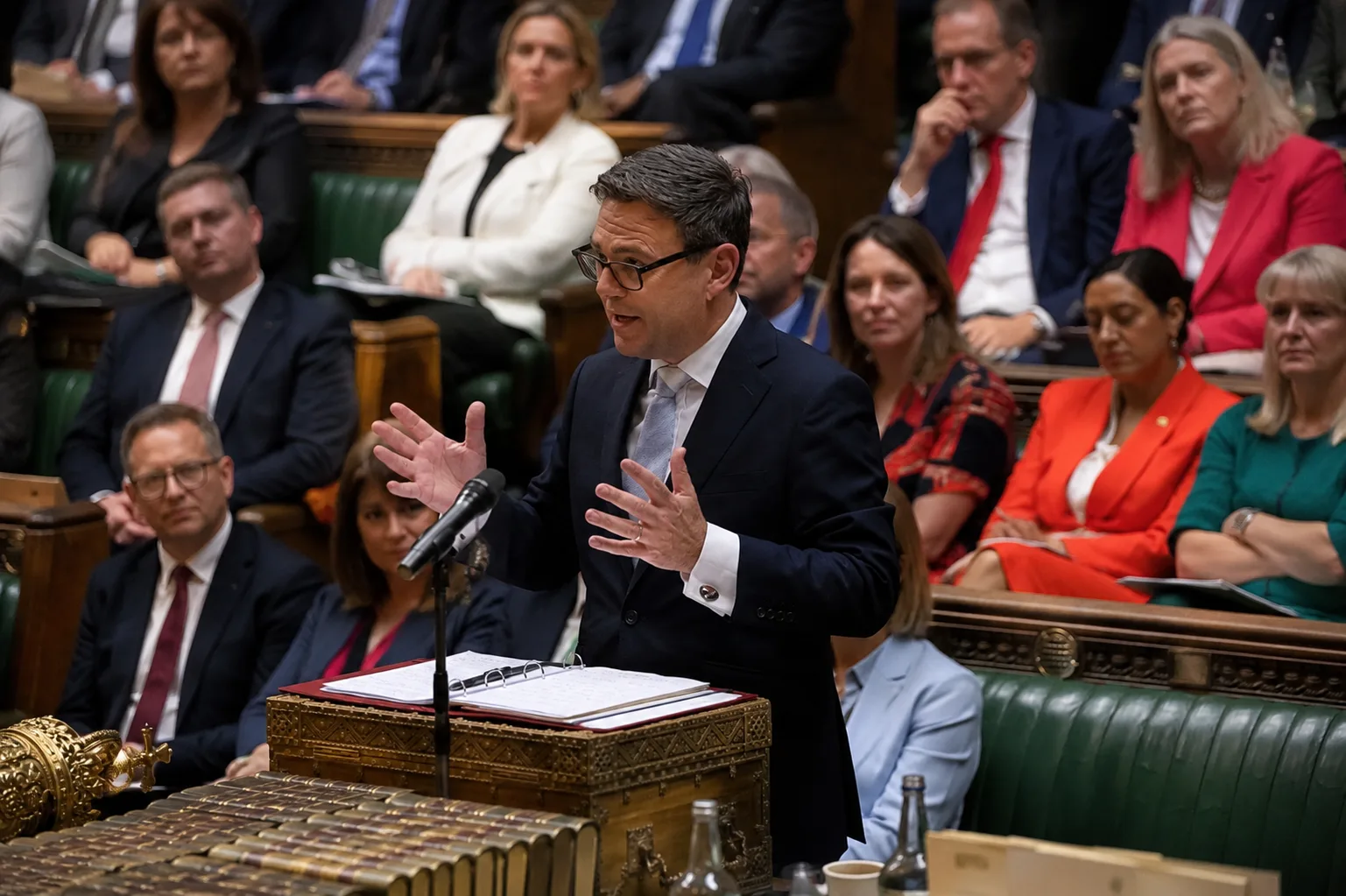
Andy Burnham's first appearance at the despatch box as Prime Minister on Tuesday was overtaken within hours by two pressures: a bond-market rout leaving him facing a shortfall of up to £14 billion in his first Budget, and a warning from Britain's biggest shopkeepers against funding a high-street revival with higher taxes on large stores. The Daily Telegraph reported that the rise in borrowing costs, which has accelerated since he took office on 20 July, now threatens the higher spending promised in his first parliamentary address.
His speech was deliberately more hopeful than anything heard from Keir Starmer, pushed out by his own party in June. "We can make this next decade better than the last," he told MPs, "and bring back hope." He laid out "a series of wrong turns" since the 1980s, when political power was centralised, economic power privatised and the country deindustrialised, before Brexit compounded the damage with "a decade of low growth". He promised greater public control over water, energy and transport, and a second prime ministerial office in Manchester, No 10 North, to oversee the biggest redistribution of power the country has seen. "Too many British high streets tell the story of this decline," he said. "People yearn to see them restored."
The market backdrop was stark. Britain suffered the biggest rise in bond yields of any G7 country on Tuesday, with ten-year gilts at their highest since 2008 and 20-year borrowing costs at their highest since 1998. The Government is expected to spend more than £130 billion on interest on the near-£3 trillion national debt this year. Ruth Gregory of Capital Economics estimated the rise has cut Budget headroom by about £9 billion, leaving the Chancellor needing to cut spending or raise taxes by £9 billion to £14 billion "to restore headroom and maintain fiscal credibility". Lord O'Neill, the former Goldman Sachs economist, called the tone of the speech "the last thing investors wanted to hear": "If it stays like this, the mortgage rates are going up."
The Conservative leader, Kemi Badenoch, dismissed the diagnosis as "completely wrong" and told the Prime Minister he was "living in the past". "He says he cares about the cost of living, but Labour's taxes have made that worse," she said, adding that he would, like every Labour prime minister before him, leave office with unemployment higher than when he came in. Andrew Griffith, the shadow chancellor, said: "Labour's reckless spending and higher taxes are killing growth and investors know it."
The comparison with earlier Labour governments has a documentary basis, though historians dispute the lesson. Sterling was devalued by 14 per cent in November 1967, a move the official government history says was forced on ministers who had resisted too long. The 1969 white paper "In Place of Strife" was abandoned after union and Cabinet opposition. The 1974 social contract gave way to a wage explosion that helped push inflation above 25 per cent in 1975, the year British Leyland was rescued into public ownership. In December 1976 Labour accepted a $3.9 billion loan from the IMF, with roughly £2.5 billion of spending cuts, after sterling had fallen from about $2.30 to below $1.60; James Callaghan then told his party conference that "spending your way out of a recession" no longer existed. The Winter of Discontent of 1978-79, when around 1.25 million public service workers struck against the 5 per cent pay policy, preceded Margaret Thatcher's election victory in May 1979. Yet revisionists argue the episode is more complicated than the moral usually drawn: David Edgerton contends the story of irreversible decline was in part constructed for political purposes, and the IPPR argues Labour's 1970s industrial strategy deserves a more nuanced reading than the "caricature" usually given it.
"The problem faced by Burnham is that a significant number of Labour voters are no longer working class. They are a relatively new form of workless class. All in need of benefits. To cut taxes on business requires him cutting the benefits of his voters. There is no way he will support the economy over his voter base. So the country is doomed to tax, borrow and spend. The goose of business, which lays the golden eggs the government so badly needs, will be sacrificed every time. He does not care if businesses suffer as long as his voter base is bribed into loyalty." - Ben Habib, Chairman Great British PAC
The reception was judged unkindly. In a satirical column in The Daily Telegraph, Tim Stanley wrote that the debut, billed as make-or-break for the British Left, "was met by embarrassed silence", and was heavy with jargon such as a "triple helix approach to economic development". Mrs Badenoch, he noted, joked that the country knew more about Mr Burnham's views on pork scratchings than economics; Mr Stanley judged the day a Conservative triumph.
The sharpest response came from the retail industry. The Retail Jobs Alliance, whose members include Marks & Spencer, Tesco, Asda, Morrisons, Primark and Sainsbury's, together with Usdaw, the shopworkers' union with around 370,000 members, wrote to warn the Prime Minister against increasing taxes on large shops. In the letter, seen by Sky News and The Telegraph, the group urged ministers to exempt bricks-and-mortar stores from a higher business rates charge. "Retail stores are integral to high street renaissance," they wrote, "but they cannot continue investing in communities if they face an ever-increasing tax burden."
Retailers fear a rise in business rates on shops with a rateable value above £500,000; around roughly 4,000 stores fall into that category, employing about one in three retail workers. The revenue could help fund the Prime Minister's plan to cut rates for pubs, clubs and live music venues, announced in July as a 20 per cent reduction expected to save a typical pub about £1,100 a year from April, on top of an earlier 15 per cent cut. Cutting the burden for hospitality while raising it for retailers, the alliance warned, would undermine the high street's "single ecosystem" and the very investment the Government wants to encourage: retail pays about 21 per cent of business rates while accounting for only 5 per cent of GDP, and last year's autumn Budget already imposed around £7 billion in new costs and taxes on the sector. The retailers also pointed to their role as "one of the country's most important pathways into work for young people" at a time of rising youth unemployment.
No decisions have been announced. The Treasury says the detail of business rates policy will be set out at Chancellor John Healey's first Budget in October, which must also fund rising defence spending towards Nato's 3.5 per cent target by 2035; options reported under consideration include a levy on banks and oil and gas companies and a rise in capital gains tax.
Tourism brought a second fiscal appeal. Sir Sadiq Khan backed restoring tax-free shopping for overseas visitors, calling its abolition "a huge mistake". Research by the Heart of London Business Alliance, reported by The Times, found VAT-free shopping could generate £11.5 billion in output, support 153,000 jobs and deliver a net £2.6 billion gain for the Treasury; more than 500 business leaders have urged a review in the Budget.
For a government elected, in its leader's words, to restore what high streets once were, two markets now hold its plans in check: the bond market, which sets the price of its borrowing, and the retail market, which must deliver the revival. The October Budget will show whether Mr Burnham can satisfy both.
What is your opinion?
Tell us in the comments below or send us an email to info@greatbritishpac.com.