
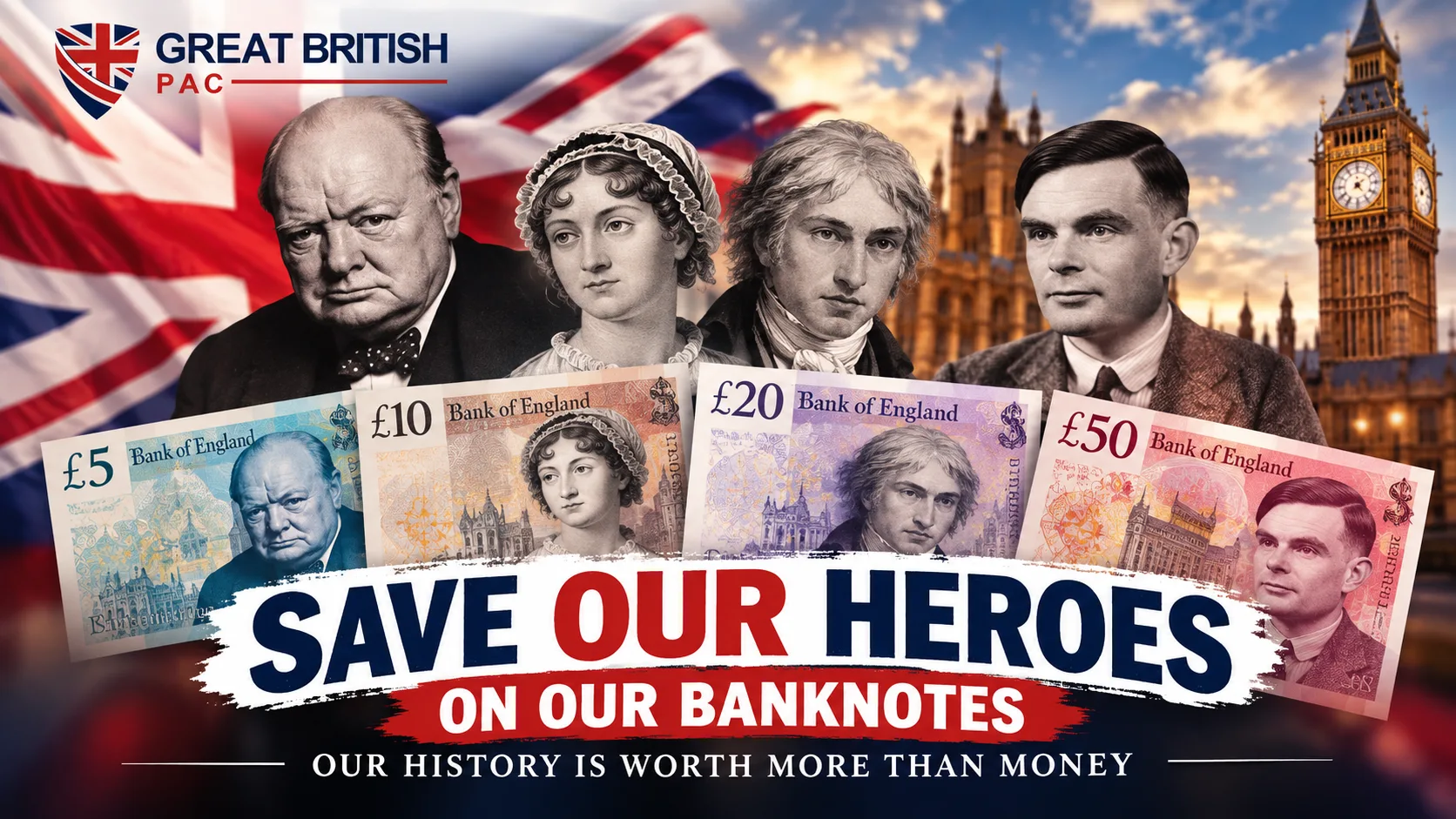
The Great British PAC has launched a national campaign to protect Britain's historic figures on its banknotes, writing directly to Bank of England Governor Andrew Bailey and submitting a formal Freedom of Information request over the decision to replace Winston Churchill, Jane Austen, JMW Turner and Alan Turing with images of British wildlife.
The organisation is demanding that the Bank reconsider its decision before the new designs are finalised, publish the evidence behind the move and explain whether members of the public were given a meaningful opportunity to object to the removal of some of Britain's most celebrated historical figures.
The intervention follows the Bank of England's announcement on Thursday, 8 October, that bumblebees, puffins, barn owls and hedgehogs have been selected to feature on the next generation of £5, £10, £20 and £50 banknotes.
The new designs will replace the historical portraits currently appearing on the reverse of the notes, bringing an end to a tradition of celebrating notable British figures that began with William Shakespeare in 1970.
The Great British PAC's new SAVE OUR HEROES campaign, carrying the message Our history is worth more than money, will seek answers about the decision-making process and encourage members of the public to share their experiences of the Bank's consultation.
Serious questions over public consultation
The Bank of England received more than 478,000 responses to its consultation on which animals should feature on the new notes. However, the Great British PAC is questioning whether the process adequately allowed people to oppose the removal of historical figures in the first place.
The Bank previously consulted on possible themes for future banknotes, with nature emerging as a popular choice. A subsequent consultation invited members of the public to select their preferred animals from a shortlist of 18 native species.
The Great British PAC argues that expressing a preference for wildlife is not necessarily the same as supporting the removal of Churchill, Austen, Turner and Turing.
The organisation is particularly concerned that the later consultation was structured around selecting animals rather than offering respondents a direct choice between retaining historical figures and replacing them.
It is now appealing for members of the public who attempted to object to the proposals, or who experienced difficulties registering their opposition, to come forward.
Anyone who tried to complain, contacted the Bank or felt unable to express their views through the consultation is being encouraged to email Info@GreatBritishPAC.com.
The organisation hopes to gather evidence of how objections were handled and establish whether those concerns were properly considered.
Formal letter sent to Andrew Bailey
Great British PAC Chief Executive Claire Bullivant has written directly to Bank of England Governor Andrew Bailey, calling for the decision to be reconsidered before the new banknote designs are finalised.
In the letter, she describes the removal of the historical figures as an extraordinary decision and raises concerns about the consultation process and the research used to inform the Bank's approach.
She argues that Britain should be able to celebrate its natural heritage without abandoning the recognition of individuals whose achievements have made an enormous contribution to the country and the wider world.
The letter states:
“Sir Winston Churchill helped lead this country through its darkest hour and to victory over Nazi Germany. Alan Turing's extraordinary work helped break enemy codes, shorten the Second World War and lay the foundations of modern computing. Jane Austen and JMW Turner are towering figures in British literature and art whose achievements are admired across the world.
“These individuals represent courage, ingenuity, creativity, sacrifice and national achievement. They are part of Britain's extraordinary contribution to civilisation, and their presence on our currency has been a fitting recognition of that legacy.”
The Great British PAC has asked the Governor to pause the finalisation of the new designs, reconsider the removal of historical portraits, publish the relevant consultation evidence and consider a further public consultation offering a clear choice between retaining historical figures, introducing wildlife or combining both.
It has also requested a meeting with representatives of the Bank to discuss the concerns.
Freedom of Information request submitted
Alongside the letter to Mr Bailey, the Great British PAC has submitted a formal request under the Freedom of Information Act 2000 seeking documents and records relating to the decision.
The request seeks to establish when the decision to remove historical figures was taken, who approved it and what evidence was used to justify the change.
It also asks for copies of the original consultation questionnaires, breakdowns of public responses, details of any objections received and internal records concerning the decision to restrict the later consultation to a shortlist of animals.
Further information has been requested about focus-group research commissioned by the Bank, including findings reported by The Telegraph that historical figures were considered by some participants to be “elitist and divisive”.
The newspaper reported that research obtained under Freedom of Information legislation included concerns that historical portraits represented a “backward-looking vision of the UK”.
The Great British PAC wants to establish how much weight was given to those findings and whether the Bank directly assessed public support for removing the existing historical figures.
The request also seeks details of expenditure on consultations, research and external advisers, alongside relevant decision-making records involving senior Bank officials.
Under the Freedom of Information Act, public authorities are generally required to respond within 20 working days, subject to applicable exemptions and extensions.
‘Our history belongs to the British people’
Claire Bullivant, Chief Executive of the Great British PAC, said:
“Britain has produced some of the greatest writers, scientists, artists and statesmen in history, yet we now find ourselves in the extraordinary position of seeing their portraits removed from our currency in favour of bumblebees and hedgehogs.
“We have absolutely nothing against British wildlife. Our countryside and native species are magnificent and deserve to be celebrated. But why on earth should celebrating a puffin mean removing Winston Churchill from the five-pound note?
“What concerns us just as much is the consultation process. People were asked which animals they preferred, but where was the clear opportunity to say they didn't want our historical figures removed in the first place?
“Choosing your favourite animal is not the same thing as voting to remove Churchill. The Bank of England needs to explain whether the public were ever directly asked that fundamental question.
“We have written to Andrew Bailey demanding that this decision be reconsidered, and we have submitted a Freedom of Information request to establish precisely what happened, who made the decision and how objections were handled.
“If members of the public tried to complain or object during the consultation, we want to hear from them. Did they find themselves being asked to choose an animal rather than being given the opportunity to oppose the proposals? Did they write to the Bank? Did they receive a response?
“We want to gather that evidence and get to the bottom of this.
“Churchill helped save this country from Nazi tyranny. Turing helped defeat the Nazi war machine. Austen and Turner helped establish Britain's extraordinary cultural legacy. These are people whose achievements should inspire future generations, not be quietly removed from our everyday national life.
“Our history belongs to the British people. It is something to be celebrated, not treated as an embarrassment.
“The Great British PAC will fight to save our heroes on our banknotes. Our history is worth more than money.”
Public urged to share their experiences
The Great British PAC is now asking anyone who attempted to oppose the removal of historical figures during the Bank of England's consultation process to get in touch.
The organisation is particularly interested in hearing from people who visited the consultation website but could not find an option to object, those who contacted the Bank directly and anyone who received correspondence explaining how their concerns would be considered.
Members of the public are encouraged to include the approximate date of their attempted objection and, where possible, copies of any correspondence or screenshots.
The organisation is also considering a national petition calling for the retention of Britain's historical figures on future banknotes.
Although the Bank has announced the four animals selected for the next series, the final designs have not yet been unveiled, with the new notes expected to enter circulation over the coming years.
The Great British PAC believes this provides an opportunity for the Bank to reconsider its approach before the designs are completed.
Anyone who attempted to object to the removal of Britain's historical figures from banknotes is asked to contact the Great British PAC at Info@GreatBritishPAC.com.
SIGN THE PETITION AT: greatbritishpac.com/campaigns/save-our-heroes
SAVE OUR HEROES — OUR HISTORY IS WORTH MORE THAN MONEY.