
Reform the Child Maintenance Service: Make Child Maintenance Fair for Both Parents
Led by Richard Thomson
National Director
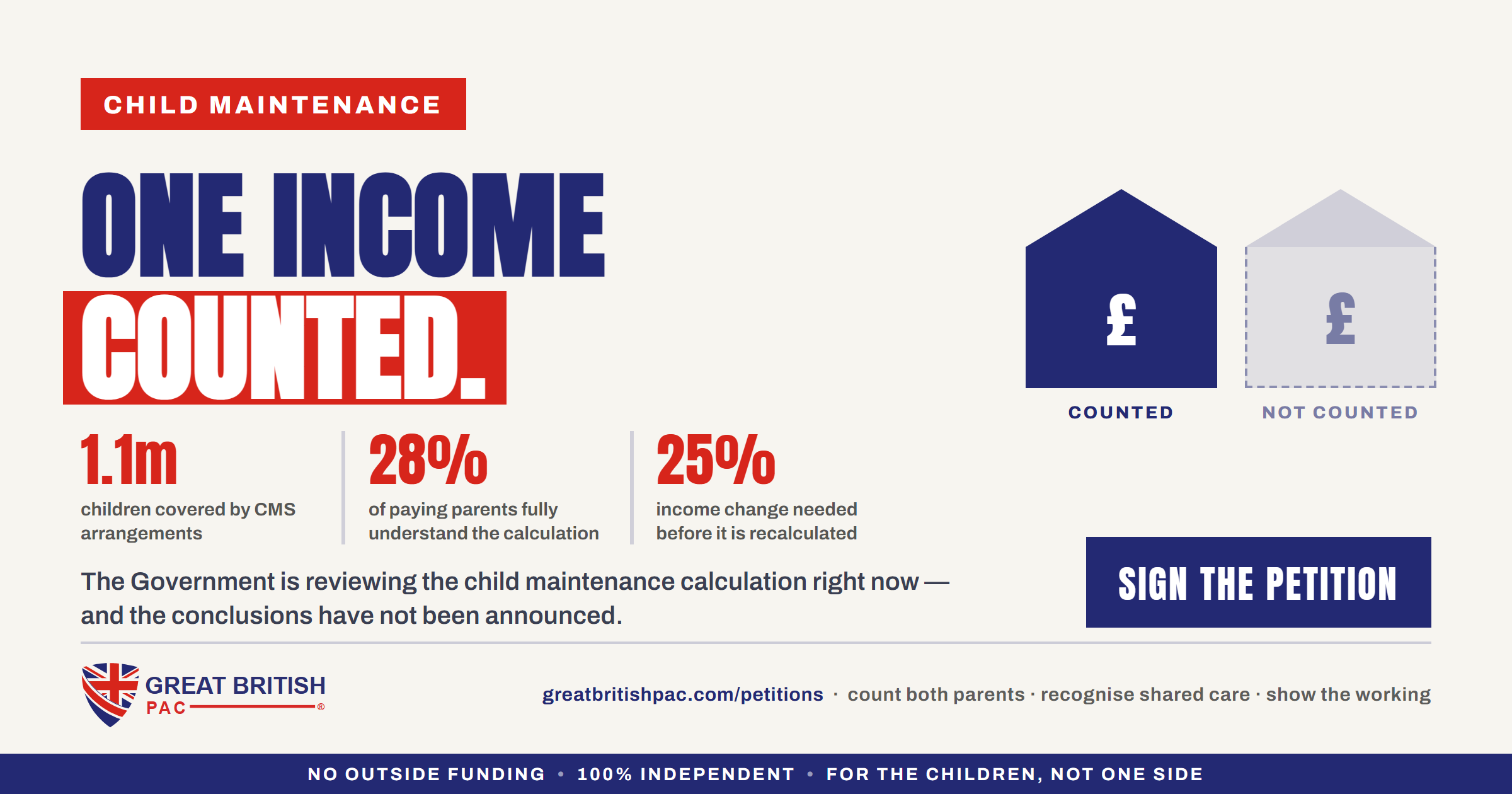
The Child Maintenance Service works out payments from one parent's income alone, takes no account of what the other household brings in, and generally only recalculates when income moves by 25% or more. The Government is reviewing that calculation right now. Sign for a system that counts both parents, recognises genuine shared care, and shows its working.
We demand
- 1
Take the income and financial circumstances of both parents into account, so responsibility for supporting children is assessed fairly.
- 2
Recognise genuine shared parenting: where children spend 156 nights or more a year with each parent, routine CMS payments should ordinarily cease unless exceptional circumstances apply.
- 3
Replace the arbitrary 25% income-change rule with a system capable of responding to material changes in either parent's financial circumstances.
- 4
Use more accurate and up-to-date income information, including greater use of real-time HMRC data.
- 5
Provide clear calculations, so both parents can understand exactly how an assessment has been reached.
- 6
Create faster routes for correcting mistakes and challenging inaccurate assessments.
- 7
Introduce properly independent oversight, and publish data on errors, complaints and the accuracy of CMS decisions.
The full petition
Britain's Child Maintenance Service needs fundamental reform. Children deserve financial security. Parents deserve a system that is fair, accurate, and reflects the reality of modern family life.
The principle behind child maintenance is simple and right: when parents separate, both have a responsibility to contribute towards the financial needs of their children. Almost nobody disputes that. What is disputed — by parents on both sides of the arrangement — is whether the system used to calculate those contributions still works.
It is a very large system. By March 2026 the Child Maintenance Service was managing 810,000 arrangements for 730,000 paying parents, covering 1.1 million children — 44,000 more children than a year earlier. Its own published statistics record £791.2 million in unpaid maintenance accumulated since the service began in 2012. A system that touches that many families cannot afford to be a byword for grievance. Today it is.
Only one parent's income is counted. The Child Maintenance Service works out payments from the paying parent's gross income, obtained from HM Revenue and Customs. The receiving parent's income does not enter the calculation at all. Whatever resources the two households actually have, only one of them is measured. We believe that is out of step with how families now live and work, and that it can produce outcomes which fail to reflect what each parent is genuinely providing.
Shared parenting should mean something. Where children spend 156 nights or more a year with each parent, both parents are running a home for them: heating, food, clothing, transport, school shoes, and a bedroom that stays theirs all year. Today that level of shared care reduces the calculation — by about 43% between 156 and 174 nights, and by half plus a further £7 a week at 175 nights or more. It reduces it. It does not end it.
We are asking for the principle to be followed through. Where genuine shared care of 156 nights or more a year is established, routine CMS payments should ordinarily cease, unless exceptional circumstances justify otherwise.
Then there is the 25% cliff edge. A parent's income can change substantially without the calculation changing at all. Under the current rules a change in gross income generally only triggers a new calculation if it moves by at least 25% — a tolerance that was 5% under earlier schemes. Below that line, an assessment can rest on money a parent no longer earns, or miss money they have started earning. Both are wrong, and they are wrong in opposite directions: one squeezes a household that cannot pay, the other short-changes a child who should be receiving more.
And too few people can see how their figure was reached. The Government's own research into the calculation, published on 4 June 2026, found that just 28% of paying parents said they fully understood how their maintenance was worked out. Parents told the researchers the service's communications lacked clarity. One put it plainly: "they don't give you a breakdown as to how they come to this conclusion." In the same research, 68% of receiving parents suspected the paying parent was earning more than had been declared.
That pair of findings is the heart of this. One side cannot follow the arithmetic. The other does not trust the income figure the arithmetic is built on. That is not really an argument between two parents — it is a failure of the system sitting between them, and it manufactures exactly the conflict a child maintenance system ought to be defusing.
The moment to act is now. The Government commissioned that research because it is reviewing the child maintenance calculation, and it has confirmed the 25% tolerance falls within the review's scope. In June 2026 the House of Lords Public Services Committee published its report on reforming the Child Maintenance Service, debated by peers on 8 June. The evidence is in. The conclusions have not yet been announced. What happens next is still to be decided — which is precisely why adding your name matters today rather than after the fact.
We are calling for a complete overhaul of the Child Maintenance Service, built on a simple idea: both parents have responsibilities to their children, and both parents' circumstances matter.
This is not a demand to pay less. It is a demand to pay the right amount — worked out from accurate, current information, in a way both parents can see, understand and check.
It doesn't matter which side of an arrangement you are on. A service that reduces conflict between separated parents instead of generating it is better for receiving parents, better for paying parents, and better for the children whose security is the entire point of it. The current system does not adequately reflect the way thousands of separated families now live.
It is time to bring the Child Maintenance Service into the 21st century.
Nobody has paid for this campaign. This petition has received no funding from any company, law firm, campaign group or third party — not a penny. It is an entirely independent initiative of the Great British PAC.
Children deserve financial security. Parents deserve fairness. The Government should deliver both.
Make your voice count. Sign this petition and demand a fairer, more transparent and child-focused Child Maintenance Service.
Stand up for children, fairness and responsible parenting. Thank you.
Promoted by Great British PAC, greatbritishpac.com, on behalf of the Great British PAC. This petition is entirely independent and has received no funding from any company, law firm, campaign group or third party.