
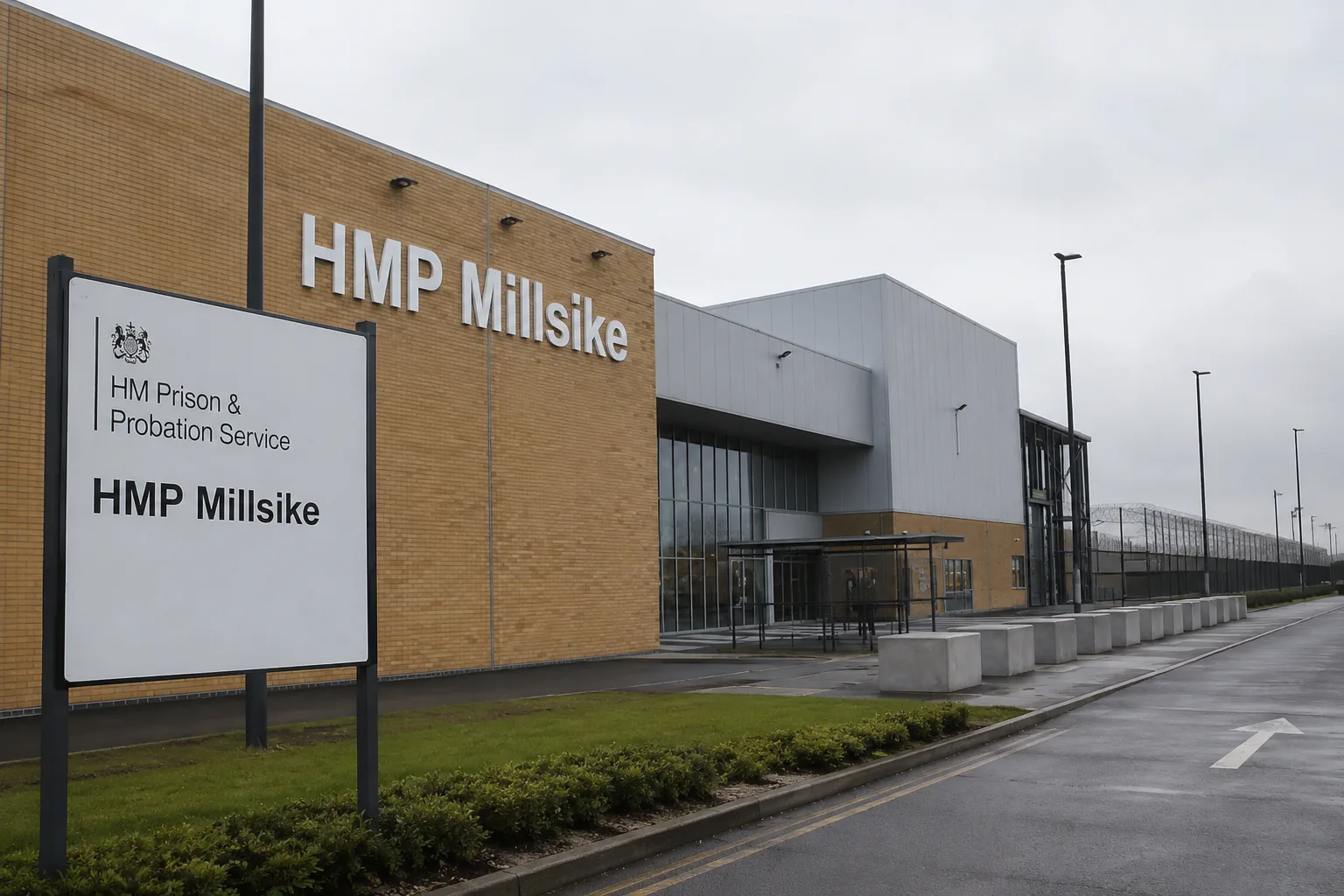
A £400 million flagship jail built to relieve Britain's prison crisis is holding almost 350 inmates below its safe capacity, because it cannot recruit enough staff, even as the government presses ahead with an early release scheme that will free hundreds of convicted killers, including two of the men jailed for the manslaughter of Pc Andrew Harper.
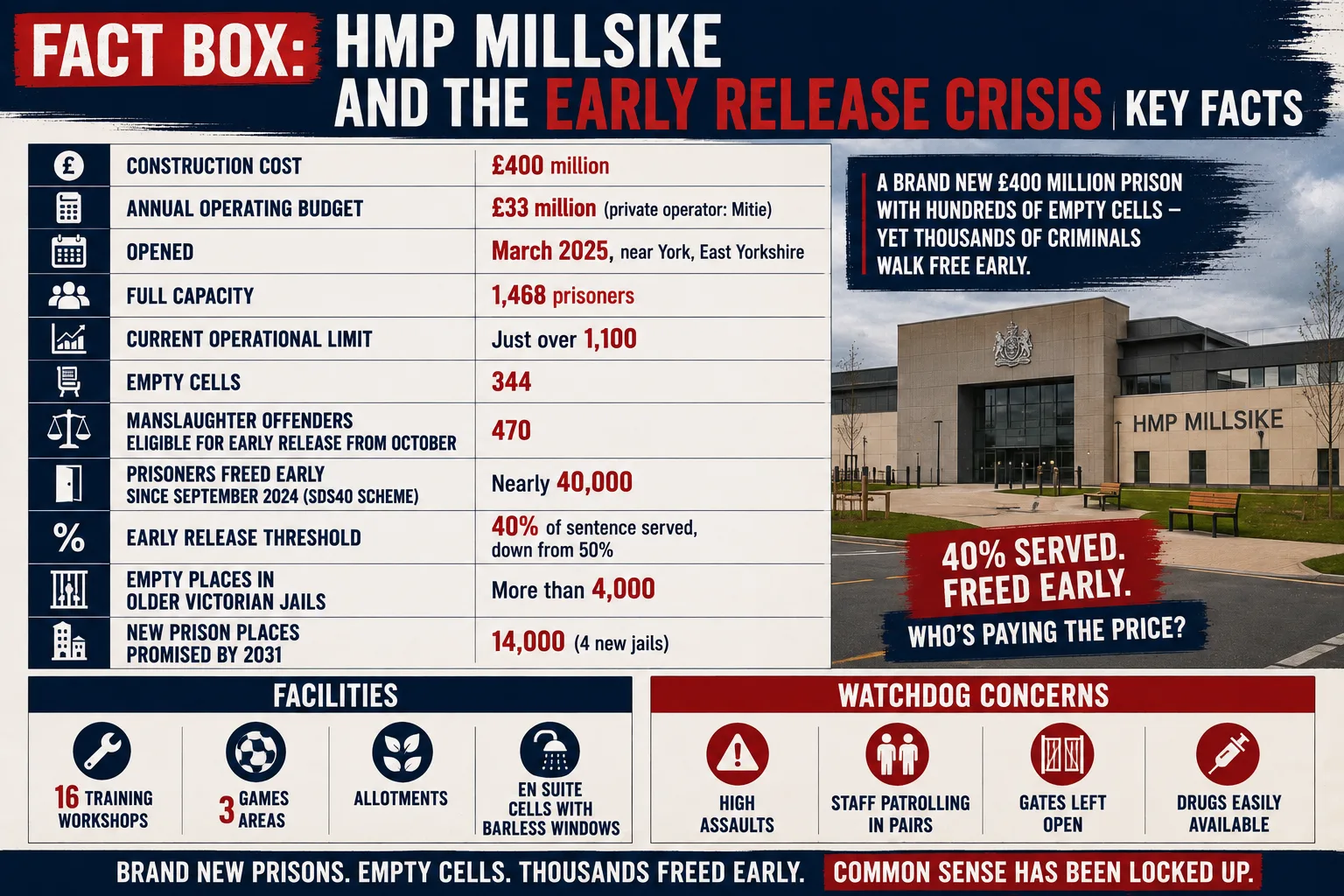
Britain's newest "super prison", HMP Millsike, was supposed to be the gleaming answer to the most acute overcrowding crisis in the history of the English and Welsh prison estate. Built at a cost of £400 million on land next to HMP Full Sutton near York, and operated by the private contractor Mitie under a £33 million a year budget, the category C resettlement jail began taking inmates in March 2025 as the first of four new prisons intended to deliver 14,000 additional places by 2031, a centrepiece of what ministers call their Plan for Change.
Yet almost a year and a half after opening, the prison has space for nearly 1,500 prisoners but is operationally restricted to just over 1,100. As of last month, 344 of its cells stood unoccupied, judged unsafe to fill with the current complement of officers. The revelation, first reported by The Telegraph, lands at a moment of maximum political toxicity, because those 344 empty beds could, in theory, accommodate the majority of the 470 people currently imprisoned for manslaughter who become eligible for early release from October under the government's controversial scheme to ease overcrowding.
A staffing bath with the plug out
The root cause is not bricks and mortar but people. A senior prison source described an establishment trapped in the same recruitment spiral afflicting the entire estate. "Millsike has been struggling to staff the prison," the source said. "They have reached the point where they have got all the staff they can recruit to safely operate at a reduced number of spaces but they are struggling to get above that. They are experiencing what most prisons are facing. We are recruiting people, training them, then they are leaving. It is a bit like a bath where the taps are on full but you have the plug out, so you are constantly struggling to keep staff levels up."
The problem extends well beyond East Yorkshire. Prison governors say renovated cells and even entire wings at other jails remain mothballed for want of officers. "I can think of jails where we have closed a wing for upgrade work but cannot reopen it because we have not got enough staff," one governor said. Older Victorian prisons account for more than 4,000 further empty places, shut for maintenance, fire safety work or health risks. Taken together, Britain is simultaneously releasing prisoners early for lack of space and leaving thousands of existing spaces unused, an absurdity that critics say exposes the crisis as one of management and political will rather than concrete.
A troubled beginning
Millsike's difficulties are not confined to recruitment. The jail has had a turbulent start that has repeatedly delayed the "ramping up" of its population towards the full complement of 1,468. New prisons do need to increase numbers steadily to avoid destabilisation, but experts say full operation should have been achieved within six months, or a year at most.
Instead, in January The Telegraph revealed that the prison's own watchdogs had expressed "serious concerns". Assault levels were so high that members of the Independent Monitoring Board said they only felt safe walking the landings in pairs. Ten months after opening, doors and gates were being left open by staff and drugs were easily available, findings later echoed in BBC reporting on safety and security warnings at the jail. The prison's director was replaced after less than a year, as the BBC reported.
All of this sits uncomfortably beside the prison's much trumpeted rehabilitative design, described by its operator Mitie as placing rehabilitation "at its heart". The cells are the most modern in the system, with bar less reinforced windows and en suite showers and toilets. There are allotments where prisoners grow vegetables and flowers, three multi use games areas with outdoor gym equipment, and 16 training workshops where up to 500 inmates at a time can learn bricklaying, carpentry, waste management, or how to work as a barista or barber. Ministers have hailed these facilities as the answer to reoffending. The question now being asked is whom, exactly, they are rehabilitating, and at what price, when hundreds of the places stand empty.
The Harper case and the politics of early release
The empty cells have acquired their sharpest political edge through the case of Pc Andrew Harper, the Thames Valley Police officer dragged to his death behind a car in August 2019, weeks after his wedding. Two of his killers, Jessie Cole and Albert Bowers, jailed for 13 years for manslaughter in 2020, are among those set to benefit from the early release scheme, as The Independent and the BBC have reported. All of the UK's police chiefs signed a joint letter last week demanding that Andy Burnham do everything possible to stop their release.
Burnham has ordered his Justice Secretary, Alex Norris, to devise a way to keep Cole and Bowers behind bars. The Ministry of Justice has warned, however, that it cannot exempt specific offenders without also holding every other prisoner convicted of the same offence, which is precisely where Millsike's unused capacity enters the equation. The Prime Minister wrote in The Telegraph that he had "pushed to the very limits of what is possible" by preventing 1,000 rapists and child sex groomers from being released early, yet days later Burnham conceded it was "incumbent" on him to "do everything within my power" to stop Cole and Bowers walking free.
The wider scheme, known as SDS40, allows eligible prisoners to be released on licence after serving 40 per cent of their sentence rather than 50 per cent, a mechanism explained in detail by the Institute for Government and assessed in an impact report by Skills for Justice. Nearly 40,000 prisoners have already been released early under emergency measures launched in September 2024, according to the BBC. In Parliament, the scheme has drawn fury from across the chamber, with one MP telling the Commons: "I am absolutely astonished that those incarcerated for raping children are not excluded from this early release scheme."
"What is the worth of such an expensive super prison?"
For campaigners, the empty cells at Millsike crystallise everything wrong with the government's approach. The Great British PAC says no to this waste of logistics, pointing out that murderers and rapists are walking free under the early release scheme while a £400 million jail runs at barely three quarters of its safe capacity. Their question cuts to the heart of the matter, what is the worth of such an expensive super prison, when Britain's worst criminals can still walk free because the prisons are too crowded?
Ian Acheson, a former governor who advised previous governments on extremism in jails, argues the solution lies in political nerve rather than new construction. He has called on Burnham to establish a "national emergency taskforce" with executive authority to override the MoJ and create space in existing accommodation. "I am convinced that additional capacity could be found to stop repeat knife carriers and domestic abusers being released early," he said. "But it takes political will, urgency, imagination and some risk taking."
The MoJ insists staffing is only one of several factors governing how quickly Millsike fills, alongside safety, security, stability and the establishment of its regime, and says capacity will increase "when operationally appropriate to do so". A spokesman added: "We are working at pace to bring every available prison place online, and have always been clear that new prisons require a ramp up period to ensure they remain safe, secure and protect the public. We are also exploring how we can go further to increase capacity, including faster deportation of foreign criminals, better use of the women's estate and reviewing the unjust imprisonment for public protection sentences." Mitie, for its part, said the prison "continues to operate in line with the ramp up plans agreed with the MoJ" and remains "focused on maintaining a safe, secure and supportive environment for prisoners and colleagues".
The arithmetic of failure
The numbers, in the end, speak for themselves. Four hundred million pounds of public money, £33 million a year in operating costs, 344 empty modern cells, more than 4,000 further places shuttered in older jails, 470 convicted manslaughter offenders becoming eligible for release, and close to 40,000 prisoners already freed early since September 2024. Britain has built a prison it cannot staff, closed cells it cannot reopen, and chosen to release killers rather than confront the shortfall.
Whether Burnham's intervention on behalf of Pc Harper's memory produces anything more than another review remains to be seen. What is already clear is that the crisis is no longer one of capacity on paper. It is a crisis of governance, in which the state has proven better at building prisons than at running them, and better at releasing offenders than at keeping its promises to their victims.