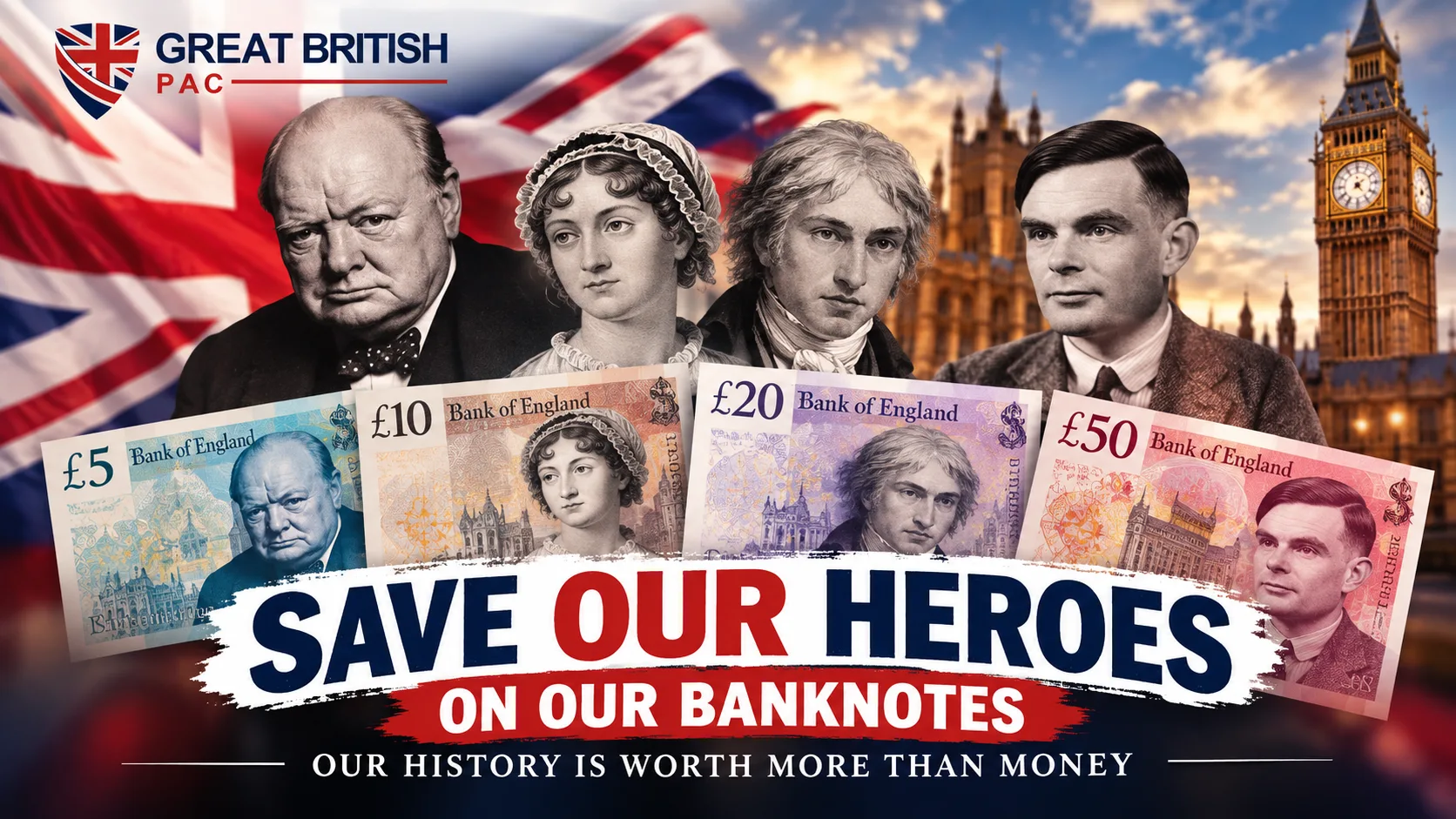
The Bank of England has confirmed that a puffin, barn owl, bumblebee and hedgehog will replace four of the most extraordinary figures in British history on the reverse of our £5, £10, £20 and £50 notes.
And we at the Great British PAC believe the British public has every right to be furious.
Not because we have anything against Britain's magnificent wildlife, but because a centuries-old institution, under the leadership of Governor Andrew Bailey, has made a decision about our national heritage without giving the public a straightforward opportunity to say whether it agrees.
This is not simply a row about banknote designs. It is about transparency, accountability and whether the British public has been genuinely consulted or merely invited to endorse a decision already heading in one direction.
Nearly half a million responses, but the crucial question was never asked
The Bank is celebrating the fact that 478,531 people responded to its wildlife consultation, making it the largest banknote imagery consultation it has ever conducted.
That sounds impressive. Until you examine what people were actually asked.
In July 2025, the Bank invited the public to nominate preferred themes for future banknotes. Nature received nominations from 60 per cent of respondents, while notable historical figures received 38 per cent.
But these were preferences for themes, not a direct referendum on whether the existing portraits should be removed.
Then, between June and July 2026, the Bank launched another consultation, this time asking people to choose their favourite animals from a shortlist of 18.
A hedgehog or a fox? A barn owl or a kingfisher? A bumblebee or a butterfly?
What the consultation did not offer was a clear choice between retaining our historic national figures and replacing them with wildlife.
Choosing your favourite animal is not the same as voting to remove Winston Churchill.
It really is that simple.
Yet the Bank is now presenting the enormous response to its wildlife consultation as evidence of public engagement with the decision.
We believe that risks creating a deeply misleading impression of public consent.
The public was consulted about which animals it preferred. It was not directly asked whether it wanted to lose Churchill, Austen, Turner and Turing.
Those are two entirely different questions.
Andrew Bailey made the final decision. He must take responsibility.
Perhaps the most extraordinary aspect of this affair is that the Bank's own consultation documents confirm that Andrew Bailey, the Governor of the Bank of England, would make the final decision, taking public feedback into account.
This was not an unavoidable administrative consequence of upgrading our banknotes.
It was a choice.
And Mr Bailey should explain why the British public was not offered an explicit opportunity to vote against removing the historical figures.
He should also explain why the Bank considers its consultation sufficient to justify abandoning more than half a century of celebrating British achievement on our currency.
The Bank has legitimate responsibilities to ensure that banknotes remain secure, accessible and difficult to counterfeit.
We fully support those objectives.
But we reject the suggestion that modernising our currency must automatically mean removing the people who helped shape our country.
Surely the Bank of England possesses the ingenuity to introduce modern security features without discarding some of Britain's most recognisable national heroes?
Britain helped pioneer the modern world through its science, literature, engineering, innovation and leadership.
We should be celebrating those achievements, not treating the people behind them as disposable decorations.
Churchill, Austen, Turner and Turing are not expendable
Consider who is being removed.
Sir Winston Churchill, whose leadership during the Second World War helped Britain withstand Nazi Germany and ultimately emerge victorious alongside our allies.
Jane Austen, one of the most celebrated novelists in English literature, whose works continue to be read across the world.
JMW Turner, a towering figure in British art whose paintings helped transform landscape painting.
And Alan Turing, the brilliant mathematician whose wartime codebreaking work contributed to the Allied victory and whose ideas helped lay the foundations of modern computing.
These are not random faces selected to fill empty space.
They represent British courage, creativity, intelligence, determination and achievement.
They tell the story of a nation whose contributions to the world have been extraordinary.
And they remind future generations of what British people are capable of accomplishing.
Why should we surrender that opportunity?
Our wildlife is wonderful. Our countryside is beautiful. Our natural heritage deserves protection and celebration.
But Britain is perfectly capable of celebrating a puffin without removing Churchill.
We do not need to erase one part of our national identity to celebrate another.
A consultation that raises serious questions
The Bank's approach becomes even more troubling when one considers reporting by The Telegraph about research commissioned during the process.
According to the newspaper, documents obtained under the Freedom of Information Act revealed that focus group participants had described historical figures as "elitist and divisive".
The Telegraph also reported that £22,500 had been spent on public consultations concerning the choice of animals.
We want to know precisely how such research influenced the Bank's decision.
Were concerns about historical figures being controversial or insufficiently representative allowed to influence the direction of the redesign?
How were opposing views considered?
And why was there no direct question asking whether the British public wanted to retain the portraits?
These are legitimate questions about a public institution exercising significant discretion over a national symbol.
We believe Andrew Bailey and the Bank of England owe the public proper answers.
We have written to Andrew Bailey and demanded action
At the Great British PAC, we are not prepared to stand by while this decision goes unchallenged.
We have launched our Save Our Heroes on Our Banknotes campaign and written directly to Andrew Bailey, calling on him to reconsider the decision before the new designs are finalised.
We have also submitted a Freedom of Information request seeking the evidence behind the consultation process, including the questionnaires, response breakdowns, records of objections, expenditure and internal decision-making documents.
We want to establish exactly what the public was asked, what opportunities existed to oppose the removal of historical figures and how the Bank arrived at its conclusions.
We are calling for five immediate steps:
Retain Churchill, Austen, Turner and Turing on Britain's banknotes.
Pause the finalisation of the new designs while the decision is reconsidered.
Conduct a genuine public consultation offering an explicit choice between retaining historical figures and replacing them.
Publish the evidence, consultation results and reasoning underpinning the decision.
Recognise the importance of protecting the historical and cultural heritage represented by our currency.
These are reasonable demands.
They are demands for openness, accountability and respect for the British public.
There is still time to reverse this decision
The Bank has confirmed that the next generation of notes remains several years away.
The animals have been selected, but the detailed designs have not been finalised and no launch date has been announced.
There is therefore still an opportunity for Andrew Bailey to reconsider.
We are calling on him to do precisely that.
The Bank of England is one of Britain's most important national institutions. It should be a guardian of public confidence, not a source of unnecessary controversy over our national identity.
And when hundreds of thousands of people are invited to participate in a consultation, they deserve to be asked the question that actually matters.
Not simply which animal they like best.
But whether they want Britain's greatest historical figures removed from their money.
Help us Save Our Heroes
We are asking everyone who believes Britain's history deserves to be celebrated to support our campaign.
Sign our petition, share our message and make your voice heard.
We also particularly want to hear from anyone who tried to object to the removal of historical figures during the Bank's consultations but could not find a clear way to register that objection.
Your experience could help us establish whether the consultation provided a meaningful opportunity for dissenting views to be heard.
Andrew Bailey must understand that Britain's banknotes belong to the nation, not to the personal preferences of those who happen to run the Bank of England.
Our history is not an embarrassment to be quietly put away.
It is an inheritance to be celebrated, defended and passed on to future generations.
We can celebrate British wildlife WITHOUT erasing British history.
Our history is worth more than money.
Support the Great British PAC's Save Our Heroes on Our Banknotes campaign and sign our petition today.