
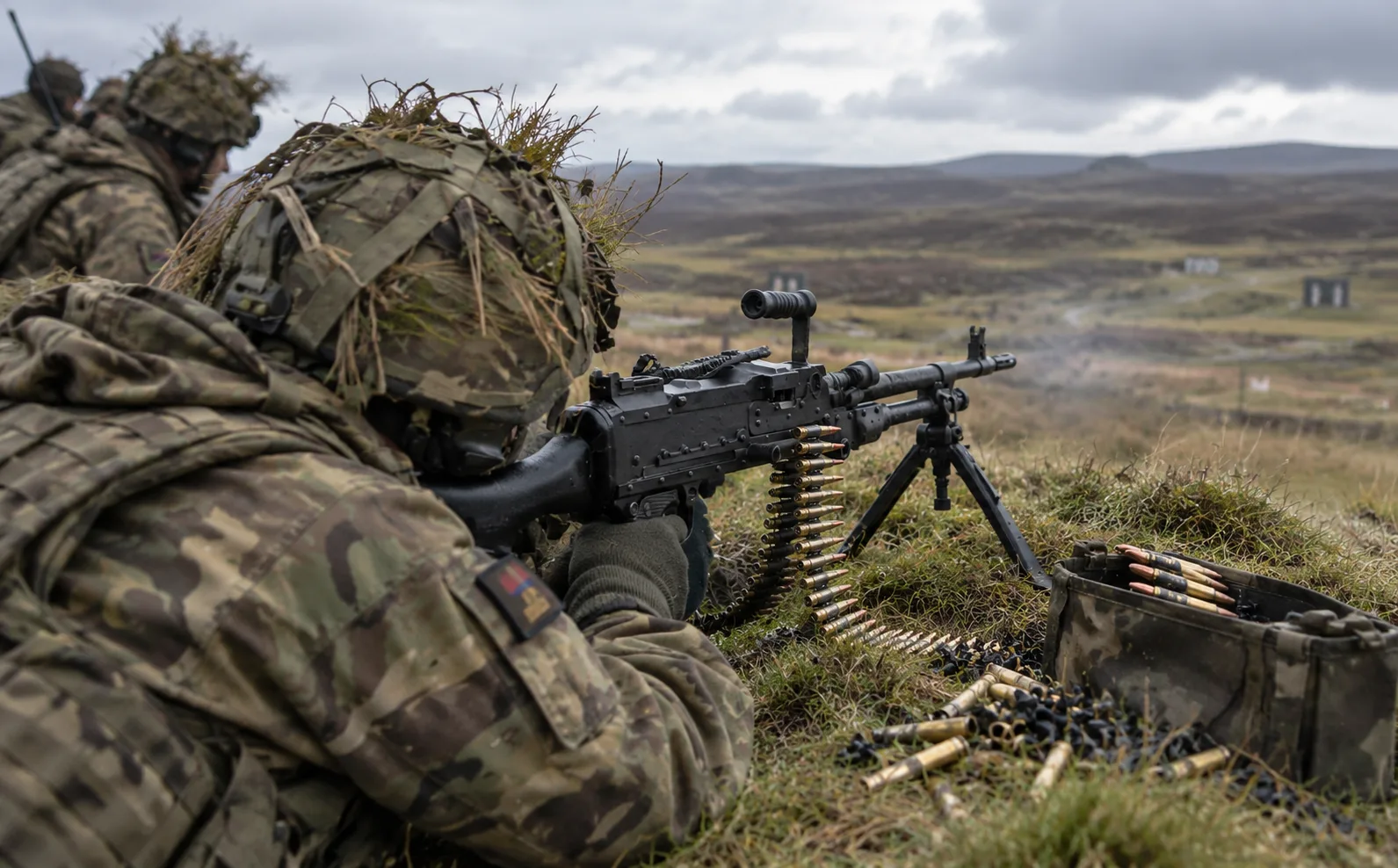
Part of the 95,000-strong Strategic Reserve is to be exercised next year on a scale not seen for a long time, even as serving Army reservists are told to cut training days to save money.
Britain is to test its ability to call former service personnel back into uniform, with part of the approximately 95,000-strong Strategic Reserve drilled next year on a scale "we haven't seen for a long time".
The exercise, disclosed by Louise Sandher-Jones, the Armed Forces minister, will test whether retired troops can be recalled, equipped and used in a crisis or wartime mobilisation. It is not a call-up of the entire reserve: the number taking part has yet to be determined, and the plans are understood to still be finalised.
Revealing the plans to the House of Lords National Resilience Committee, Ms Sandher-Jones said: "The strategic reserve is a real commitment for those that are in it and they will be exercised as part of our exercise programme next year where we will go through measures to call out, use, equip and all the rest of the procedures we'd have to go through to use the strategic reserve properly."
A retired Army officer and herself a member of the reserve, she said the network of former troops would have a crucial role in defending the country, but conceded it had been "a lot less used in my lifetime". "When I left the Army and found out I was in the strategic reserve, I just filed it away and never thought about it again. We are definitely no longer in that space," she said.
The plans come amid warnings that Russia could pose a direct military threat to NATO members within the coming years. Moscow has threatened to attack British factories building drones for Ukraine, and Western intelligence officials have warned that Vladimir Putin is waging a sabotage campaign that could end in a "miscalculation" that triggers war.
The mobilisation plan comes with an awkward contradiction. While ministers prepare to test whether former troops can be brought back in greater numbers, the Ministry of Defence is asking the Army's existing volunteer reserve to do fewer days.
The Telegraph understands that Army Reserve commanding officers have been briefed to make in-year savings, with reservists losing an average of four to six days of service between now and the end of the year. The reductions hit training and other work, including tasks connected with defending the nation's critical national infrastructure and cyber warfare. Both the RAF and Royal Navy reserves have also been instructed to find in-year savings, although the Army Reserve is expected to be hardest hit.
The timing makes the cut more painful than the numbers suggest. An Army reservist typically serves a minimum of 27 days, and the annual camp, which accounts for the largest block of service days, has already taken place, so the remaining reduction falls across a much smaller number of days.
A military source said: "There is no such thing as just 'training'. It is about maintaining a credible deterrent and ability to deploy force at readiness. It is impossible to do this with a regular and reserve Army sitting on its rucksack."
The two pools of personnel are easily confused. The Strategic Reserve is made up of former regulars who retain a legal liability to be recalled; the Volunteer Reserve is made up of serving part-timers who train and contribute to military tasks now, of whom there are around 32,000 across the three services.
Steve Barclay, a former Conservative cabinet minister, questioned how the Government could talk up the national threat while cutting the reserves. He told The Telegraph: "In his first Prime Minister's Questions, Andy Burnham said he chose a Chancellor who is prioritising defence. So how is it that a time when the Prime Minister is warning the national threat has increased and we need to build more resilience, cuts are being made to the reserves which directly support operational output and are an important part of the country's national resilience?"
Last week Mr Barclay tabled a written parliamentary question to Wes Streeting, the Defence Secretary, asking whether a decision had been taken on any change to reserve service days in 2026-27. In a written reply, Calvin Bailey, a defence minister, said the Army did not set a number of reserve service days and that any allocation varied by reservist. Mr Barclay accused the Government of "brushing off" the issue.
Lord de Mauley, chairman of the Council of the Reserve Forces and Cadets Associations, said the cuts sent a clear message to serving reservists: "It says: you don't matter. What does that do for morale and recruitment of people?"
The Ministry of Defence said:
"The Reserves make a significant contribution to the defence of the country bringing specialist skills which form a critical part of our whole force. Their training continues as we prioritise activity which contributes most directly to readiness, deployability and operational effectiveness. Reservists do far more than train: they contribute directly to operational effectiveness at home and overseas, and those priority commitments will continue to be protected."
Richard Thomson, National Director of the Great British PAC and Former Royal Marine, said the Government's approach exposed a wider contradiction in its defence policy.
"This is performative nonsense.
If the Government genuinely believes Britain could be facing a major conflict by 2030, then act like it. You don't prepare for war by cancelling Army training to save money, running down our fighting strength and promising 3.5% of GDP on defence by 2035.
If the threat is as serious as ministers tell us, we should be talking about defence spending closer to 5% and rebuilding our Armed Forces now, not in another decade. And perhaps you don't give away strategically vital British territory in the Chagos Islands while claiming national security is your priority.
Westminster has spent years dragging former servicemen through investigations and courtrooms over conflicts they were sent into by politicians. Now those same politicians want to know whether 95,000 veterans can be recalled when the country needs them.
Veterans will answer the call. That's what they do.
But here's an idea. Back them in peace if you expect them to defend you in war.
National security isn't a just a headline. Either prepare Britain to fight or stop pretending you are."
Separately, parts of the regular Army are also being asked to find savings, with training for some full-time soldiers in the Army's 3rd Division restricted and live-firing drills reportedly suspended until April to save money. John Healey, the Chancellor, is expected to stop short of committing to 3 per cent of GDP on defence by 2030 in his first Budget, a decision that has put the Prime Minister, Andy Burnham, under scrutiny over Labour's military spending plans. The Government has previously pledged, alongside other NATO members, to raise core defence spending to 3.5 per cent of GDP by 2035.
The state of the standing Army explains the urgency. At about 71,000 full-time, fully trained soldiers, the regular Army is at its smallest size for more than 200 years, and the reserves increasingly carry out work that the regulars do not have the capacity to fulfil. There are early signs of a turnaround: the MoD said last week that more people joined the full-time forces than left over a full year, the first such result since 2021. The gains are modest, with the Army up by 170, the RAF by 840, and the Navy and Royal Marines by 440.
The Government is also changing the rules on who can be recalled. Recall liability varies according to rank, service and circumstances. Former regular and reserve officers can retain liability for life, while other former personnel can remain liable for a period after leaving service, and the Ministry of Defence is required to maintain contact with former staff during their first six years out of service. The new Armed Forces Bill will expand the circumstances in which former personnel can be recalled, including raising the maximum recall age for certain veterans from 55 to 65, aligning the period of liability across all three services, and lowering the threshold for recall from "national danger, great emergency or attack in the UK" to "war-like preparations", the test already applied to reservists who have recently left the forces. Former personnel whose recall liability has already expired will not be affected. The changes take effect in spring next year.
The exercise matters because officials do not know where many of these veterans are. Lord Robertson of Port Ellen, who led the strategic defence review, has said defence officials did not "know where most" of these reservists were, and called on the Government to "round up those who are available and fit and willing". The Chief of the Defence Staff, Air Chief Marshal Sir Richard Knighton, has warned that Britain lacks an "effective system of tracking and engaging" those who have recently left the military.
The exercise will test whether the recall machinery still works. It will not answer the harder question: whether a country that is cutting training days for serving troops and reservists has the resources to find, equip and effectively use thousands of former personnel when a crisis comes.