
As official statistics confirm unprecedented change, the argument over immigration is being poisoned from two directions, conspiracy theorists on one side, and an establishment that brands all concern as extremism on the other
LONDON, The argument about immigration in Britain has collapsed into a shouting match between two falsehoods. On one side stand those who claim that demographic change is the product of a hidden conspiracy, orchestrated, in the ugliest and most persistent version of the claim, by Jews. On the other side stands a political and media establishment that treats virtually any expression of concern about migration levels as evidence of extremism. Between these two positions, the facts sit largely undisturbed, and the majority of the British public sits largely unheard.
This article examines what the official record actually shows, how the conspiracy theory diverges from it, and why the distinction between the two has become the most contested ground in British politics.
What the official statistics show
The demographic transformation of the United Kingdom over the past quarter century is not a projection, a forecast, or an internet rumour. It is documented in the government's own data.
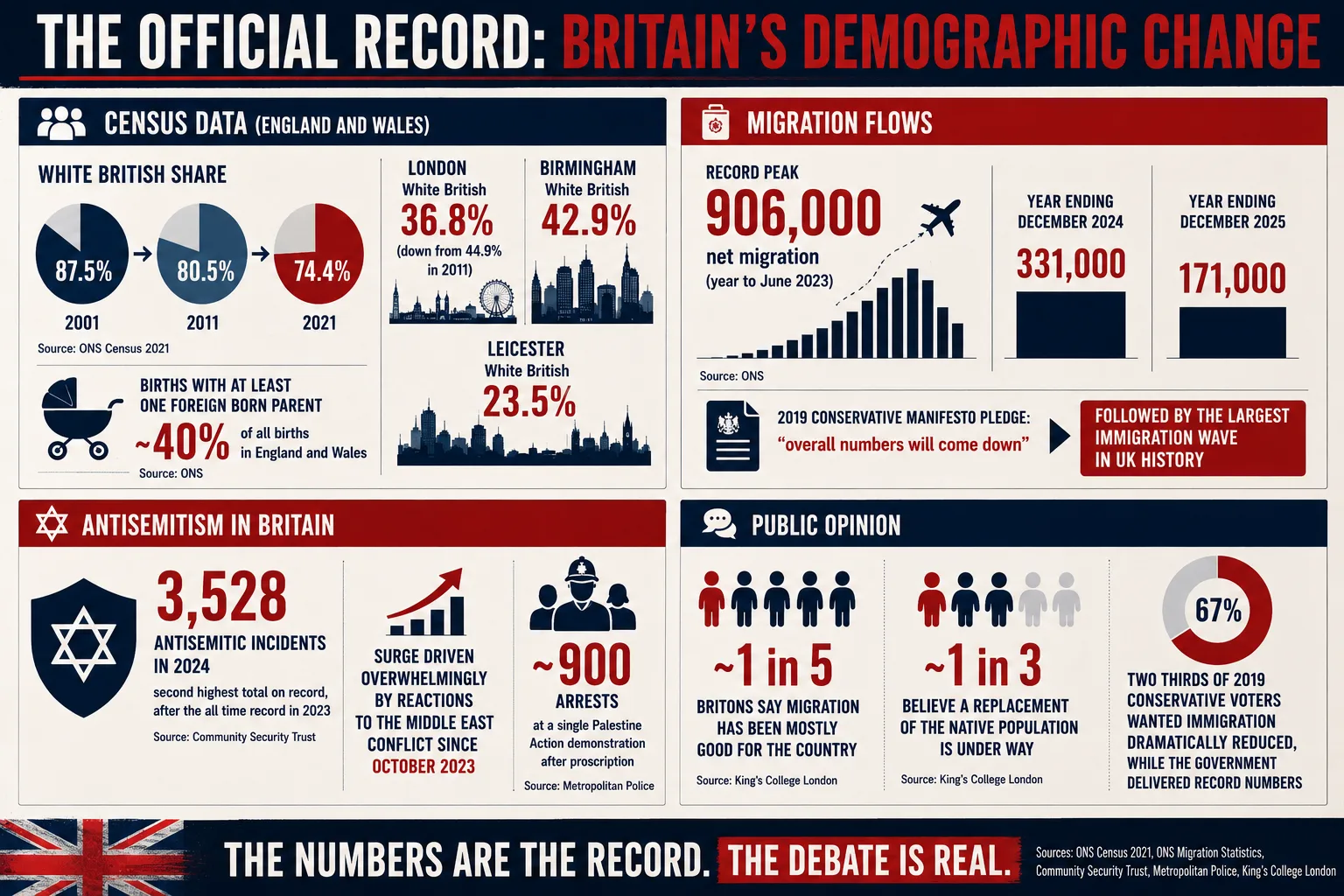
According to the 2021 Census published by the Office for National Statistics, the White British population of England and Wales stood at 74.4 per cent, down from 80.5 per cent in 2011 and approximately 87.5 per cent in 2001. In London, White British residents account for 36.8 per cent of the capital's population, down from 44.9 per cent a decade earlier. In Birmingham the figure is 42.9 per cent, in Leicester 23.5 per cent. The ONS further reports that around 40 per cent of babies born in England and Wales now have at least one parent born outside the United Kingdom.
On migration flows, net migration peaked at 906,000 in the year to June 2023, the highest figure ever recorded, before falling to 331,000 in the year ending December 2024 and 171,000 in the year ending December 2025, according to the ONS. Even after that decline, the cumulative effect of two decades of historically high inflows has reshaped the country's demographic profile in a way no British government ever placed before the electorate as an explicit choice.
These figures are not contested. What is contested, ferociously, is what they mean, and who is permitted to discuss them.
Where the conspiracy theory departs from the facts
The so called Great Replacement Theory, in the form popularised by American broadcaster Tucker Carlson and a network of online influencers, takes these observable trends and attaches to them a fabricated cause, the claim that mass migration is deliberately engineered by Jewish interests to erode white European populations. Carlson's recent suggestion, made without evidence, that Israel was "using mass migration as a weapon" against European governments, is a representative example.
The claim fails on its own terms. Israeli prime minister Benjamin Netanyahu has publicly warned that mass migration threatens Western nations, referring to the UK as risking becoming "the first Islamic republic with nuclear weapons", a position difficult to reconcile with the allegation that Israel orchestrates the phenomenon. The actual drivers of British migration policy are extensively documented and thoroughly mundane, economic demand for labour, skills shortages, university funding models reliant on foreign students, and a cross party political consensus that treated migration primarily as an economic lever.
Tony Blair told the CBI in 2004 that "our strong and growing economy needs migration to fill these vacancies". His former adviser Andrew Neather later wrote that the policy was partly intended to "rub the Right's nose in diversity". Subsequent home secretaries and prime ministers, from David Blunkett and Gordon Brown through Theresa May, Boris Johnson and Rishi Sunak, made similar economic arguments. None of this required a hidden hand. It required only a political class that preferred easy growth figures to harder questions about training, productivity, and social cohesion.
The conspiracy theory is not merely wrong, it is dangerous. It was cited in the manifestos of the murderers responsible for the Christchurch mosque attacks, the Tree of Life synagogue shooting in Pittsburgh, and the Buffalo supermarket massacre. Antisemitism of this kind is a poison that discredits every legitimate question it touches, and any movement that tolerates it forfeits its claim to speak for the national interest.
The moral distinction the debate keeps losing
This is the point at which the public conversation most often breaks down, and where clarity matters most. The distinction is best stated plainly, in the formulation adopted by the Great British PAC.
This is not an argument about the colour of someone's skin, where their grandparents were born, or whether somebody "looks British". Millions of black and Asian Britons are every bit as British as anyone else. They represent the country on the athletics track, serve in the Armed Forces, work in the NHS, build businesses, raise families, and contribute to the communities everyone calls home. Britain's Jewish community, small in number but woven into the national story for centuries, is an integral and valued part of that story, and antisemitism has no place whatsoever in British patriotism.
Equally, Britain has always benefited from people who arrive legally, work hard, integrate, and embrace the country as their home. The argument that millions of voters are actually making, and that polling consistently reflects, is not with those people. It is with governments that have allowed immigration to reach levels the country cannot reasonably absorb, too often without the consent of the people they govern.
There is an enormous moral difference between opposing people because of who they are, and questioning a government's immigration policy. The first is racism. The second is democracy. A political culture that cannot tell the difference will continue to produce two toxic outcomes at once, genuine extremists who hide behind legitimate concerns, and a genuine majority whose legitimate concerns are dismissed as extremism.
The establishment's double standard
The charge of hypocrisy against the media and political establishment rests on a documented asymmetry, not on party preference.
Consider the response to different forms of antisemitism. When figures associated with right wing populism use phrases such as "demographic replacement", the coverage is extensive and the condemnation instant, often without distinguishing between those describing census data and those propagating conspiracy. Yet the largest wave of antisemitic incidents in modern British history has come from a different direction entirely. The Community Security Trust recorded 3,528 antisemitic incidents in 2024, the second highest annual total on record, exceeded only by 2023, when incidents surged following the Hamas atrocities of 7 October. The overwhelming driver of that surge was reaction to the Middle East conflict, concentrated in constituencies associated with progressive activism and Islamist politics, not the traditional far Right.
Since October 2023, central London has hosted repeated mass marches at which proscribed terrorist organisations have been openly glorified. When Palestine Action was proscribed, the Metropolitan Police arrested nearly 900 people at a single demonstration, an event that received a fraction of the sustained editorial alarm routinely generated by a single provocative tweet from a right wing commentator. Meanwhile, the label "far Right" has been applied so broadly, to Britain First's genuinely racialist fringe, to Reform voters, to Restore activists, and at times to the roughly one in three Britons who, according to King's College London research, believe a replacement of the native population is under way, that it has lost analytical value.
That one in three figure deserves particular attention. It was widely reported as evidence of conspiracy thinking infecting the public. A more careful reading suggests something else, most respondents have never read Renaud Camus and have no theory of hidden orchestration. They are describing, in the only vocabulary available to them, what the census itself records. When official statistics and public perception align, but the vocabulary of perception is criminalised, the deficit lies with the vocabulary police, not the public.
A record of broken promises
The democratic grievance at the heart of this debate is not manufactured. In 2019, the Conservative Party won an 80 seat majority on an explicit manifesto pledge that "overall numbers will come down". What followed was the largest wave of immigration in British history, delivered while polling showed two thirds of the party's own voters wanted dramatic reductions. Labour, for its part, opened the era of mass migration under Blair without ever seeking a specific mandate for the scale of change that followed, and its current leadership faces the same structural pressures and the same public scepticism.
For more than twenty years, across governments of both major parties, the pattern has been identical, campaign rhetoric acknowledging public concern, followed by policy outcomes bearing no relation to it. The result is a collapse of trust that no amount of vocabulary policing will repair.
Conclusion
The facts permit a position that is simultaneously patriotic, anti racist, and hostile to conspiracy, and it is the position most Britons actually hold. Demographic change on an unprecedented scale is real, and debating its pace, scale, and management is a democratic right, not a hate crime. Antisemitic conspiracy theories are a moral abomination, responsible for real bloodshed, and must be confronted wherever they appear, on the populist Right, on the progressive Left, and on Britain's streets. And the British people, who were never asked about any of this, are owed something they have not had from either major party in a generation, candour.
The establishment's refusal to grant that candour, its preference for smearing concern rather than answering it, has not contained extremism. It has fed it, by confirming to the disaffected that the system will not listen. The antidote to poison is not silence. It is honesty, equally applied.