
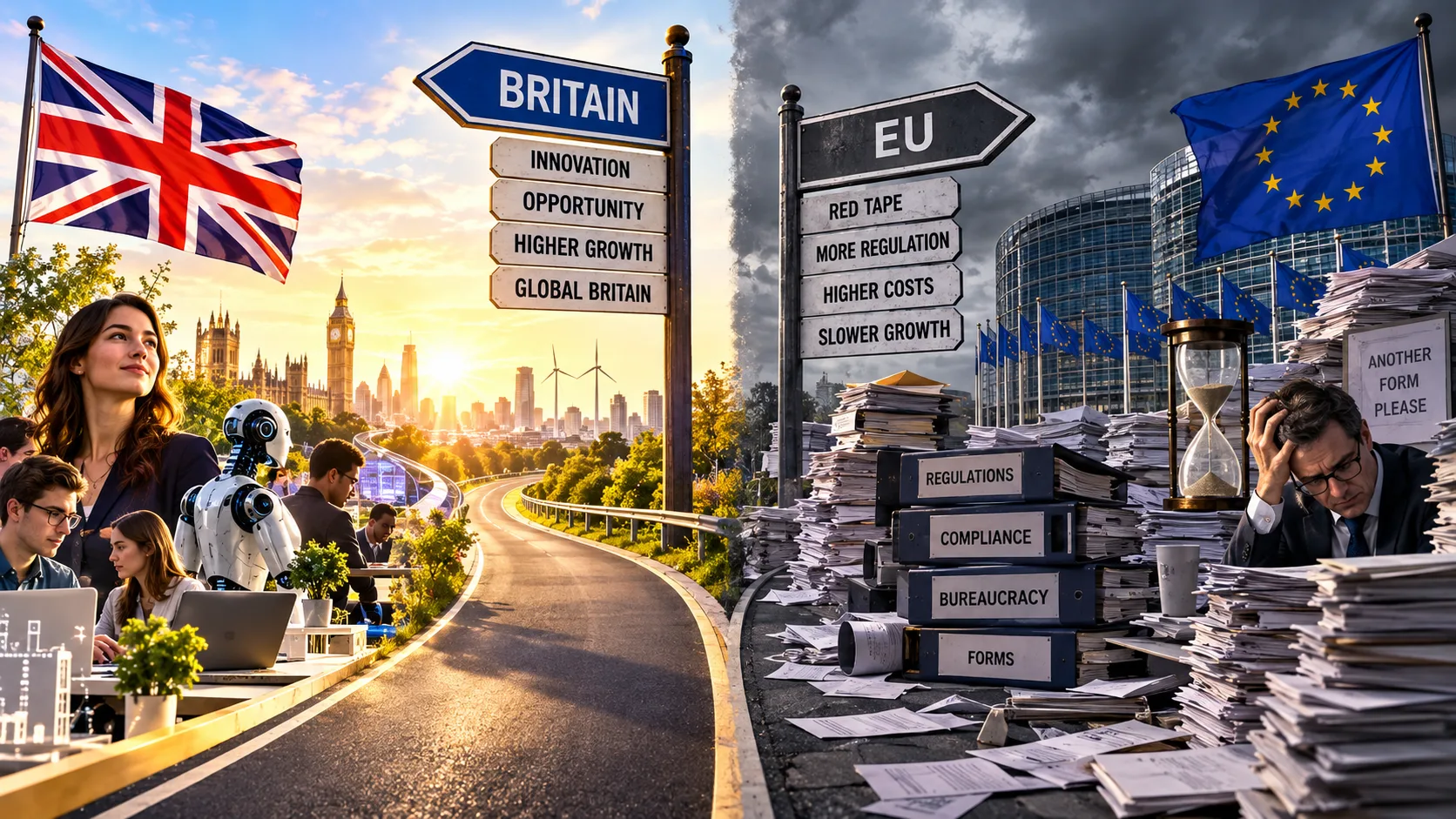
In 2016, we made the case for Brexit with the information we had then. We talked about sovereignty, borders, democracy, trade and the fundamental principle that the people who make Britain's laws should ultimately be accountable to the British people.
Those arguments remain. But there is another argument for Brexit that we could barely have made ten years ago, because the technology that makes it so urgent had not yet arrived.
Artificial intelligence is going to change almost everything, and Britain now faces a choice that could prove every bit as consequential as the referendum itself. Do we use the freedom Brexit gave us to become one of the world's great technological nations, or do we allow ourselves to be slowly pulled back towards a European regulatory system designed around harmonisation, precaution and rules agreed between 27 very different countries?
Marc Andreessen's Techno-Optimist Manifesto contains an idea that Britain urgently needs to rediscover. Human progress does not come from managing decline. It comes from invention.
Technology allows us to do more with less. Productivity creates prosperity. Cheap energy makes almost everything cheaper. Greater intelligence allows us to solve problems previously thought insoluble. Innovation turns yesterday's luxuries into tomorrow's ordinary conveniences.
For too long, much of the West has begun from the opposite assumption. What might go wrong? How do we regulate it? Which committee should oversee it? Which form needs completing? Which permission is required?
Andreessen's challenge is to ask another question: what might go right?
That question should be at the centre of Britain's post-Brexit future.
The age of one-size-fits-all is ending
For most of human history, systems have had to generalise because human beings simply did not possess the capacity to personalise everything. Governments created standard procedures, businesses created standard products, schools taught classes of 30 children broadly the same lesson and healthcare systems treated enormous categories of patients through standard pathways.
AI changes the economics of that. The extraordinary promise of artificial intelligence is differentiation, decentralisation and personalisation on a scale humanity has never previously been able to achieve.
What works for Germany may not work for Britain. What works for London may not work for Worcestershire. What works for a multinational corporation may be hopeless for a family business. What is medically appropriate for a seven-year-old girl may be completely different from what is appropriate for a 70-year-old man.
Imagine an education system in which every child can have access to something approaching a personal tutor, adapting explanations to the way that particular child learns. Imagine doctors supported by systems capable of considering a patient's age, history, genetics, symptoms and vast quantities of medical evidence.
Imagine a tiny British company having access to analytical capabilities that once required an army of accountants, researchers and lawyers. Imagine scientific discoveries accelerated because machines can analyse combinations of information no individual human being could absorb in a lifetime. Imagine public services designed around individual citizens rather than citizens being forced to navigate bureaucracies designed around the convenience of the institution.
That is the revolution coming towards us.
The twentieth century was the age of mass standardisation. The twenty-first century could be the age of mass personalisation, and Britain should be running towards it.
Brussels has chosen its path
We no longer need to speculate about the direction the European Union intends to take. It has already passed its Artificial Intelligence Act, creating a sweeping harmonised regulatory framework for AI across the bloc.
The legislation entered into force in 2024 and, as of August this year, much of the regime has become generally applicable, with some provisions continuing to be phased in.
Think about the timing of that. At precisely the moment artificial intelligence is developing at breathtaking speed, Europe is constructing an enormous regulatory architecture around it.
The EU says its approach will encourage trustworthy AI, protect fundamental rights and provide certainty for businesses. Those are legitimate objectives. Britain needs safeguards too.
But we should ask a question Brussels too often appears reluctant to confront. What happens when regulation intended to make innovation safer also makes innovation slower, more expensive and harder for the very start-ups capable of challenging today's giants?
Large corporations can employ armies of lawyers, compliance officers and consultants. A brilliant 23-year-old with an idea and a laptop cannot.
That is one of the great paradoxes of regulation. Rules intended to control powerful incumbents can end up creating a regulatory moat around them, because the biggest businesses are precisely those best equipped to absorb the cost of compliance.
And the EU AI Act has teeth. Depending on the infringement, the legislation provides for fines running into millions of euros and, in some cases, percentages of a company's worldwide annual turnover.
This is not simply guidance about how Europe would like AI companies to behave. It is an extensive legal regime governing one of the fastest-moving technologies humanity has ever developed. AI moves too quickly for Britain to become trapped in the wrong regulatory philosophy.
Europe harmonises. AI personalises.
Here lies the deeper problem. The European Union's instinct towards harmonisation is understandable, it is inherent in the structure of the organisation. One regulatory framework must somehow accommodate 27 countries.
But AI points towards precisely the opposite future: personalisation, experimentation, decentralisation and rapid adaptation.
The future will increasingly be about discovering the best answer for a particular country, a particular region, a particular business, a particular school, a particular patient or a particular human being.
Why should the optimal technological policy for Estonia automatically be the optimal policy for Germany, Greece, France and Ireland? And why on earth should Britain voluntarily surrender its ability to find its own answer?
This is where Brexit becomes not merely an argument about sovereignty, but an argument about experimentation.
Independent nations can try different things. Britain can pursue one approach, America another, Singapore another and Japan another. We can watch what succeeds, learn from what fails, borrow good ideas tomorrow and abandon bad ones just as quickly.
And when the technology changes six months later, we can change again.
That agility could become one of Britain's greatest competitive advantages. Brexit gave Britain something increasingly precious in a rapidly changing world: manoeuvrability.
A speedboat should not voluntarily tie itself to a tanker.
The risk of doing nothing
Of course AI presents risks. Every transformative technology does. But there is a peculiar tendency in modern politics to calculate the risks of innovation while pretending that refusing to innovate carries no risk at all.
It does.
There is a risk in developing AI badly. There is also an enormous risk in allowing America, China and other technologically ambitious countries to develop the industries, companies, expertise, medicines and productivity gains of the future while Britain regulates itself into comfortable irrelevance.
The greatest danger may not be that Britain moves too quickly. It may be that everybody else does.
This is perhaps Andreessen's most important challenge to the modern political mindset. When considering innovation, we compare the possible consequences of doing something with an imaginary world in which doing nothing has no consequences.
But doing nothing has a price. Delaying a medicine has a price. Failing to build energy infrastructure has a price. Stopping houses being built has a price. Preventing a business from experimenting has a price. Allowing the AI revolution to happen somewhere else would have an enormous price.
Britain does not have to choose between technological anarchy and bureaucratic paralysis. We can regulate genuine dangers while preserving the freedom to experiment.
Indeed, Britain has previously explicitly pursued a principles-based, context-specific and pro-innovation approach to AI regulation, recognising that the risks posed by artificial intelligence depend heavily on how and where it is being used.
That instinct is exactly right. Regulate the risk, not the existence of the technology. Protect people where protection is necessary, then let people build.
Your children aren't waiting for permission
There is another uncomfortable reality for anyone who believes we can simply decide that AI is too frightening and put it back in its box.
It is already out, and your children and grandchildren are not waiting for a government consultation.
They are using it. They ask AI to explain their homework, how to word a text message, what to wear, how to approach the boy or girl they like at school. They ask it for ideas, reassurance, explanations and advice.
Previous generations said, "I'll Google it." The emerging generation increasingly says, "I'll ask AI."
Think about what that means. For millions of young people, artificial intelligence is rapidly becoming not some strange futuristic technology, but an ordinary part of life. Increasingly, it is becoming something they consult.
That deserves serious thought, including serious thought about safety, privacy and the development of young minds. But pretending it is not happening is not a policy.
Whether politicians approve of this technological transformation is rapidly becoming beside the point. The technology is here.
The question is whether Britain shapes it, builds it and benefits from it, or merely consumes technologies created elsewhere under rules determined elsewhere.
This is the Brexit argument we couldn't make in 2016
This is where Brexit suddenly looks very different from the argument we had ten years ago.
Taking back control was never supposed to mean taking back control so that Westminster could reproduce Brussels bureaucracy with a Union Jack stuck on the front.
Sovereignty is valuable because it gives a country the ability to choose. It allows Britain to experiment. If a regulation fails, we can change it. If a new technology emerges, we can respond. If another country discovers a better approach, we can copy it. And if Britain discovers the better approach, others can copy us.
That competition between systems is healthy.
In 2016, nobody could credibly have stood on a referendum platform and explained how generative AI would transform education, medicine, science, government and business. ChatGPT did not exist. The technological landscape was completely different.
We can make that argument now.
And it makes the idea of surrendering Britain's regulatory independence at this particular moment in history look extraordinarily short-sighted.
The next great global competition will not simply be about who has the largest economy today. It will be about who possesses the energy, computing power, capital, scientific talent, artificial intelligence and political courage to build the economy of tomorrow.
Britain has extraordinary advantages. We have world-class universities, the English language, the City of London, globally respected scientific institutions, the common-law tradition, deep capital markets, brilliant entrepreneurs and a history of invention wildly disproportionate to the size of our islands.
What we cannot afford is timidity.
Britain should become the laboratory
We should want the world's greatest AI entrepreneurs to think of Britain as the place where they can build. We should want the scientists here, the data centres here and the investment here. We should want British universities spinning out companies here rather than watching them leave.
We should want British children learning how to command these technologies rather than merely being protected from them. We should want AI transforming the NHS, defence, manufacturing, agriculture, financial services, scientific research, education, government and our small businesses.
And we should want regulation intelligent enough to distinguish between an AI system helping somebody write an email and one making a life-changing medical decision.
That is what proportionate regulation means. Not no rules, better rules. Rules capable of changing when the world changes.
Above all, we should stop talking about technology as though the future is something being done to us.
Britain should be doing it.
That is why the renewed enthusiasm for drawing Britain back into the EU's regulatory orbit is so profoundly mistaken. The argument against rejoining is no longer merely about recovering powers surrendered in the past. It is about retaining the freedom to seize opportunities that barely existed when we voted to leave.
The EU can have its harmonised model. Britain should become the laboratory.
Let countries experiment, let entrepreneurs compete, let scientists discover, let successful ideas spread and unsuccessful ones die.
Build the energy, build the infrastructure, back the scientists, teach the children, welcome the entrepreneurs. Protect people where genuine dangers exist, then get government out of the way where they do not.
Experiment, learn, adapt, compete.
The most powerful argument for Brexit may ultimately turn out to be one we could not fully articulate when Britain went to the polls in 2016.
We voted to take back control.
Now the technological revolution has arrived. It is time to use it.