
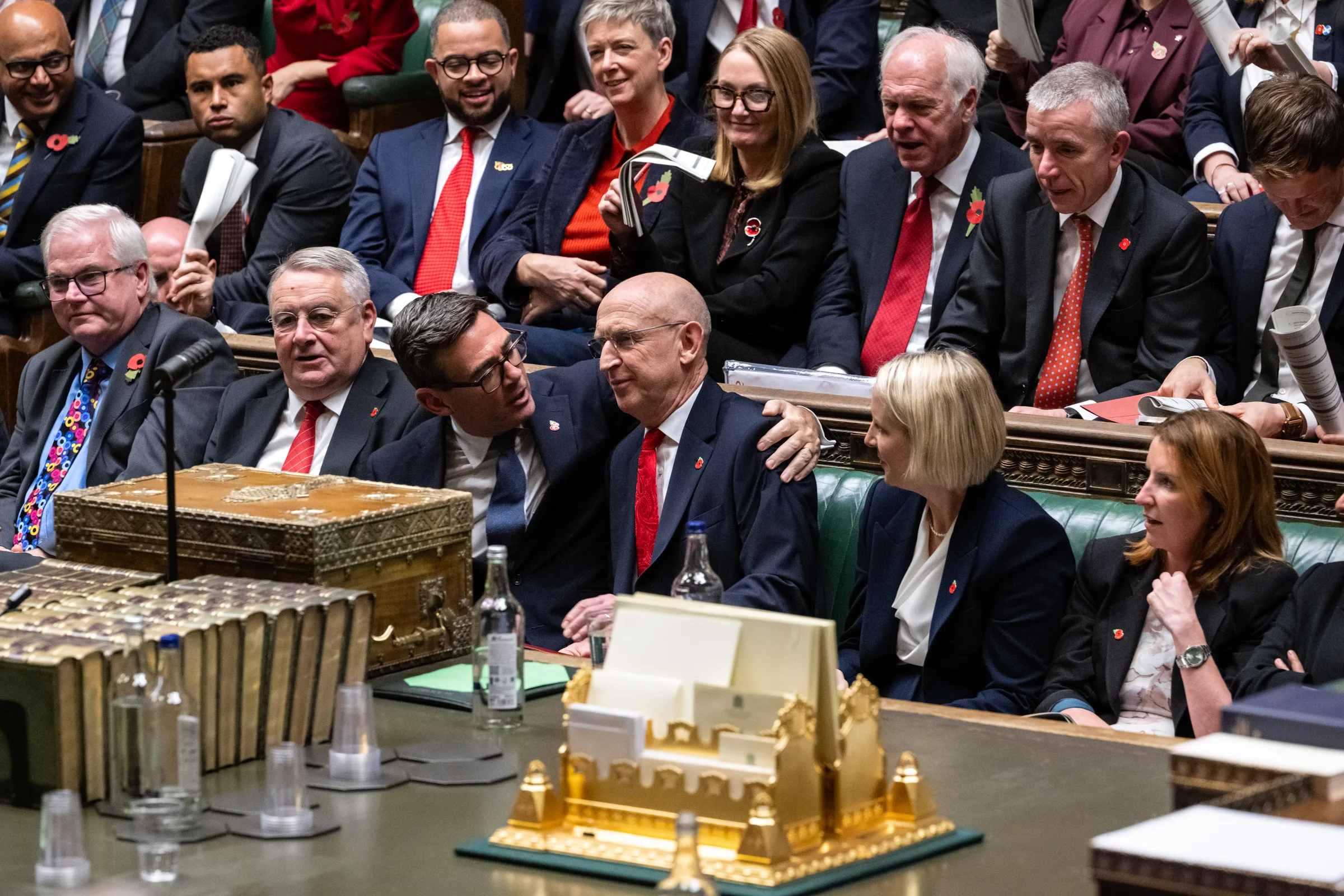
John Healey presented his first Budget as a demonstration of national seriousness, telling MPs the Government would "fully fund the Defence Investment Plan" and putting Britain on what Nato's Secretary General called a "credible path" to its spending commitments. The documents published alongside the Chancellor's speech tell a more complicated story. Four months after the Government allocated the Ministry of Defence £73.8bn for 2027-28 and £76.5bn for 2028-29 in its June defence investment plan, the Budget sets the department's budgets at £72.8bn and £75.5bn for those same years. The difference is £1bn a year, £2bn across the two years, and it corresponds to the Armed Forces pension funding no longer counted within the MoD's departmental allocation.
What happened to that money is the row now running through Westminster. The Conservatives say the MoD has been cut by £2bn. Treasury ministers say the claim is "absolute garbage" and that a technical change in how pension contributions are accounted for has left defence spending power untouched. The published figures establish the difference in departmental allocations. Whether that amounts to a loss of usable defence spending power is the question ministers must answer.
What has actually changed
The mechanics are set out in the Budget 2026 documents and were first reported in detail by The Telegraph. The MoD's departmental allocation for 2027-28 and 2028-29 is £1bn a year lower than the June plan. The explanation offered by the Treasury is that employer pension contributions fell following the 2024 pension valuations, and that the funding is now accounted for through a central arrangement rather than the MoD's own day-to-day budget. The Budget document itself acknowledges a "technical change due to lower employer pensions contributions resulting from 2024 pension valuations" when explaining adjustments to departmental funding.
Three things should be kept distinct, because the argument collapses without the distinctions. First, Armed Forces pension entitlements have not been reduced: nothing in the Budget documents changes what serving personnel and veterans are owed, and no one on either side of the row claims otherwise. Second, employer pension contributions are not a discretionary pot the MoD could freely redirect into training, equipment or operations; they are the contributions that fund pension entitlements, which continue unchanged. A change in how those contributions are accounted for between a department and the Treasury is therefore a change in budgetary presentation and departmental allocation, not in itself a change to pensions or to Nato-defined defence expenditure, which the Government says is unaffected. Third, a lower departmental allocation does not automatically establish a loss of usable military capability. The Conservatives must substantiate their claim of a cut, but the Government has a particular responsibility to explain its own figures and demonstrate that the MoD's effective spending power remains intact.
What the technical explanation does not yet settle is accountability. Torsten Bell, a Treasury minister, wrote on X: "This is a technical change that happens when public sector pension contributions change. There's no impact on defence spending power and the Tories used the same mechanism in government." Perhaps so. But a Government that insists nothing has been lost has an obligation to demonstrate it transparently. The Treasury should reconcile the June and October allocations using comparable figures, and show precisely why it believes the MoD's effective spending power is unchanged. The Government has yet to provide a clear, publicly accessible reconciliation demonstrating how the change leaves the MoD's effective spending power unaffected. Until the Treasury publishes that reconciliation, ministers cannot expect Parliament or the public to accept on assurance alone that a £2bn reduction in the MoD's published allocation has left its effective spending power entirely unchanged.
The Conservatives' case
James Cartlidge, the shadow defence secretary, told The Telegraph: "Hidden in the back of the Budget – John Healey is actually cutting £1bn a year from the MoD in a Budget where he should have been increasing defence spending, to keep Britain safe in a dangerous world. The same John Healey who resigned demanding 3 per cent on defence by 2030 has failed to deliver this as Chancellor, and has instead resorted to penny-pinching our military. We all know why Healey's kicked down the road on 3 per cent and hit defence with further cuts – because he's got no plan to cut welfare. Labour are still putting social security before national security. This is a complete dereliction of duty from the Chancellor."
A Conservative source added: "To describe a billion pounds as a 'technical adjustment' when the MoD is cutting training this year to save cash, is for the birds. Labour have been caught out – talking up defence spending in the speech then cutting it in the footnotes." The Liberal Democrats, whose defence spokesman James MacCleary called the change "disgraceful" and said it would leave "our troops worse off", reach a version of the same conclusion from the opposite bench.
The criticism does not rest on the accounting alone. According to The Telegraph's reporting, the MoD has withdrawn £2bn earmarked to develop three new battlefield vehicles and a further £1bn intended to improve barracks plagued by leaks and mould. These are reported withdrawals from planned programmes rather than confirmed cancellations of delivered capability, and they should be read as such. But they are the context in which the public is being asked to accept that a department with £1bn a year less in its allocation has lost nothing that matters.
The 3 per cent question that will not go away
The sharper political issue predates the Budget. Mr Healey resigned as defence secretary in June over Sir Keir Starmer's refusal to commit the money, citing in his resignation letter the importance of reaching 3 per cent of GDP on defence by 2030. As Chancellor, he has now written that same date into the Budget speech as a "target", not a funded commitment, sitting within Nato's separate commitment of 3.5 per cent of GDP on defence expenditure by 2035, and has deferred the plan for reaching both to a spending review expected next year.
The distinction between a target and a commitment is not pedantry, and neither are the figures. The Office for Budget Responsibility estimates that reaching 3 per cent by 2030 would require an additional £17.3bn of spending in 2029-30 alone: an annual requirement, not a cumulative total. Separately, the OBR estimates that meeting the Nato commitment of 3.5 per cent by 2035 would cost £35bn across the forecast period. Neither figure is currently matched by published funding. General Lord Dannatt, the former head of the Army, told The Telegraph: "Wes Streeting said we will be at war in 1,000 days. But is it not irresponsible of the former defence secretary, now the Chancellor, to squander 365 of those days to say they will map the path to getting to 3 per cent of GDP in 2030 next year? Are we fiddling while Rome burns?"
Labour voices share the concern. Tan Dhesi, the Labour chairman of the Commons defence committee, said key decisions had "lamentably been delayed until next year's spending review" and warned that "investment in our nation's defence and security cannot be kicked into the long grass". Helen Miller, director of the Institute for Fiscal Studies, said the Chancellor had "largely kicked" the tough decisions down the road. Kemi Badenoch told the Commons the Chancellor had offered only "a plan to have a plan".
How the funding gap was filled
The Chancellor told MPs he was "fully funding the Defence Investment Plan, including through capital reprioritisation across Whitehall". The Budget document sets out how. Of the £15bn plan announced in June, £10.3bn had already been funded by reprioritising public spending. The residual £4.7bn is now covered by two distinct sources: "further reducing departmental capital budgets by 1% from 2027-28 to 2029-30 to raise £3 billion", and "an additional £1.7 billion" drawn from "unallocated contingency in the Treasury's capital Reserve". The Budget also records that the Government's Strategic Asset Review has identified surplus assets for disposal as part of the Defence Investment Plan funding package.
It follows that defence money has indeed been found, but largely through reprioritisation across Whitehall rather than new money. The Budget documents do not identify which individual projects, if any, will be cancelled or delayed as a consequence of these reductions, leaving the practical effects of the reprioritisation unclear. A source close to Wes Streeting, the Defence Secretary, said spending is rising on a like-for-like basis from £68.4bn this year to £73.9bn next, £14bn more than the previous government's plans. That may all be true, and it sits alongside, rather than answers, the question of what the MoD can now spend at its own discretion.
The figures are already under scrutiny
There is a further dimension. Sir Ben Wallace, the former Conservative defence secretary, has complained that the Government is inflating the reported defence budget by counting billions of pounds of intelligence spending that Nato's rules exclude from defence expenditure, The Telegraph reported. The Office for Statistics Regulation has confirmed that it will consider the concerns raised about the presentation of UK defence spending. That is a preliminary consideration of a complaint, not a formal investigation, and no finding has been made. But a Government whose headline defence numbers face statistical scrutiny, at the same moment its department's allocation falls £1bn a year below what it promised in June, has handed its critics a story that writes itself.
Great British PAC reaction
Claire Bullivant, Chief Executive Officer of Great British PAC, said:
“The defence of this country is the first duty of any government. It is not a political luxury, a Treasury accounting exercise or something to be pushed into next year's in-tray.
“Labour talks endlessly about national security, yet when we examine the small print, we find £2 billion less in the Ministry of Defence's published allocations than was promised just four months ago. Ministers insist this is merely an accounting adjustment. Very well. Then publish the figures, explain the difference and prove that not a single pound of our Armed Forces' effective spending power has been lost.
“Our servicemen and women do not defend this country with Treasury spreadsheets. They need proper equipment, adequate training, decent accommodation and, above all, a government that understands the difference between announcing an ambition and delivering it.
“Britain has one of the proudest military histories in the world. Generations of men and women have made extraordinary sacrifices to defend our sovereignty and our freedoms. The very least we owe them is a government that treats national defence with the seriousness it deserves.
“Labour cannot keep confusing press releases with progress, targets with commitments and accounting adjustments with answers.
“National security is not something you promise at the despatch box and quietly revisit in the Budget footnotes. It is the most solemn responsibility of government. And on something this important, the British people deserve straight answers, not another Labour exercise in smoke and mirrors.”
Britain's Armed Forces are being asked to deter a resurgent Russia, sustain support for Ukraine and meet Nato commitments that the Government itself has signed. They can do none of that on accounting adjustments. The Government's position may yet prove correct that no spending power has been lost. If so, it should have no difficulty publishing the arithmetic: reconciling the June and October allocations with comparable figures and demonstrating why it believes the MoD's effective spending power is unchanged. It should also set out a credible, fully funded timetable towards the 3 per cent of GDP target, which currently exists as an ambition without published funding rather than a commitment with a plan behind it. Until then, the country is entitled to judge by the documents rather than the assurances, and the documents show a department allocated £2bn less than it was promised four months ago. The men and women who serve, and the veterans this country pledged to honour, deserve better than a promise with the funding left to a future review.