
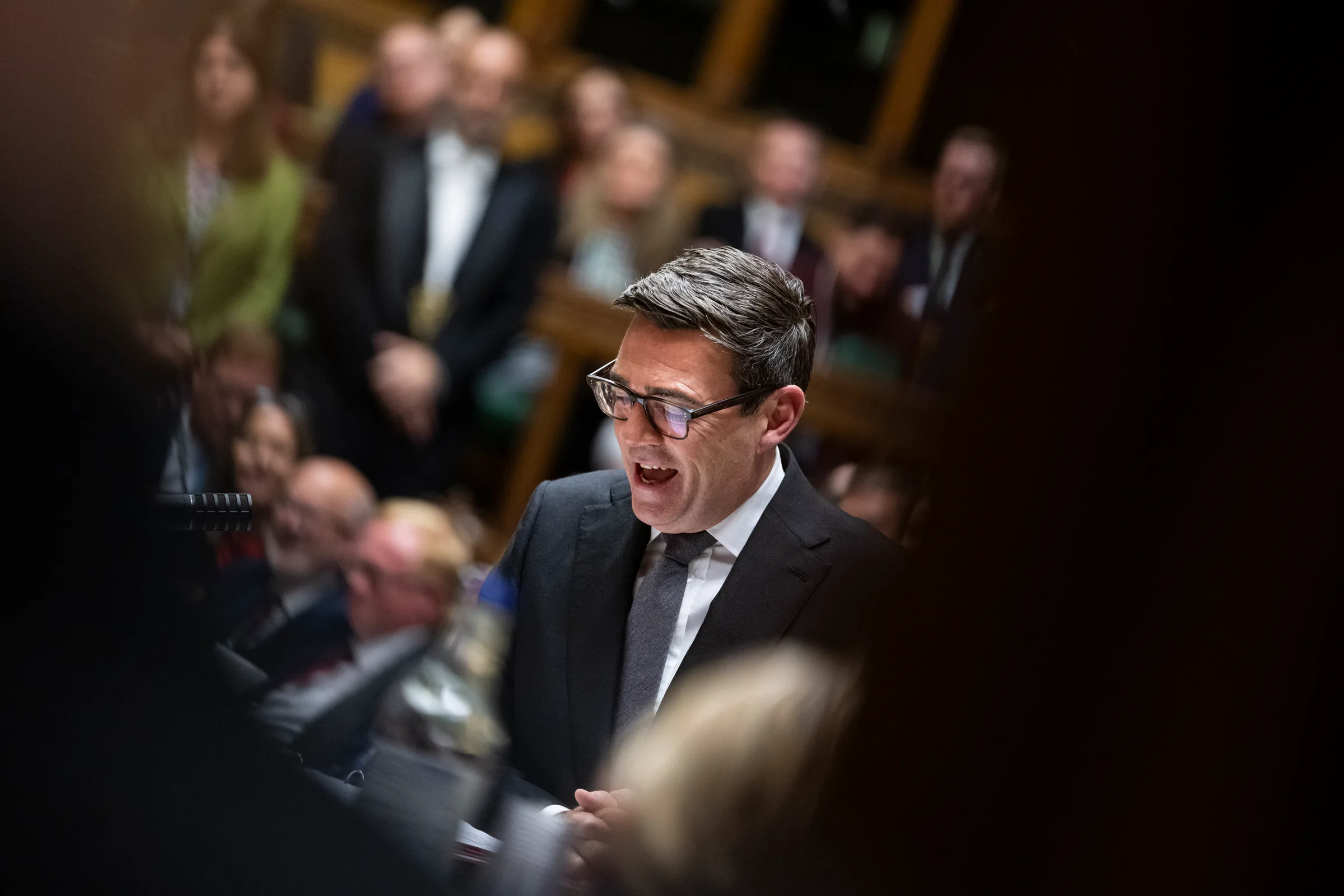
Andy Burnham's hundredth day as Prime Minister fell on Tuesday. He marked it with the kind of announcement that has become the signature of his short premiership: a promise to curb private parking charges. Yet his milestone was overshadowed by a controversy entirely of his own making: a weekend interview that put freedom of movement with the European Union back on the table, just two days before his Chancellor's first Budget.
Downing Street spent Monday trying to close a door it had opened. According to The Guardian, a spokesman insisted the Prime Minister was "not proposing a return to freedom of movement, or any particular option" and was "crucially not leaning either way". By then Burnham had already told reporters that "in my lifetime I would like to see that happen", while promising not to "move ahead of the public".
The sequence matters more than any single sentence. In the Sunday Times interview that started it, the Prime Minister said a new relationship with Brussels could include full EU membership or the single market, both of which require free movement, and that Britain needed "a very factual, quite evidence-based debate". On Monday he ruled out rejoining within this parliament, said he would not "move away from the red lines that were in the Labour manifesto", and answered "no" when asked whether the UK could join the EU's free movement scheme without a referendum. He also told Reuters that there was "no election coming anytime soon".
By Monday evening, the Prime Minister's remarks, subsequent qualifications and Downing Street's clarification had left the Government explaining a position that should have been clear from the outset.
A question the country answered, reopened in a weekend
The politics of this are not complicated. Britain left the European Union in 2020, and control of legal migration was central to the case for leaving. Burnham knows the arithmetic better than most. He won Makerfield on 18 June with 54.8 per cent of the vote and a majority of 9,231, in a seat where 65 per cent voted Leave.
During that by-election campaign he was asked repeatedly about his past support for rejoining. He said then that the question would not be reopened. He now says he wants an "honest discussion" about it, and that the nature of migration has changed: "longer term, permanent migration has replaced what was freedom of movement."
That argument leaves a central question unanswered. Restoring freedom of movement would not, by itself, remove the existing settlement routes Burnham criticises. It would create an additional legal framework for migration, while its effect on overall migration numbers would depend on how the new arrangements operated and how people responded.
When Kemi Badenoch said the Prime Minister "hasn't thought this through", she was making a point about coherence rather than sentiment. Robert Jenrick, who campaigned for Remain in 2016 and is now Reform UK's economy spokesman, called the idea "completely mad".
Jeremy Hunt, another Remain voter, put the electoral objection more sharply. Pointing to the million young people not in work or training, he said: "Surely our priority in that situation is to get those jobs filled by the young people we have here instead of parking them on welfare. Which is why I think it's astonishing to lead on the issue of free movement." Few Conservative interventions will trouble Downing Street more.
The small things, and the large ones deferred
Burnham's defence is that governing is not only about the constitution. His first hundred days have produced a genuine list. He scrapped the digital ID programme on his first day. He approved the Jackdaw gasfield, which the Conservatives had licensed in 2022 and Labour had left in limbo. He set out a path to a national care service, funded in part by a change to the triple lock, and told the Commons he had "grasped the nettle in a way that nobody on their side ever has".
The private parking code is more substantial than its critics allow. Some 17 million tickets were issued on private land in 2025-26, a 17 per cent rise in a year, worth up to £100 each. The new rules freeze the cap, cancel charges for honest mistakes and broken machines, and give drivers ten minutes to leave. Angela Rayner's summary was blunt: parking "shouldn't be a way of making money".
Then there was the sofa. Burnham became the first Prime Minister to appear on Celebrity Gogglebox, alongside his friend Steve Rotheram, the Liverpool City Region Mayor, raising money for Stand Up To Cancer. He said he would "make no apology" for trying to "lead with a bit of lightness". Badenoch's reply was that between the television appearance and ministers advising households to stockpile essentials, "they're not actually doing the really difficult stuff that will protect the country".
Voters appear to be making a similar distinction. A YouGov survey of 5,394 adults on 22 October found that 23 per cent said Burnham had so far met their positive expectations, while 12 per cent had expected him to do well and were disappointed. Another 23 per cent said he had performed as badly as they anticipated.
That is not the whole picture, and it would be dishonest to present it as one. Labour's polling has recovered markedly. As the Press Association's weekly averages record, the party stood at 19 per cent on the day Keir Starmer announced his resignation and reached 29 per cent in the week to 25 October, with the Conservatives and Reform tied on 22 per cent. An Ipsos poll put Labour on 32 per cent, the Tories on 24 and Reform on 20. Opinium finds Burnham the only party leader with a positive net approval rating.
The recovery began before he entered Downing Street, when it became clear he would. Lord Hayward, the polling expert, drew the conclusion that matters: Burnham is currently seen as adequate but untested, and the Budget is the first test. He added that the Budget, from what has been briefed, looks less like governing than delaying, and that the number of disappointed voters is therefore likely to rise.
The first Budget, and the silence before it
John Healey delivers his first Budget today. He has spent the autumn lowering expectations, telling departments at the IMF meetings in Bangkok to manage with "the budgets we've got".
At Prime Minister's Questions last week, Badenoch pressed the case that presentation has replaced decision. "He is talking about big decisions, but he has not made any decision on social care. Talking about it is not making a decision," she said in the Commons. Earlier she observed that when Burnham began discussing process, "it almost felt like Keir Starmer was still standing there." She also noted that the IMF's deficit reduction timetable runs to 2029, after the next election.
The most revealing exchange concerned welfare. Burnham said: "I do not want to see anybody in their 20s on benefits in this country; I want to see them in work, in training, in education." He is right to say it. Almost a million 16 to 24-year-olds are not in education, employment or training, and 331,000 18 to 24-year-olds claim unemployment-related benefits, nearly double the figure in 2016. He has called the situation "an economic catastrophe and a moral failure".
But the mechanism is missing. Alan Milburn's review reports next month. The legislation will not be voted on until the New Year. And the two ministers now charged with delivering savings, Louise Haigh and the chief whip Anneliese Midgley, were leading figures in the backbench revolt that forced Starmer to abandon £5 billion of welfare savings. The last attempt to make this argument collapsed on the votes of the people now responsible for making it.
The Great British PAC view
Great British PAC takes no issue with a Prime Minister who says plainly that he would like to see Britain back inside the European Union. That is a legitimate political position, and one he should be free to argue for at an election. What the organisation objects to is the method: a position floated in a weekend interview, qualified within hours, denied by a spokesman the following day, and then described as a conversation rather than a policy. Sovereignty is not a mood to be tested on a Sunday and clarified on a Monday. The decision to leave was taken by the British people, control of who enters the country was central to it, and any government proposing to revisit that settlement owes voters a clear proposition, costed and put to them, not unattributed briefing.
The pattern of the first hundred days is consistent. On welfare, on social care, on the deficit, the analysis is offered and the decision is postponed. On Europe, the reverse: a decision is floated, denied, and floated again. Neither is governing.
The Budget today is the first occasion on which Burnham cannot answer a question with a gesture. The public will judge him on whether the numbers add up, whether the promises survive contact with the Treasury, and whether the money is being spent on the country's priorities: defence, borders, and the young people he says he wants off benefits and into work. On the evidence of the last three months, the small things have been done well and the large things have not been done at all.