
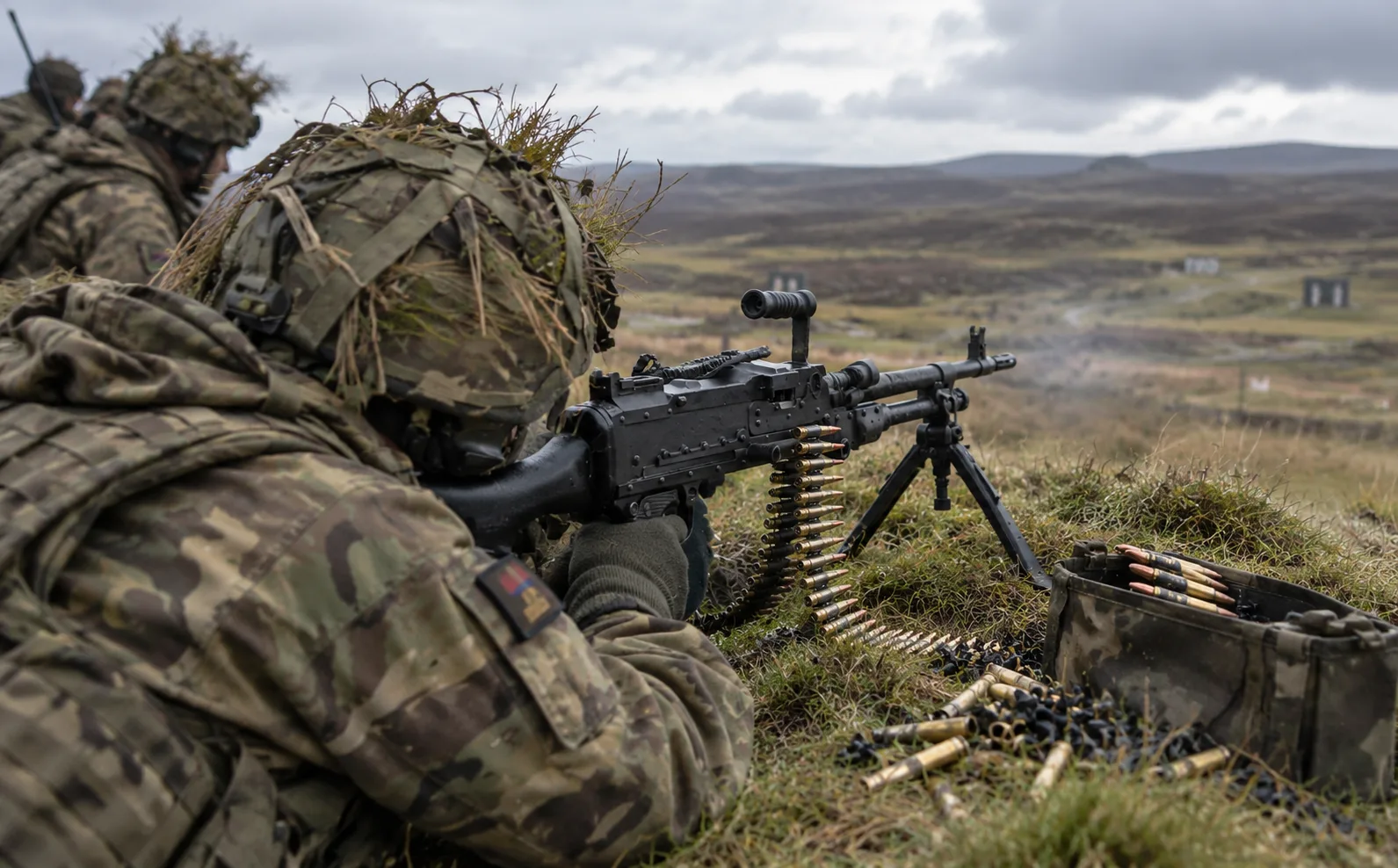
Major collective exercises have been restricted until 2027 as the Army is being told to modernise for a changing battlefield.
The Ministry of Defence has reportedly halted major war-fighting training for 3 (UK) Division until 2027 in an effort to save £30 million.
Collective training exercises for units based in Britain have been suspended for most of this year, with live-fire exercises involving Challenger 2 tanks and Apache helicopters among those cancelled. 3 (UK) Division, the Army's "Iron Division" and the formation Britain would rely upon to defend the Falkland Islands, has been told to park its tanks and drones for more than six months and wait until the Treasury finds the money for training again in the summer of 2027.
Training has not stopped altogether, and it is worth being precise about that. Units preparing for deployment, whether to Estonia, the Falklands or Cyprus, will continue to exercise as planned, and the Army says drone and counter-drone training informed by the lessons of Ukraine is being prioritised. The Government points to £2bn reportedly allocated to transform Army training over the next 15 years. What has been restricted is specifically the large-scale collective war-fighting training that turns a division into a coherent fighting force.
That matters because training is the foundation of military capability. Without it, the most sophisticated tanks, drones, missiles and communications systems in the world count for little. The sum at stake, £30m, works out at approximately 0.01 per cent of the annual welfare budget.
The timing makes the decision harder still. Days after the Kremlin threatened to strike British military targets, and with Ukrainian drones still reaching deep inside Russia (AP), Britain has chosen to stand its main war-fighting division down from collective training. Argentina, meanwhile, is once again flexing its military muscles over the Falkland Islands.
Ministers have spent years telling the military to prepare for the next war rather than the last. Yet just as the Army is attempting to transform itself for the modern battlefield, the Government is pulling the plug on the very training required to make that transformation work.
The Army will, of course, do what it has always done. It will turn to the right, salute smartly and get on with it. There will be Tactical Exercises Without Troops, simulations, table-top exercises and plenty of running and PT. The General will doubtless march his soldiers up Sidbury Hill to make them fit and robust. But none of this can substitute for putting troops, drones, tanks and commanders together in the field and making them fight as a coherent force.
The Prime Minister and Defence Secretary have been in their jobs for weeks. They should listen to the people who have spent decades preparing for the consequences of getting this wrong.
Richard Thomson, former Royal Marine and National Director of the Great British PAC, said:
'You don't prepare for war by talking about drones, buying kit and writing strategies. You prepare by training soldiers to fight. Russia is threatening British military targets and our response is to save £30 million by cutting the very training that keeps our Army lethal and effective. You can modernise warfare, but you cannot shortcut readiness. An Army that doesn't train together won't fight together, this is something the penny pinchers will not understand. This isn't saving money. It's gambling with national security.'
Ukraine is demonstrating at the sharpest possible end why this matters. The Recce Strike concept in the Government's own Strategic Defence Review calls for a force increasingly dominated by drones, sensors, electronic warfare and precision fires, but one that still needs tanks and infantry to close with the enemy and take and hold ground. Ukrainian operations in the Oleksandrivka sector, where its forces retook around 745 square kilometres of ground in an offensive that began last winter, show the power of a drone-led force operating alongside conventional combat arms. Technology finds the enemy, fixes him and destroys him; but ultimately men and armour still have to seize and hold the ground. That is precisely what 3 (UK) Division is supposed to be able to do. Britain is telling the Army to become a cutting-edge Recce Strike force while preventing the Iron Division from training to become one.
If ministers want a case study in what happens when armies fail to train, they need look no further than Russia. Western military assessments have argued that much of the professional Russian force that entered Ukraine in 2022 was lost during the first year of fighting (CSIS). Since then Moscow has fought on with successive waves of less experienced and less well trained men, and the casualty toll has continued to climb.
Quantity can replace quality for a while. It cannot replace training.
A well-trained soldier with an effective commander, good intelligence and the right equipment can achieve extraordinary things. A poorly trained soldier becomes another casualty statistic. The Russians have paid for that lesson in enormous losses. Britain appears determined to learn it from a spreadsheet.
Deterrence depends on an adversary believing that you can and will fight. An adversary who watches Britain restrict large-scale collective training for its main fighting division over £30m will draw conclusions of his own.
The Government has promised a stronger defence posture and spoken repeatedly about spending more on defence. If the first response to pressure on the public finances is to stop the Army training for war, those promises look hollow.
Claire Bullivant, chief executive of the Great British PAC, said:
'An Army that does not train together cannot be expected to fight effectively together. You can invest in drones, artificial intelligence and all the technology in the world, but none of it replaces soldiers, commanders and units repeatedly training under realistic battlefield conditions.
To cancel vital collective and live-fire training to save £30 million, at precisely the moment the threat to Britain and our allies is becoming more serious, is dangerously short-sighted. Readiness is not something you can switch back on overnight when a crisis begins, it is built through relentless training, experience and preparation.
Britain's Armed Forces are among the finest in the world, but they cannot be expected to maintain that standard if the Government continually asks them to do more while denying them the resources to prepare properly. Defence of the realm is the first duty of government. It cannot be treated as another line in a spreadsheet.'
The British Army will still turn up when called. Its soldiers always have. But you cannot deter war by saving money on preparing to fight one.