
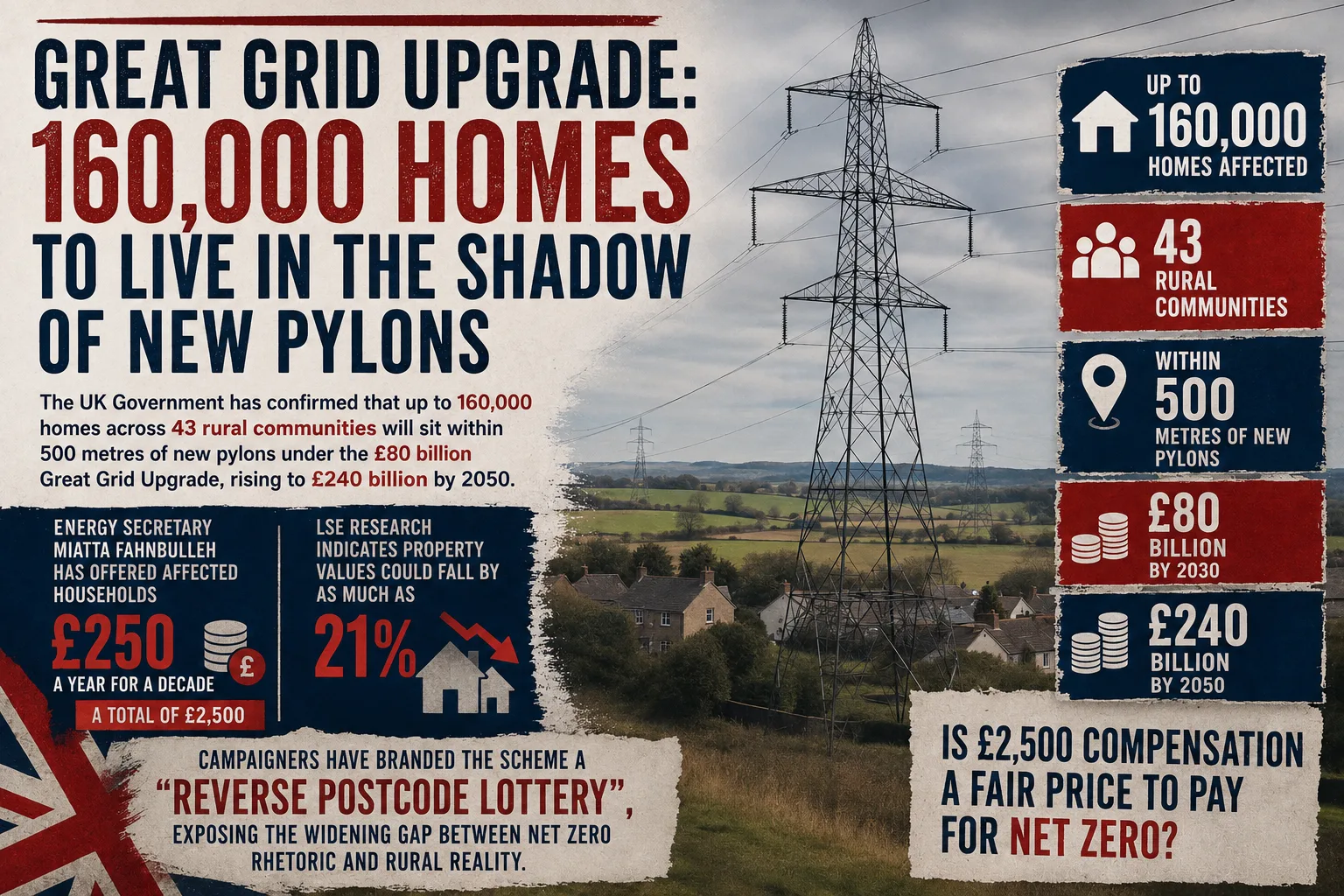
By the time the last of the steel giants is bolted into place across the English countryside, more than 160,000 households will wake up each morning to a horizon reshaped by the ideological ambitions of Westminster. The Department for Energy Security and Net Zero has now formally admitted what rural communities have suspected for years, that Britain's frantic pursuit of a decarbonised grid will overshadow tens of thousands of homes with pylons erected less than 500 metres from their front doors. The first 43 communities on the list have been named, their landscapes effectively conscripted into a national experiment whose economic logic grows shakier by the month.
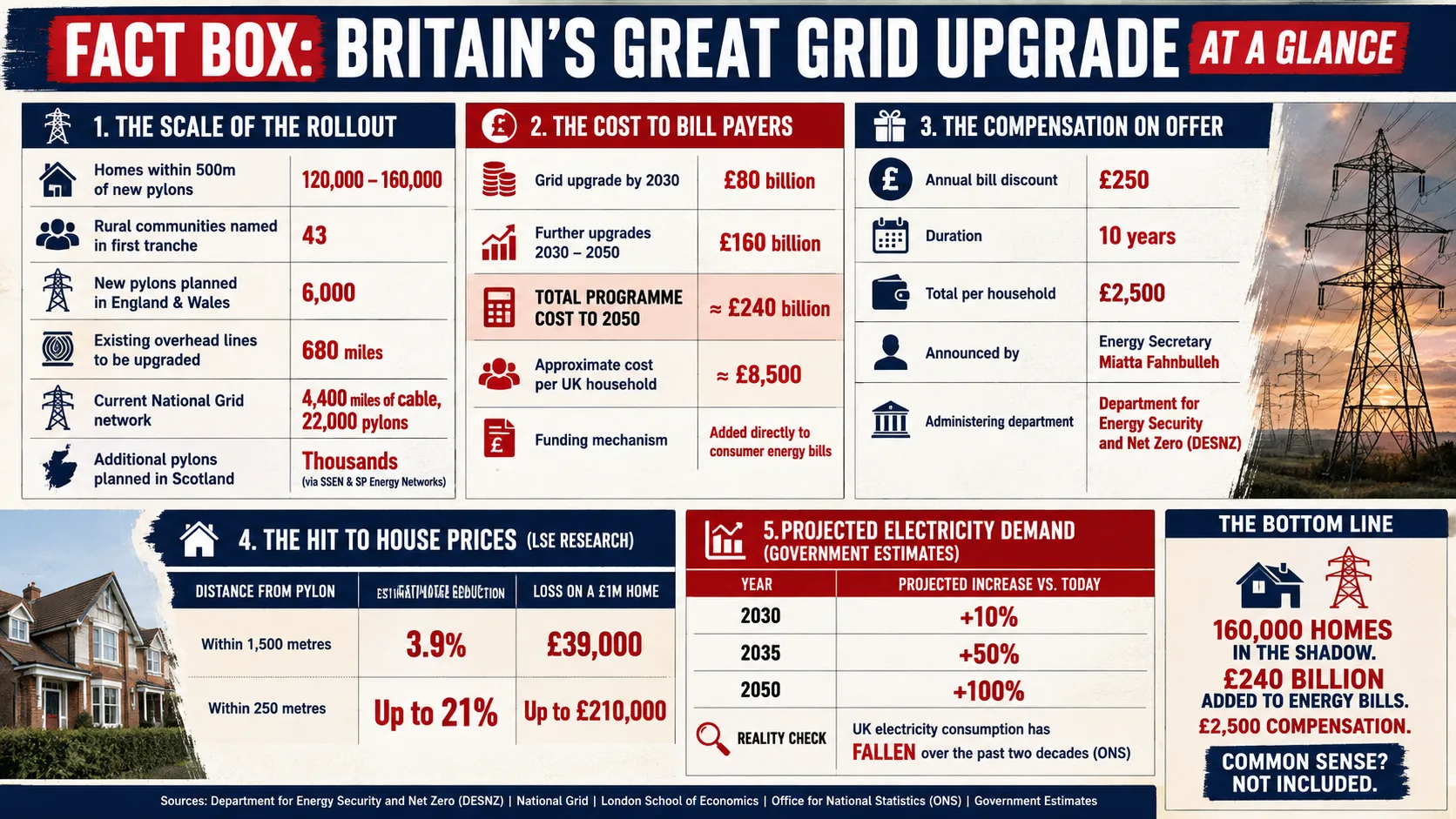
The offer on the table, courtesy of Energy Secretary Miatta Fahnbulleh, is a £250 annual discount on electricity bills for ten years, a grand total of £2,500 per household. Ministers have branded this a "direct benefit" for hosting "vital infrastructure." Homeowners, particularly those watching their most valuable asset depreciate in real time, view it rather differently.
A Reverse Postcode Lottery
The arithmetic tells its own story. Research published by the London School of Economics indicates that overhead power lines within 1,500 metres of a property can reduce its market value by 3.9 per cent, a hit of roughly £40,000 on a £1 million home. Bring the pylon within 250 metres, and the discount widens to as much as 21 per cent. For a homeowner in Essex, Suffolk or Norfolk, the government's £2,500 sweetener could evaporate against a six-figure loss in equity before the first cable is even strung.
Rosie Pearson, founder of the Essex Suffolk Norfolk Pylons campaign group, put it bluntly, calling the scheme "a nasty reverse postcode lottery" and describing the £250 offer as "beyond insulting." Jonathan Dean of the Campaign for the Protection of Rural Wales went further, admitting he "would happily pay not to have a line of pylons ruining my views." That is not the language of communities being courted, it is the language of communities being coerced.
The Great Grid Upgrade, and Its Great Contradictions
The scale of the intervention is staggering. National Grid currently oversees 4,400 miles of overhead cable suspended on 22,000 pylons across England and Wales. Under the so-called Great Grid Upgrade, it wants to erect a further 6,000 pylons, replace or reinforce 680 miles of existing lines, and install larger structures where smaller ones already stand. In Scotland, SSEN Transmission and SP Energy Networks are preparing to add thousands more.
The total bill, according to government estimates, will approach £80 billion by 2030, every penny of which will be recovered from the same bill payers already staggering under some of the highest domestic electricity prices in the developed world. A further £160 billion of grid works is scheduled between 2030 and 2050, meaning the true cost of the transition sits at around £240 billion, roughly £8,500 for every household in the country.
Ministers justify the outlay by citing anticipated demand growth of 10 per cent by 2030, 50 per cent by 2035 and more than 100 per cent by 2050. Yet, as the Office for National Statistics has repeatedly documented, actual UK electricity consumption has fallen for two decades. The projected surge exists only on paper, contingent on a nationwide rollout of electric vehicles and heat pumps that consumers, thus far, have shown little enthusiasm for buying. According to figures from the Society of Motor Manufacturers and Traders, private EV demand has repeatedly undershot targets, while the Heat Pump Association has conceded that installations remain a small fraction of the government's 600,000-a-year ambition.
The Hypocrisy at the Heart of Net Zero
Herein lies the contradiction the Government would prefer not to discuss. The pylons are being justified by demand that does not yet exist, funded by consumers who cannot afford them, and imposed on communities offered a pittance in return. The very phrase "cheaper, clean electricity," repeated with liturgical regularity by ministers, sits uncomfortably beside the fact that Britain's industrial electricity pricesare now among the highest in the International Energy Agency bloc, four times those of the United States, and rising.
The policy asks rural Britain to sacrifice its landscapes, its house prices and its tranquillity, so that offshore wind farms, whose intermittent output requires vast quantities of gas back-up, can be connected to cities whose residents will never see a pylon in their gardens. It is a redistribution not of wealth, but of visual and economic burden, from the metropolitan centres that vote for net zero to the villages that must live with it.
Meanwhile, the same government that lectures households on their carbon footprint approves airport expansions at Heathrow and Gatwick, imports liquefied natural gas from the United States and continues to sanction new drilling in the North Sea via the North Sea Transition Authority. The moral architecture of net zero, in other words, is applied selectively, sternly to the countryside, generously to industries with lobbyists in Whitehall.
The Numbers Nobody Wants to Add Up
Fintan Slye, chief executive of the National Energy System Operator, insists the upgrade will "deliver significant benefits to all consumers." The benefits, however, are notably abstract. The costs, by contrast, are concrete, quite literally. A single new pylon can rise 50 metres, taller than Nelson's Column, and each carries steel foundations sunk into fields that until recently produced food. Analysis by the Country Land and Business Association suggests that thousands of acres of productive farmland will be permanently sterilised by the works.
The regulatory framework, presided over by Ofgem, permits transmission owners a guaranteed rate of return on their capital expenditure, meaning the more they build, the more they earn, a structural incentive that rewards the largest possible interpretation of "necessary" infrastructure. It is a business model dressed up as environmentalism.
A Question of Consent
The residents of the 43 communities named this week did not vote for a pylon at the end of the lane. They were not consulted on the modelling that underpins the demand forecasts, nor on the assumption that undergrounding cables, standard practice in Germany and the Netherlands, is too expensive for Britain despite adding only a fraction to a £240 billion programme. They were simply told that £250 a year should suffice.
Net zero, in its current form, is not a scientific project, it is a political one, and its costs are being paid disproportionately by those least able to influence its direction. Until Westminster confronts that hypocrisy honestly, the pylons rising over rural Britain will stand as monuments not to a green future, but to a government that mistook expenditure for progress, and silence for consent.