
Britain is losing its wealth creators at the fastest pace in nearly two decades, according to new research from the Adam Smith Institute (ASI), raising fresh concerns about the long-term sustainability of the UK's tax base, investment climate and economic competitiveness.
The think tank's latest Millionaire Tracker estimates that Britain is now home to just 442,000 sterling millionaires—a 7% decline compared with 2024 and the lowest figure since the aftermath of the 2008 Global Financial Crisis.
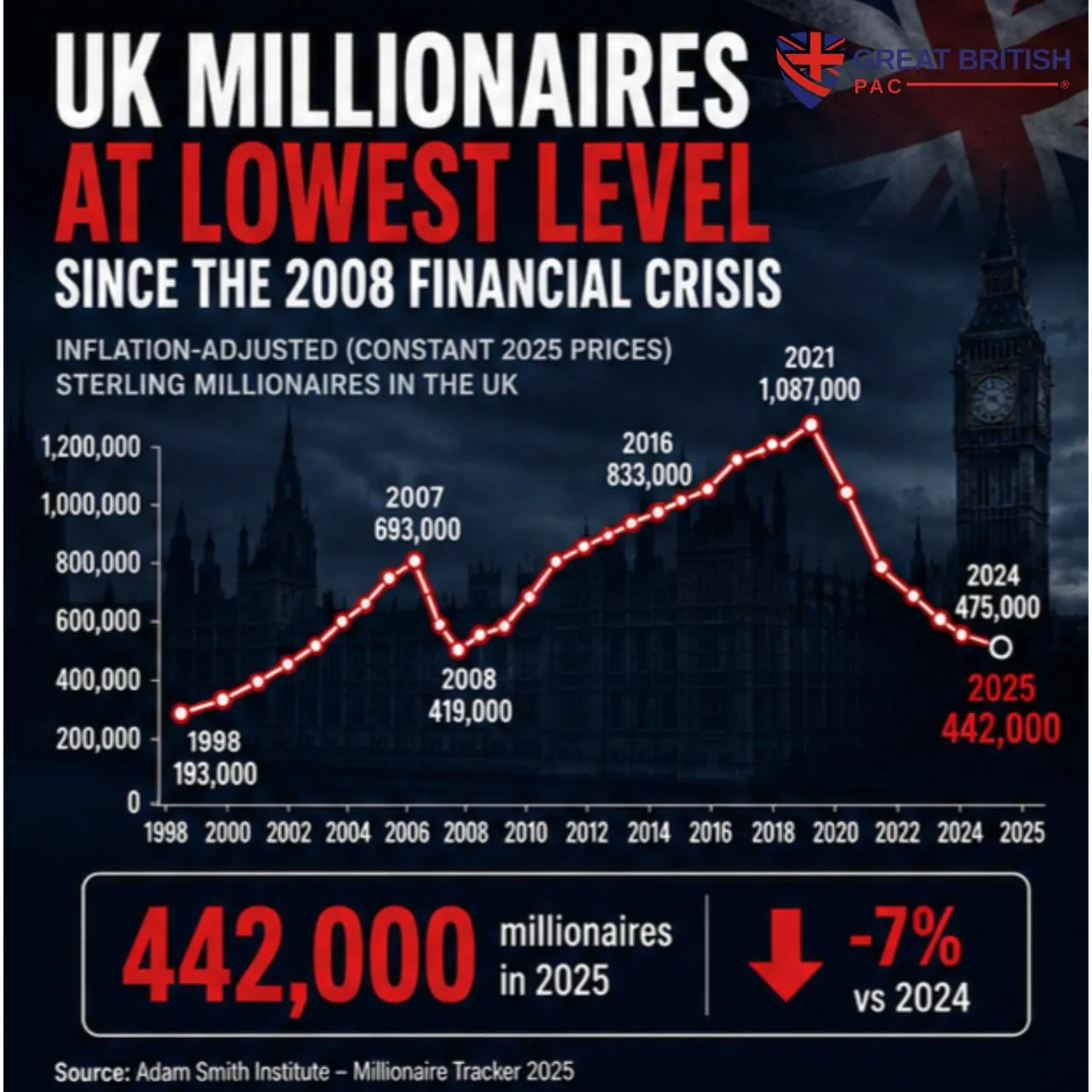
Behind the headline lies a broader economic question: what happens when the people who contribute a disproportionate share of investment, entrepreneurship and tax revenue increasingly choose to leave?
A Sharp Decline in Britain's Wealth
According to the Adam Smith Institute, the number of inflation-adjusted sterling millionaires has fallen because of three major factors:
Falling real asset values, particularly at the upper end of the property market.
Persistently low household savings rates.
The continued emigration of high-net-worth individuals (HNWIs).
Unlike many international wealth rankings, the ASI measures net wealth, including pensions, property and financial assets after debts have been deducted, rather than simply gross asset values. The figures are adjusted into constant 2025 prices to remove the effects of inflation.
By contrast, UBS's Global Wealth Report measures US dollar millionaires, meaning someone with approximately £750,000 in assets may qualify depending on exchange rates. This explains why UBS estimates around 2.6 million UK millionaires, substantially higher than the ASI's more conservative methodology.

Tax Policy Under Growing Scrutiny
The report argues that Britain's increasingly punitive tax environment is becoming a major factor in the departure of wealthy residents.
Among the policies cited are:
the abolition of the long-standing non-dom tax regime,
high overall taxation,
speculation over future wealth taxes,
and an increasingly hostile political climate towards wealth creation.
While restrictions on non-doms began under the previous Conservative government, Labour significantly expanded those reforms after taking office.
HM Revenue & Customs' provisional figures show the number of non-doms had already fallen to 60,700 in 2023-24, around 30% lower than in 2014-15, reflecting a decade-long decline.
The debate intensified further after senior Labour figures declined to rule out introducing a wealth tax.
Former Prime Minister Sir Keir Starmer has argued Britain has "overtaxed labour and undertaxed wealth", while Liverpool Mayor Steve Rotheram recently said he would "look seriously" at a wealth tax to help fund social care and defence.
Economists warn that even discussing further taxes on wealth may encourage additional capital flight before legislation is ever introduced.
"When Labour attacks wealth creators remember that the top 1% of income tax payers pay 30% of all income tax. The top 5% pay half of all income tax. Their jealous socialist policy of ratcheting up taxes on hard workers, while rewarding sloth, is bankrupting the country." - Ben Habib, Chairman Great British PAC
Property Market Weakness
Britain's luxury property market has also deteriorated.
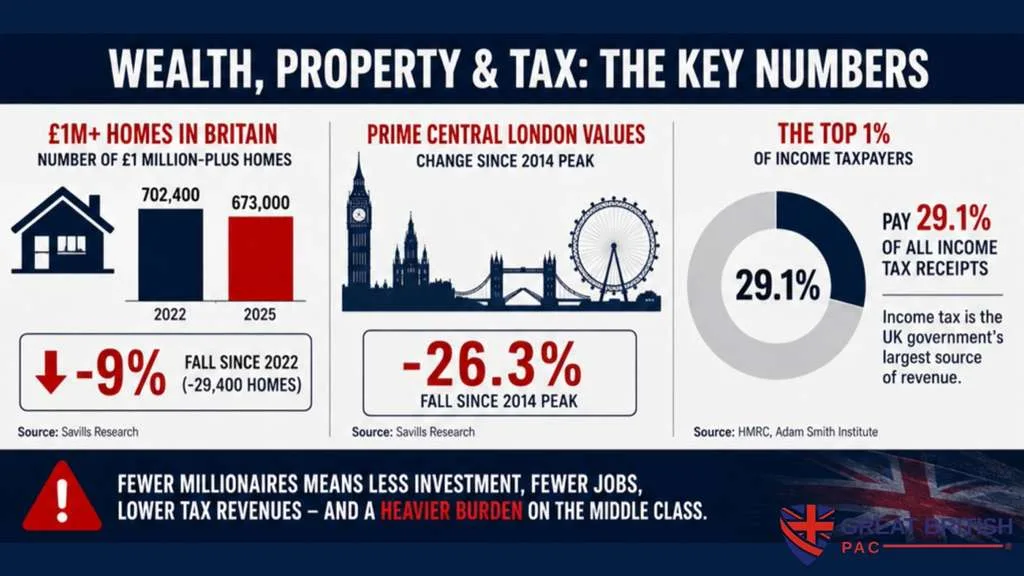
Separate research by Savills shows the number of £1 million-plus homes has fallen by approximately 9% since 2022, leaving around 673,000 such properties nationwide.
Prime central London has experienced some of the sharpest corrections, with values falling more than 26% from their 2014 peak, driven by higher interest rates, increased stamp duty and additional surcharges on expensive properties.
Because property represents a substantial portion of wealth for many affluent households, declining prices have also reduced the number of people whose net worth exceeds the £1 million threshold.
Why Millionaires Matter
The political debate often focuses on inequality.
The economic debate focuses on something different: who pays for the state?
According to HMRC data cited by the Adam Smith Institute, the top 1% of income taxpayers contribute approximately 29.1% of all UK income tax receipts.
Income tax remains the single largest source of government revenue.
Millionaires are also disproportionately represented among:
business founders,
investors,
employers,
angel investors,
exporters,
and high-value entrepreneurs.
Mitchell Palmer, economist at the Adam Smith Institute, argues that each departing millionaire represents more than simply one less wealthy resident.
"Every millionaire that leaves means less capital for British businesses, fewer international connections and weaker entrepreneurial spirit in the economy."
Business lawyer James Quarmby of Stephenson Harwood echoed those concerns, warning that wealthy individuals today can relocate themselves, their businesses and their investments more easily than ever before if the UK's tax environment becomes uncompetitive.
International Lessons
Supporters of a UK wealth tax argue that those with the greatest resources should contribute more.
Critics counter that international experience suggests such taxes often fail to raise expected revenues.
The Adam Smith Institute notes that countries including France, Austria and the Netherlands eventually abandoned wealth taxes after experiencing capital flight, tax avoidance or lower-than-expected receipts.
Whether Britain would experience similar outcomes remains contested among economists, but concerns about international competitiveness are becoming increasingly prominent.
A Warning Beyond the Numbers
The decline in Britain's millionaire population is about far more than a statistical milestone.
It reflects growing concerns over investment confidence, economic competitiveness, business formation and the mobility of capital in an increasingly global economy.
As affluent individuals relocate, governments face an increasingly difficult fiscal challenge.
A smaller pool of high taxpayers means either:
lower public revenues,
higher borrowing,
spending reductions,
or higher taxes on those who remain.
At the same time, Britain continues to face rising demands on public services, an ageing population, growing welfare expenditure and increasing infrastructure costs.
The Question Every Taxpayer Should Be Asking
Whether one views millionaires sympathetically or not, the broader economic question affects everyone.
If increasing numbers of high earners and wealth creators continue to leave Britain, who replaces the billions in tax revenue they generate?
The Labour government argues that higher taxes on wealth create a fairer society and help fund public services. Critics argue the opposite, that making Britain less attractive to entrepreneurs, investors and internationally mobile taxpayers ultimately shrinks the tax base available to finance those same services.
The pressure does not disappear simply because wealthy individuals leave. Instead, it risks shifting further onto middle-income workers and businesses who cannot relocate as easily.
At the same time, Labour continues to face criticism over its handling of illegal migration and rising public expenditure. Opponents argue that expanding welfare obligations while simultaneously creating conditions that encourage productive taxpayers and investors to leave raises fundamental questions about the long-term sustainability of Britain's public finances.
There is a practical limit to how much revenue can be extracted from the middle class and ordinary taxpayers. If the country's highest contributors continue to depart while the number of people dependent on public services continues to grow, the fiscal gap becomes increasingly difficult to close.
That leaves one unavoidable question:
Why should every British citizen care about the millionaire exodus?
Because this debate is not ultimately about the rich. It is about who will fund Britain's schools, hospitals, defence, pensions and public services in the decades ahead. If the UK's most mobile taxpayers continue leaving while the burden on the state continues to increase, every household could eventually feel the consequences, through higher taxes, reduced public services, slower economic growth or greater public debt.
Graphic and AI-generated illustration by Great British PAC. Created for editorial and illustrative purposes.