
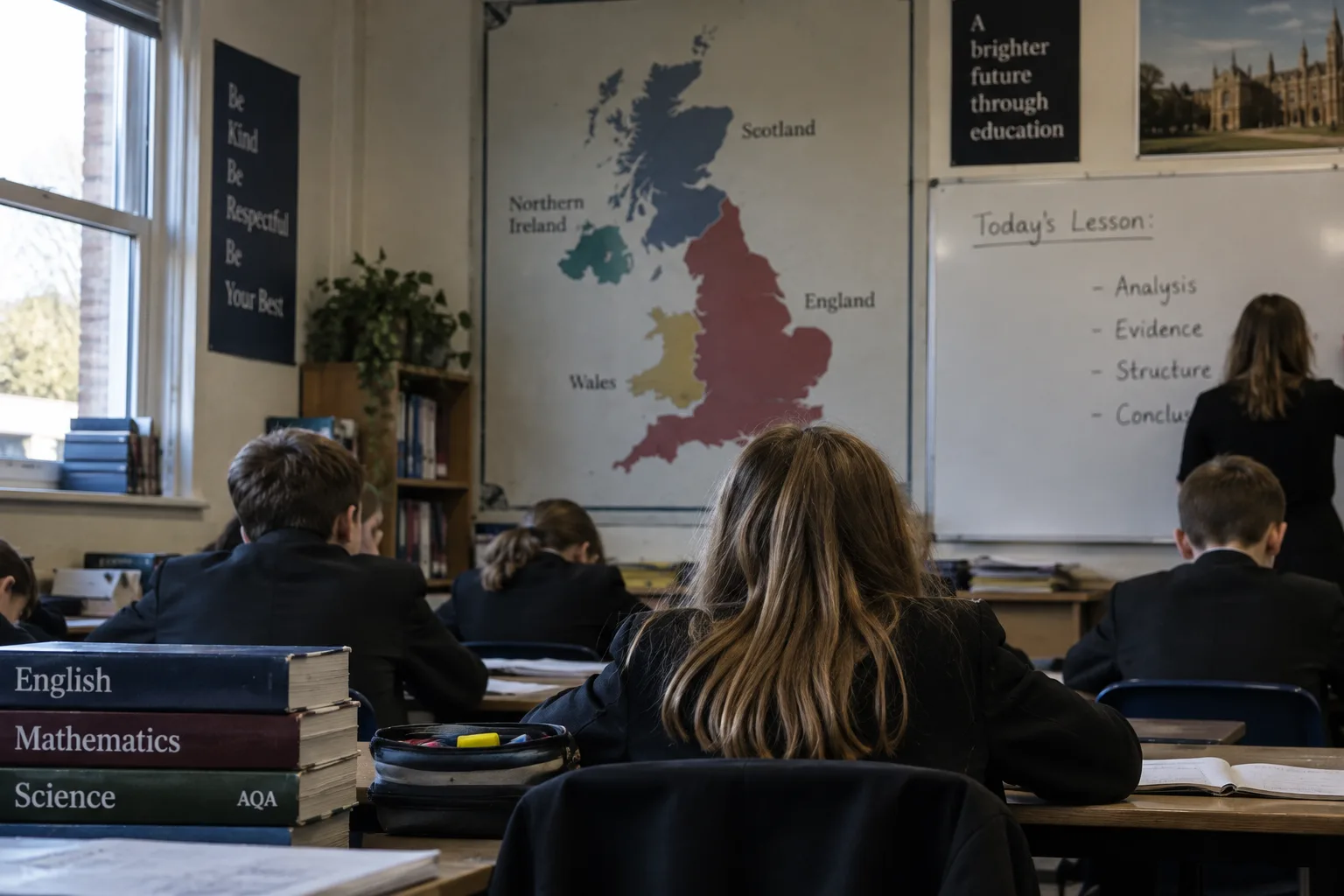
England has moved further ahead of the rest of the UK in the latest OECD PISA 2025 study, while Wales remains the weakest of the home nations and Scotland continues to lag badly in maths. That is the central fact in a survey which tested more than 760,000 pupils across 91 countries and economies.
The numbers are stark. According to Senedd Research's summary of the UK results, England scored 516 in science, 497 in reading and 492 in maths. Wales recorded 476, 459 and 456. Scotland's own national report puts it on 491 in science, 488 in reading and 467 in maths. Northern Ireland's official PISA 2025 publication says it remained above the OECD average in all three subjects, but still below England across the board.
Those figures do not prove that one reform caused one result. Serious people should be careful with claims like that. But they do make it much harder to argue that sharply different approaches to curriculum, testing and standards have made little difference to outcomes.
Wales is the clearest warning. The Welsh Government's own summary says Welsh pupils were significantly below the other UK nations in all three domains, and significantly below the OECD average in maths and science. The trend is worse than a single set of scores suggests. According to Senedd Research, Wales's maths score fell from 466 to 456 between 2022 and 2025, reading dropped from 466 to 459, and science rose only slightly from 473 to 476. More tellingly, its gap with the next lowest-scoring UK nation widened in all three subjects, from 10 points to 15 in science, from 5 to 11 in maths and from 19 to 23 in reading.
Another point matters too. Those same Senedd researchers note that the pupils who sat PISA 2025 were the last Year 11 cohort not to have studied under the new Curriculum for Wales. So this is not a clean verdict on one brand new reform. It is evidence of a wider Welsh system that has struggled for years, and of a governing class that has had a long time to get the basics right.
The Institute for Fiscal Studies was blunt when it examined Wales's weaker performance. Lower scores, it argued, were unlikely to be explained fully by higher poverty, a different ethnic mix, statistical quirks or lower resources. The more likely explanation, it said, lay in differences in policy and approach. That is not a party slogan. It is a serious warning from one of the country's most respected research bodies.
Wales's own inspectorate has supplied another uncomfortable detail. In a 2025 thematic report, Estyn said some schools were assessing pupils against the curriculum's four purposes rather than focusing on the knowledge and skills children need to develop over time. The result, it said, was a superficial approach to assessment, with valuable teaching time taken up by activities that did not contribute meaningfully to pupils' learning. That is a grim sentence, and it comes from Wales's own inspectorate, not from its political opponents.
Scotland deserves some plain speaking too. Scottish politics can have all the dynamism of day-old porridge. Change comes slowly, while the latest educational numbers make uncomfortable reading. In PISA 2025, Scotland was behind England in all three core subjects. In maths, the nation of John Napier now trails England by 25 points. In science, the country that gave the world James Clerk Maxwell is also 25 points behind. Reading is the relative success story. Walter Scott's homeland is only nine points behind England.
That sting would be easier to shrug off if Scottish officialdom were not making similar points in drier language. A Scottish Parliament briefing, drawing on the OECD's earlier review of Curriculum for Excellence, noted that there was no clear model of how knowledge, skills and attitudes were meant to fit together. The Scottish Government's current improvement plan now says the system needs a curriculum review cycle that clarifies the role of knowledge, improves progression and, over time, reduces reliance on high-stakes exams. Governments do not rewrite the handbook when all is well.
None of this means England can sit back and congratulate itself. The OECD's wider picture is poor. Reading scores have fallen sharply across much of the developed world, and the organisation warns that too many teenagers are losing the habits of deep reading and concentration. But England's relative strength does matter, especially when ministers in Westminster are talking about the next phase of reform.
Lucy Powell, the Education Secretary, has said in her Ruskin College speech that she wants a curriculum which secures knowledge and develops skills. Georgia Gould, the Minister of State for School Standards, has pointed to Estonia as an example of academic excellence sitting alongside high-quality vocational routes, as the BBC reported after the PISA release. Fair enough. In principle, that is not the same as dumbing schools down. But the experience of Wales and Scotland should make Westminster wary of blurring the line between strong academic foundations and fashionable vagueness. Changes made in curriculum and assessment can take years to show up in the classroom.
That is the real warning in these results. England does not need to copy the systems that are already underperforming. It needs to look hard at what went wrong in its neighbours, then approach its own reforms with cold discipline. The OECD tables are not a culture war toy. They are a report card, and for Wales and Scotland the writing is already there in black and white.