
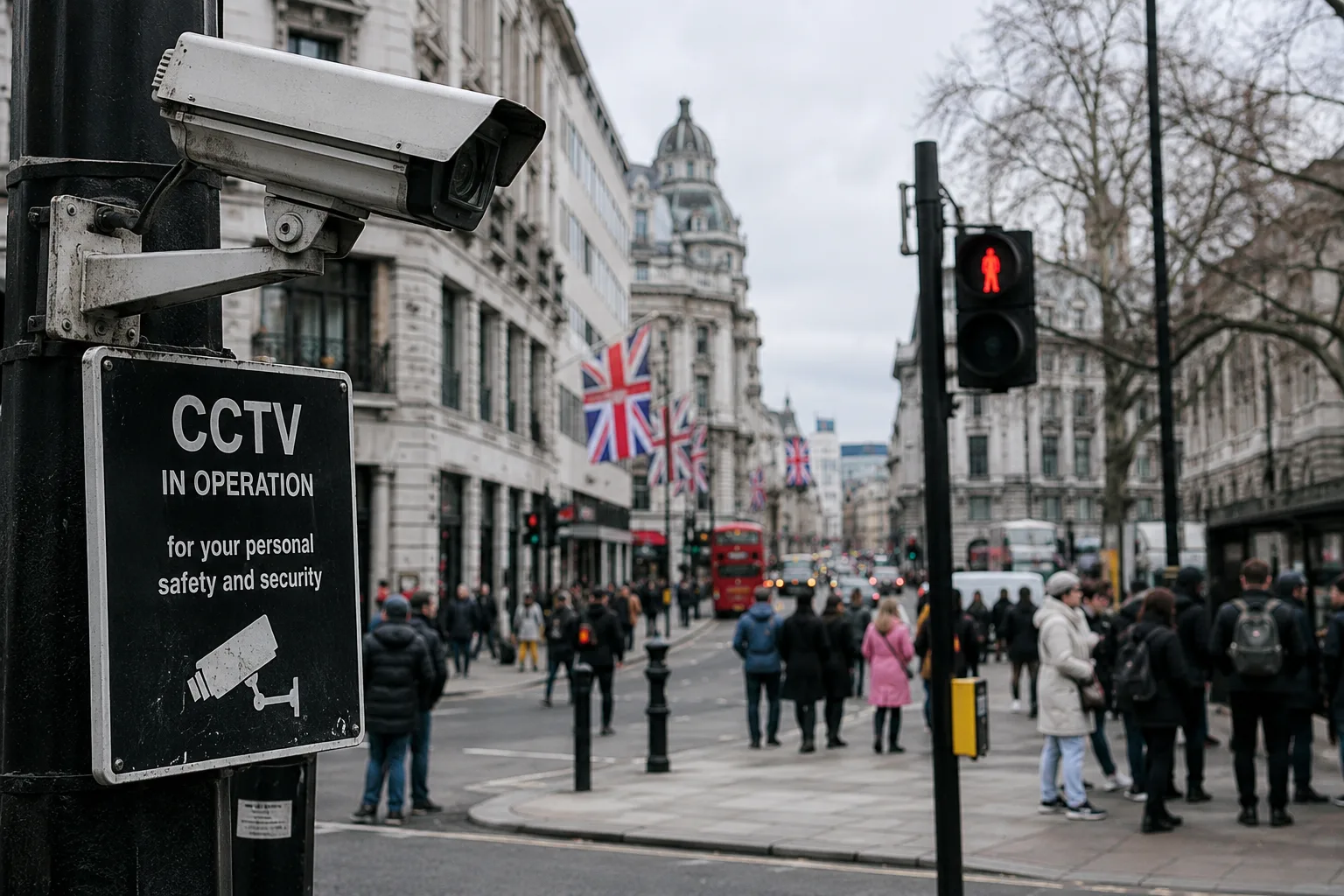
Britain has long liked to think of itself as a country of liberty, pragmatism and common sense. Yet over the past few decades it has also become something else, one of the most heavily surveilled democracies in the world. Cameras watch city centres, housing estates, transport hubs and shopping streets. Police forces increasingly use live facial recognition. Supermarkets and retailers are embracing biometric systems. Artificial intelligence is being folded into policing, welfare and education. All of it is usually justified in the same way, as a practical answer to crime, disorder and insecurity.
The trouble is that the evidence for this vast surveillance build-up is far less convincing than its advocates suggest. Britain has created an enormous system for watching people, but it is much less clear that this system is making the public safer.
The UK has been moving in this direction for years. CCTV spread rapidly in the 1990s, driven by fear of crime and by the security pressures of the IRA era. After the 9/11 attacks and the London bombings of 7 July 2005, surveillance powers expanded again in the name of counter-terrorism. Since then, the camera has become a familiar feature of daily life, so familiar, in fact, that many people barely notice it any more.
London is often cited as one of the most watched cities in the world. By 2019, reports put the capital’s CCTV estate at more than 420,000 cameras. That scale has made the UK an attractive testing ground for more advanced systems, especially facial recognition. Britain offers something that many governments and technology firms find useful, a dense urban environment, widespread existing camera infrastructure, and a more permissive legal culture than much of continental Europe.
That matters because facial recognition is not just another camera. It is a step change. A standard CCTV camera records what happens. Live facial recognition tries to identify who is there, in real time, by scanning faces and comparing them with police watchlists. The Metropolitan Police say this helps them find wanted offenders more efficiently. The Government’s own factsheet presents the technology as a useful modern policing tool.
But the use of such systems raises serious questions, not only about privacy, but also about effectiveness, proportionality and trust. This year, the British Transport Police trialled live facial recognition at transport hubs in London. According to a BBC report, officers scanned more than 530,000 faces and recorded zero true matches and no arrests. That is not a minor wrinkle in an otherwise successful system. It goes to the heart of the argument. If vast numbers of innocent people are being scanned for little or no public safety return, then what exactly is the point?
Supporters of these technologies often say that law-abiding people have nothing to fear. But that line misses the issue. In a liberal democracy, the question is not whether an innocent person will be arrested on the spot. It is whether the state should be routinely collecting and processing biometric information from the public in everyday spaces, often without meaningful consent, and with weak legal safeguards.
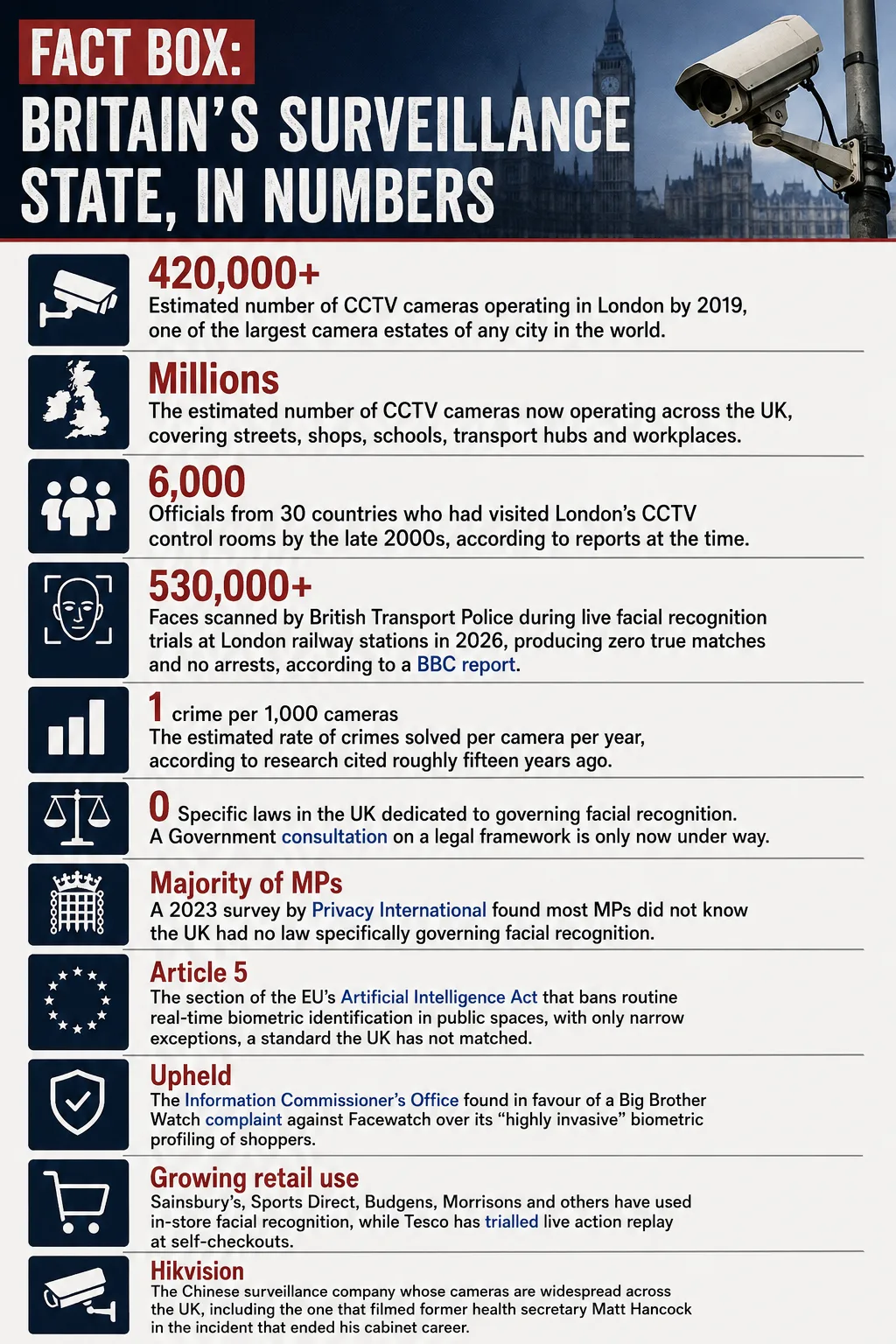
On that front, Britain stands apart from much of Europe. The European Union’s AI Act places strict limits on real-time biometric identification in public places, allowing it only in narrowly defined circumstances. The UK, by contrast, still has no single law specifically governing facial recognition. Parliament’s own POST briefing on facial recognition technology in policing has acknowledged the uncertain legal landscape. A Government consultation on a legal framework has finally begun, but the fact that the technology has spread so widely before firm rules were in place tells its own story.
The surveillance issue also extends well beyond the police. Retailers are now turning to facial recognition and other tracking systems in the name of loss prevention. Companies such as Facewatch have promoted biometric monitoring in shops, and civil liberties groups have pushed back. The campaign organisation Big Brother Watch has been one of the most persistent critics, arguing that Britain is drifting into a culture of routine monitoring without public debate or democratic control. The Information Commissioner’s Office has upheld concerns about highly invasive biometric profiling in at least one complaint involving Facewatch, a reminder that private surveillance can be just as troubling as state surveillance.
This is one of the most important parts of the story. Surveillance is no longer just about police cameras on lamp posts or intelligence agencies intercepting data. It is becoming woven into ordinary life. A person can be watched on the train, scanned in a shop, tracked online, monitored at work, and analysed at school, often by systems they do not fully understand and cannot meaningfully avoid. The cumulative effect is easy to miss because each individual step can be presented as minor, technical and reasonable. But taken together, they amount to a profound shift in the relationship between citizens, institutions and power.
And there is another problem. Surveillance systems tend to expand by failure. When crime remains high, the response is often not to question whether the technology works, but to demand more of it, more cameras, better software, larger watchlists, more data sharing. If a system produces few results, its backers rarely conclude that it was a mistake. Instead they argue that it was not extensive enough, not integrated enough, not intelligent enough. That is one reason surveillance grows so easily and contracts so rarely.
Meanwhile, the risks are multiplying. More cameras and more biometric systems mean more sensitive data, more opportunities for abuse, more pressure on civil liberties, and more potential points of failure. That includes misidentifications, unlawful data retention, mission creep and hacking. It also includes the more subtle cost of living in a society where anonymity, once a normal part of public life, starts to disappear.
None of this means that surveillance has no legitimate role. Cameras can help investigate specific crimes. Targeted monitoring in clearly defined circumstances may be justified. The problem is the leap from targeted use to blanket use, from limited intervention to normalised mass observation. That leap has happened in Britain with remarkably little public argument.
The result is a country that is increasingly watched, increasingly measured and increasingly told that this is the price of safety, even when the evidence remains thin. Britain should be asking harder questions. Does mass surveillance actually work? Who controls it? What laws govern it? What happens when these tools are wrong, or abused, or quietly expanded? And what kind of public life is left when every movement, purchase or protest can be turned into data?
For a country that still prides itself on freedom, those are no longer abstract questions. They are becoming the central political questions of the age.