

There comes a point in every premiership when the folksy gestures and the carefully trimmed policy tweaks stop mattering, when the country stops listening to the spin and watches instead what a leader does with power under pressure. Andy Burnham has reached that point sooner than he would have wished, on an issue that cuts straight to the contract between the state and the people who risk their lives to serve it. By any honest measure, he has failed the test, and the burden of that failure is being carried by a grieving mother in Berkshire who describes the waiting as "torture".
The underlying facts remain as stark as they were seven years ago. Pc Andrew Harper, 28, was investigating the theft of a £10,000 quad bike in Sulhamstead when Albert Bowers and Jessie Cole, then both 17, tried to escape in a car driven by Henry Long, 18. The officer's ankles became caught in the vehicle's tow rope, and he was dragged for more than a mile through the dark at 43mph. Bowers and Cole were sentenced to 13 years for manslaughter; Long received 16 years and is not eligible for early release. Last month it emerged that the two killers were nonetheless set to walk free early under the Government's prison overcrowding measures, alongside thousands of other offenders, with more than 5,000 further prisoners expected to be freed under the latest scheme from October.
What followed has been a masterclass in indecision. First Mr Burnham paused the early release scheme, only to restart it weeks later with a new promise to exempt murderers, rapists and child sex offenders. When pressed on Pc Harper's killers, he insisted he had "pushed to the very limits of what is possible", warning that further exemptions would see the prison system "collapsing within months". Days later, he was exploring "every option" to keep Cole and Bowers behind bars. Then his spokesman said exempting two offenders was legally impossible without exempting all manslaughter convicts. Then, on Tuesday, the Prime Minister announced it was "incumbent" on him to "do everything within my power", adding, pointedly: "I have not accepted that it is impossible to do more." By Wednesday, in his own words, he was "turning over every stone".
This is not the behaviour of a leader who has mastered his brief. It is the behaviour of a man reacting to headlines, to the temperature of public anger, and the cost is being paid by the victims. Debbie Adlam, Pc Harper's mother, has described the limbo as "torture" and this week said she had "to be very careful with where I'm putting my trust at the moment". The buck-passing has compounded it. Rather than own the problem, Mr Burnham has deposited it on the desk of Alex Norris, the new Justice Secretary, who has been in post two weeks. One senior Ministry of Justice source was blunt: "Alex has 100 per cent been thrown under the bus."
Nor can the Prime Minister claim he was short of warning. In an unprecedented display of unanimity, all 50 chief constables across the United Kingdom have signed a joint letter, published by the National Police Chiefs' Council, demanding that he examine "every lawful option" to ensure Cole and Bowers serve their full sentences. A petition organised by the Thames Valley Police Federation has now been signed by more than 900,000 people. Harper's Law, secured after a determined campaign by Pc Harper's widow Lissie, introduced a mandatory life sentence for anyone convicted of killing an emergency worker, through the Police, Crime, Sentencing and Courts Act 2022, yet does not apply retrospectively. About 470 people are believed to be serving manslaughter sentences in jails now running at the highest population since 1900, at around 87,300.
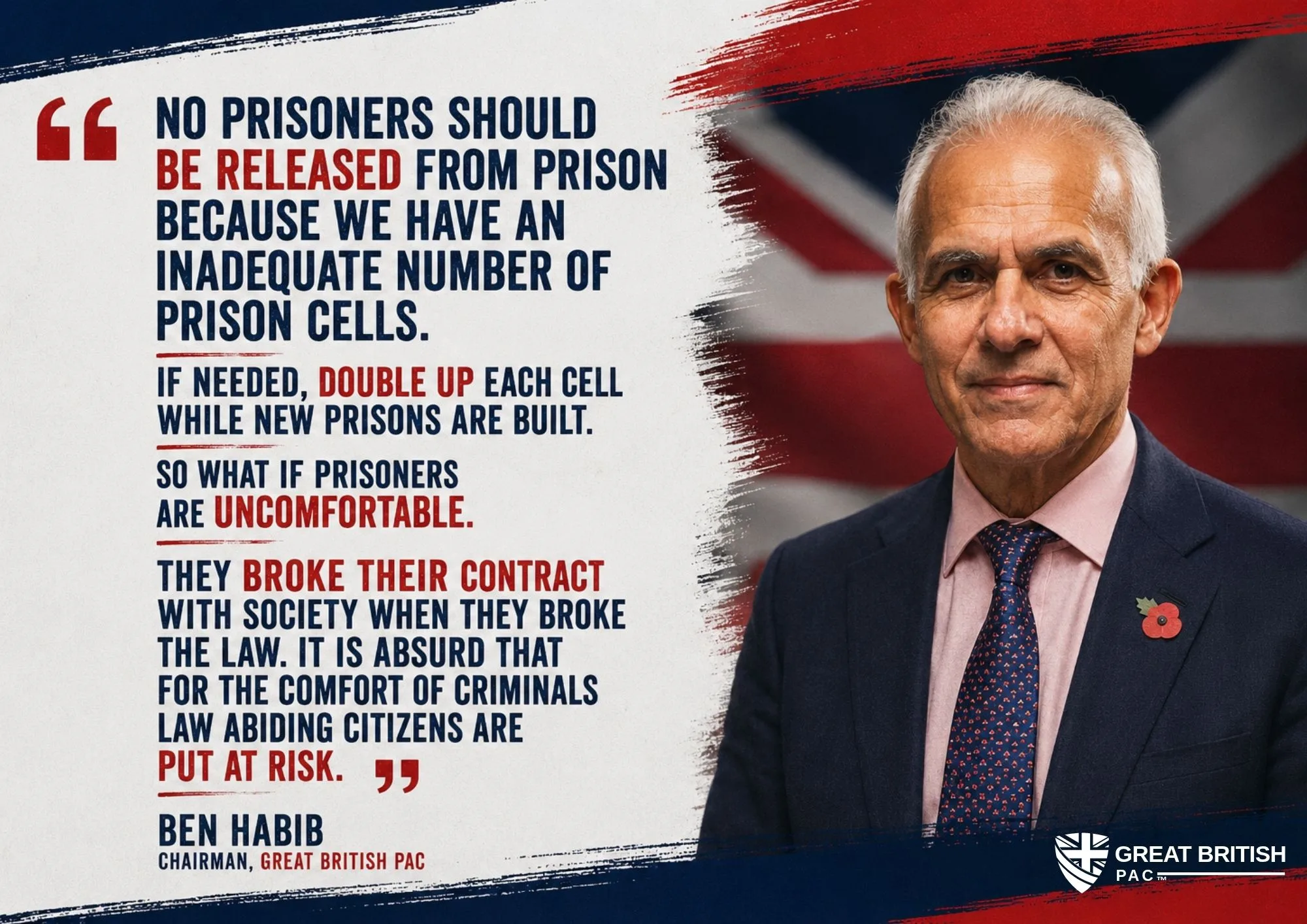
"No prisoners should be released from prison because we have an inadequate number of prison cells. If needed, double up each cell while new prisons are built. So what if prisoners are uncomfortable. They broke their contract with society when they broke the law. It is absurd that for the comfort of criminals law abiding citizens are put at risk." - Ben Habib, Chairman Great British PAC
The truth is that every option in front of the Prime Minister carries a serious cost, which is why he keeps flinching. Officials say a carve-out for killers of emergency workers, his own favoured fix, would probably be struck down in the courts because no distinct offence of killing an emergency worker exists, raising the humiliating prospect of releasing Cole and Bowers later and paying them compensation. Releasing lower-risk prisoners on the almost 1,000 outstanding indeterminate Imprisonment for Public Protection sentences, which Mr Burnham has called a "long-running injustice", would place the most heavily monitored offenders back in the community, where 42 per cent are sex offenders, 31 per cent violent offenders and 17 per cent robbers, and any reoffence would be catastrophic politically. Nigel Farage's "Nightingale prisons", built on Ministry of Defence land, could add 12,400 places within 18 months, on his estimate, but the Covid-era Nightingale hospitals cost £530 million and each new permanent prison space costs £600,000 to build, meaning a serious pop-up estate would run into the billions. Converting disused barracks or reviving prison ships such as the Bibby Stockholm ran aground last time on Legionella outbreaks and local opposition. Increasing deportations of the roughly 11,000 foreign nationals in British jails, about 12 per cent of the estate, depends on countries agreeing to take them back, as Shabana Mahmood's stand-off with Pakistan over the leader of the Rochdale grooming gangs demonstrates. Releasing more of the 2,500 non-violent women among the 3,650 in the female estate, an idea championed by Baron Garnier, was previously dismissed by Baron Katz as "simplistic". Diverting serial thieves into rehabilitation, an idea from No 10's own justice adviser Harvey Redgrave, collides directly with Mr Burnham's own message this week that forces must take "a strong line" on shoplifting.
None of this excuses the drift, however. A Prime Minister serious about his "new politics" would combine several of these levers into a coherent package, in legislation, this autumn. First, legislate narrowly and honestly, creating a statutory presumption against early release for those convicted of the manslaughter of an emergency worker, applied prospectively and retrospectively where the sentence has not yet expired, and fight the human rights challenge on its merits rather than pretending the fix exists. Second, fast-track the repurposing of parts of the women's estate for male prisoners, paired with properly funded community support, so releases of low-risk women are managed rather than dumped. Third, publish a hard timetable for deportations by country, backed by visa leverage of the kind Ms Mahmood has already used. Fourth, review the IPP cohort case by case under enhanced probation and electronic monitoring, not by blanket release. Fifth, impose a statutory duty to consult victims' families before any change to release arrangements, so a mother learns of her son's killers' fate from the Prime Minister, not from the television.
Which brings this piece to its readers. Public pressure has already moved this Government once, and it can move it again. If you believe Cole and Bowers should serve their full sentences, add your name to the Thames Valley Police Federation petition, write to your MP through WriteToThem, and respond to the Ministry of Justice's consultations on sentencing at gov.uk. But go further. Tell your representatives which of the trade-offs above you accept, because ministers cannot legislate courage on your behalf if the country will not tell them what it is willing to pay for. Would you accept a Nightingale prison near your town, higher taxes to fund 12,400 new places, faster deportations even at diplomatic cost, or the release of non-violent women offenders under strict supervision? Send that answer to Downing Street, to your MP, and to the Ministry of Justice, and do it this week.
Mr Burnham promised Britain a new politics. Here is what that would look like in practice: a leader who states his position once, defends it in public, legislates where the law is deficient, accepts the constraints of capacity without hiding behind them, and takes personal ownership of the outcome. The 50 chief constables, the 900,000 petitioners and the family of Pc Andrew Harper have done the Prime Minister's thinking for him. It is time he did his own, and it is time the country told him, clearly and loudly, which of the hard choices in front of him it is prepared to back.