The head of one of Britain's largest homelessness charities has issued a blunt challenge to the Prime Minister: act now on rough sleeping, or be judged by a nation that has heard such promises before.
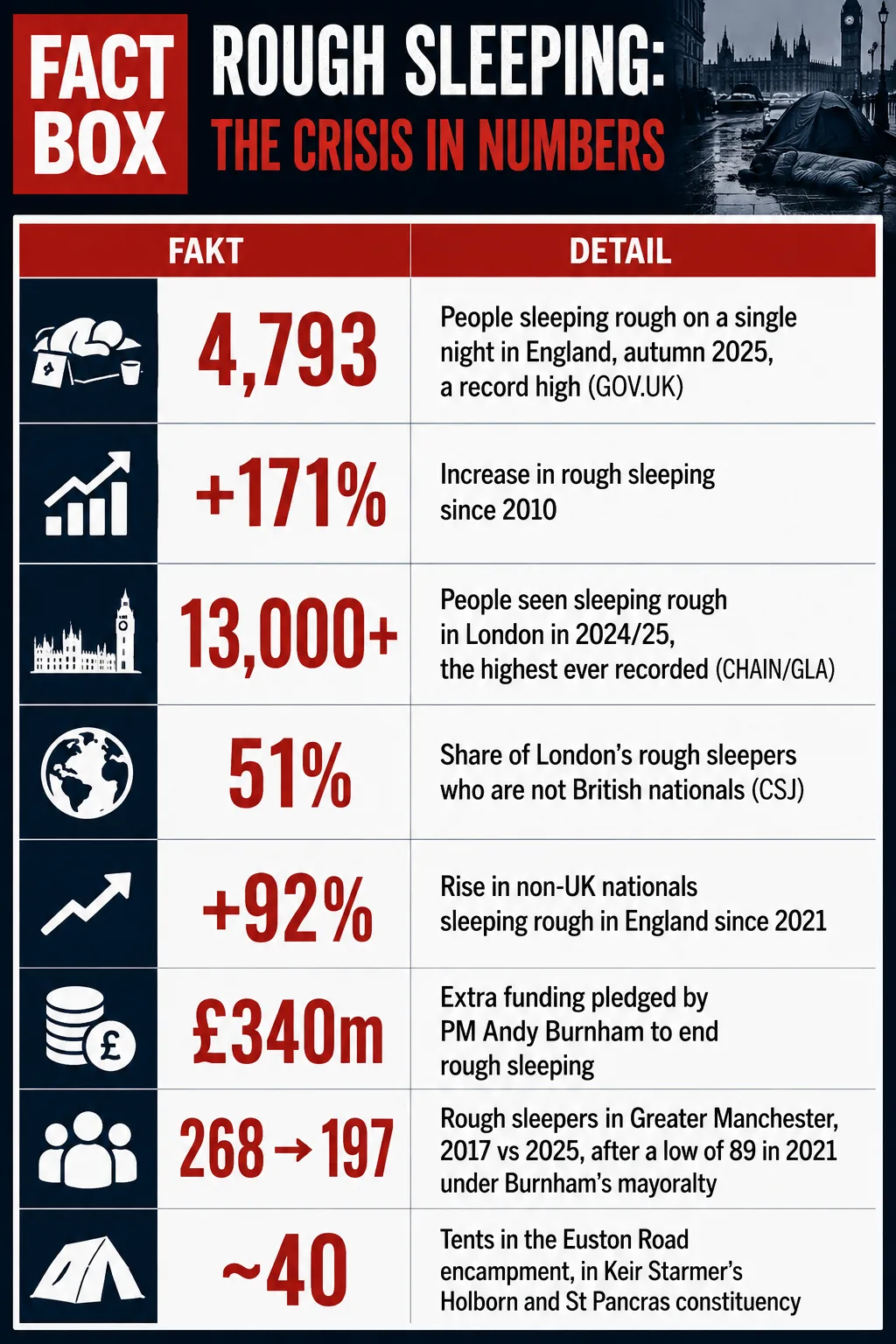
Emma Haddad, the chief executive of St Mungo's, which supports more than 3,150 people every night, has told Andy Burnham he must "urgently respond to record levels of rough sleeping", as photographs emerged of a sprawling encampment on Euston Road in central London, a camp that continues to grow despite the Prime Minister's very public pledge, made in his first speech in office, to end rough sleeping altogether.
The symbolism is almost too pointed to ignore. Some 40 shelters have been crammed onto a central reservation on one of the capital's busiest arterial roads, positioned precariously between two streams of traffic, tents propped up on wooden pallets and ringed by accumulated refuse. The camp, reportedly occupied mainly by Romanian and Bulgarian nationals, sits within Sir Keir Starmer's Holborn and St Pancras constituency, and the former prime minister is said to have made representations about it to Camden Council and the Metropolitan Police on behalf of his constituents. Similar tent cities have previously appeared near Marble Arch, Speaker's Corner and Oxford Street, turning some of the most visited corners of the capital into open-air testimony to a policy failure decades in the making.
"The fact that people are forced to sleep rough in 21st century Britain is a scandal," Dr Haddad told The Telegraph. "For too long, people have been forced to bed down on the pavements, where they face abuse, trauma, and worsening mental and physical health with every single night they continue to sleep rough."
The scale of the crisis
The numbers behind her intervention are stark. According to the government's own rough sleeping snapshot for autumn 2025, a record 4,793 people were estimated to be sleeping rough on a single night in England, a figure 171 per cent higher than in 2010, and equivalent to 8.2 people per 100,000 of the population. In London, the picture is grimmer still. Data from the CHAIN reports, compiled by outreach workers across the capital, show that more than 13,000 people were seen sleeping rough in London in 2024/25, the highest figure ever recorded and almost four times the level of fifteen years ago, according to analysis by Trust for London.
These are not abstractions. Each figure represents a person exposed nightly to violence, deteriorating health, and the slow erosion of the ability to rebuild a life. The longer rough sleeping persists for any individual, the harder and more expensive it becomes to reverse, a point on which the homelessness sector, across political lines, is entirely agreed.
A promise made, and a record that invites doubt
In his first speech as Prime Minister last month, Mr Burnham declared he would "end rough sleeping in our country" and earmarked an additional £340 million towards the goal. "For too long, we've been told that ending rough sleeping will take decades or even that it's impossible," he said. "I'm not having that. This is something a government can fix if it chooses to. Today, I'm choosing to."
The rhetoric is confident. The record, however, is more complicated, and it is precisely this gap between word and outcome that makes the coming months so revealing of the Prime Minister's true intentions towards the most vulnerable of his citizens.
As Mayor of Greater Manchester, Mr Burnham made ending homelessness a signature pledge, launching the flagship A Bed Every Night scheme in 2017, when 268 people were recorded sleeping rough in the city region. The count fell to 89 by 2021, a decline widely acknowledged to have been flattered by the exceptional "Everyone In" initiative during the coronavirus lockdowns. Since then, as reported by the BBC and local investigators at The Manchester Mill, the numbers have risen in each of the past four years, reaching 197 in 2025.
His political opponents have been quick to draw the conclusion. Robert Jenrick, Reform UK's economy spokesman, remarked that Mr Burnham "is not the first person I'd pick up the phone to for advice on how to tackle rough sleeping", while Sir James Cleverly, the Conservative shadow housing secretary, said the Prime Minister had failed his 2020 mayoral pledge "because he didn't do the hard work".
Such attacks are predictable. The more uncomfortable question is whether they contain a kernel of truth, and whether Mr Burnham's premiership will be defined by the same pattern observed in Manchester: early progress, loudly claimed, followed by quiet regression once the political spotlight moves on. How a leader treats those with no voice, no vote worth courting, and no lobby behind them, is among the most honest measures of what that leader actually believes government is for.
The migration dimension no one wants to name
To have any realistic chance of keeping his promise, Mr Burnham will also have to confront a driver of the crisis that politicians of every stripe have been reluctant to discuss candidly. Analysis by the Centre for Social Justice shows that the number of non-UK nationals sleeping rough across England has risen by 92 per cent in the four years since 2021, and by 396 per cent among non-EU nationals. One in four rough sleepers nationwide is now a foreign national, and in London the figure rises to more than half, 51 per cent, with the think tank's further analysis finding that 5,667 non-UK nationals slept rough in the capital in 2025/26, against 5,475 British nationals.
A homelessness strategy that refuses to grapple with the failures of the asylum and immigration system is, on this evidence, a strategy designed to fall short.
What must be done
Dr Haddad's prescription is unambiguous: scale up the interventions proven to move people off the streets quickly, build genuinely affordable homes at pace, and restore local housing allowance to a level that actually covers rent. "Burnham's biggest challenge will be confronting all of these systemic problems head-on, and galvanising action across Government to end this moral tragedy, once and for all," she said.
The £340 million pledge is a beginning, not a solution. The tents on Euston Road, visible from the constituency of the man Mr Burnham replaced, are a daily reminder that declarations do not house anyone. The country has heard prime ministers promise to end rough sleeping before. What it has not yet seen is one who treated the promise as a test of his own character, and passed it.
Fact Box