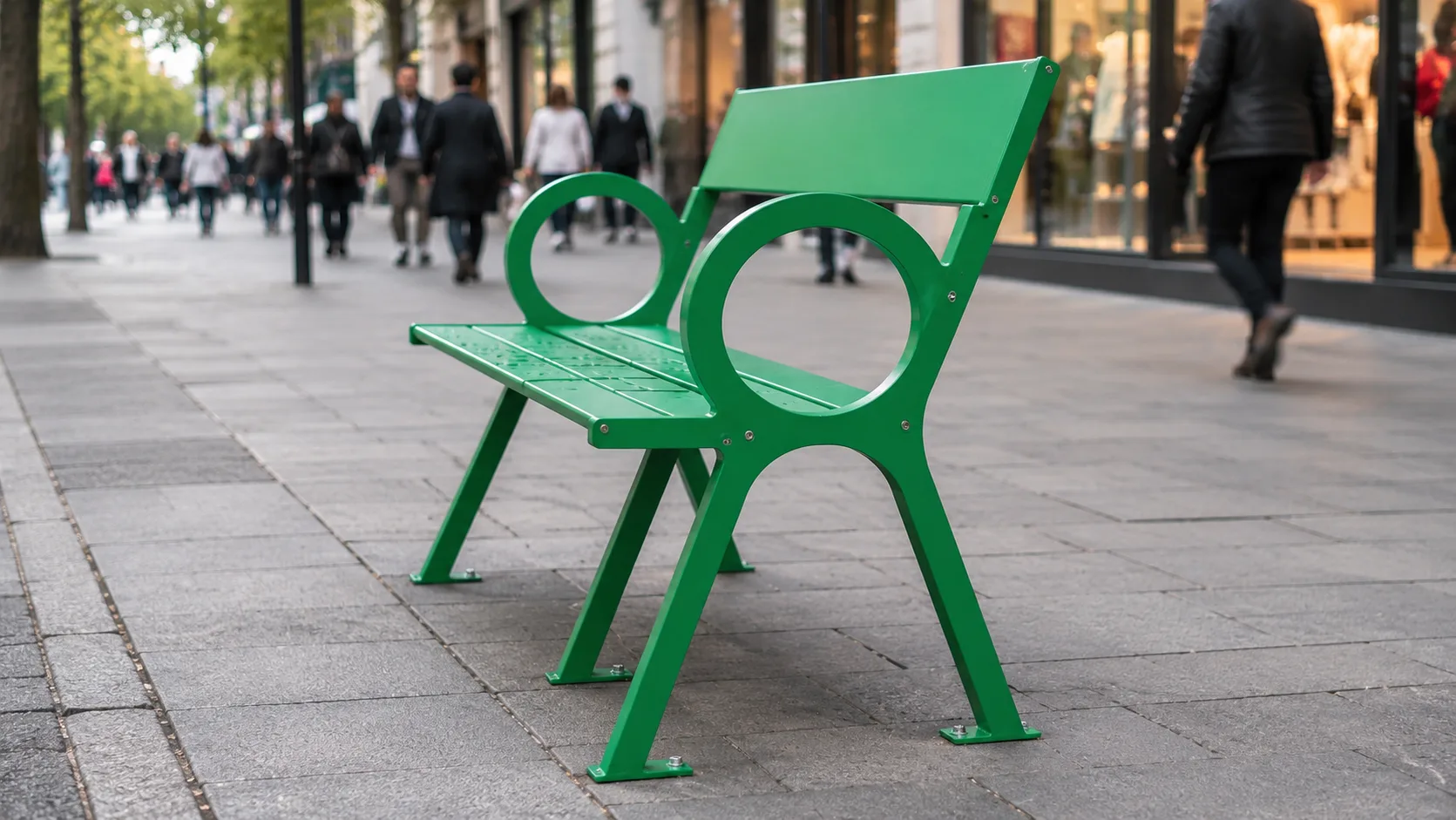
Spanish benches have been installed on the street Lord Khan promises to make the pride of Britain. Six are already fixed to the pavement on the stretch of Oxford Street he closed to buses, taxis, cars and cyclists on 26 October. More than 50 are on the way. Each costs about £1,540 before it is shipped, installed or maintained, and the reported value of the order is at least £86,000.
Those benches sit inside a transformation programme planning about £144m of capital spending. The benches are not the £144m, and the £144m is not yet a bill presented to taxpayers. But the two numbers belong in the same sentence, because no contract for the seating has been published, and no current account of who is paying for the rest has been placed before the public.
That is the political question. Not whether green steel looks well on Oxford Street, but whether a Labour Mayor given control of Britain's most famous shopping street can account for how the money is being spent, and whether the British firms he says he wants to back were ever asked to quote.
A bench, a bill and a Spanish catalogue
The figures were established this week by The Telegraph, which reported six benches installed between Orchard Street and Great Portland Street, more than 50 still to be erected, and a unit price of around £1,540 excluding import and installation. GB News put the unit cost at about £1,570 and the total close to £90,000. Two national outlets, two sets of numbers, one fortnight after the street reopened, and still no published contract.
The reported figure is a procurement estimate, not a settled account of money already paid. The Oxford Street Development Corporation (OSDC), the mayoral body running the project, has not published the precise number ordered, the total contract value or the payment schedule.
The manufacturer is Urbidermis, a Spanish street furniture business. Its Perisphere bench is described by the company as "a tribute to the bench designed for the New York World Fair" by James Corner's Field Operations, with "a colour palette designed to enhance spaces". It carries a list price of $2,060, about £1,570, and the company holds B Corporation certification for social and environmental performance.
The corporation will not say what the benches cost to land and fix. "Due to commercial confidentiality, we do not discuss the cost of individual elements of the project," a spokesman told GB News, adding that all elements are "within the agreed budgetary guidelines" and that suppliers were chosen after "a full procurement process".
Its wider defence is reasonable on its own terms. It says more than 15,000 people pass along the street every hour, that the benches must withstand heavy use, and that older and disabled visitors need somewhere to rest at regular intervals. Accessible seating on a pedestrianised shopping street is a legitimate public good, and the case for durable furniture in a location used by millions is not in dispute.
The dispute is about disclosure. A body spending public money on a public street has withheld the unit cost while a newspaper was able to publish it. That leaves taxpayers unable to examine the full cost of a publicly funded purchase. The corporation may have run a proper process. Without the paperwork, nobody outside it can say whether that process delivered value for money, and the published material has not demonstrated that the procurement delivered value for money.
For shoppers, the verdict was blunter. "It looks pretty plain. I mean, it's a bench. I don't think it's worth £1,500," Axel Simbad, 20, told The Telegraph. Ella Clarke, also 20, put the value at £250. A group of Swedish tourists suggested importing timber instead. John O'Connell, chief executive of the TaxPayers' Alliance, told GB News that "a large bill for tacky furniture will leave taxpayers scratching their heads".
The council that no longer decides
Westminster City Council has opposed pedestrianisation since it rejected an earlier version of the scheme in 2018. It now has very little power to shape this one, and the manner in which that power was removed is central to the story.
Oxford Street was redesignated a GLA road, making Transport for London, which the Mayor chairs, the highway authority. Planning control followed. The Oxford Street Development Corporation (Functions) Order 2026 was made on 14 July and came into force on 10 August, transferring planning decision making for the Mayoral Development Area from Westminster and Camden to the corporation, as the council's own guidance confirms. The order was made by ministers. Labour in government supplied the legal architecture within which a Labour Mayor now exercises control over the street.
That is a decision with consequences beyond planning applications. Councillors elected in Westminster lost the power to determine what happens on a road running through their borough, and the residents whose side streets absorb diverted traffic lost the representatives best placed to press their case. When a government transfers authority away from local councils, it takes on a duty to ensure the body receiving it is more transparent, not less. On the evidence of the benches, that duty has not been met.
The corporation's board is appointed by the Mayor and includes his Deputy Mayor for Business and Growth, Howard Dawber. Eight of its 12 members were chosen by Lord Khan, according to The Telegraph. The board sets strategy and approves the budget, business plan and "major expenditures", according to its own governance pages. It is chaired by the retail veteran Scott Parsons and run by chief executive Nabeel Khan.
Responsibility divides cleanly enough on paper. The Government made the order. The Mayor appointed the board, redesignated the road and ordered the closure. The corporation oversees the programme and its budget, while the precise procurement and approval arrangements for the benches have not been fully disclosed, and the identity of the contracting authority and the official who signed off the purchase has not been published. Those distinct responsibilities make a public record of procurement decisions, expenditure approvals and financial oversight essential. A complete public record of the bench procurement and approval process has not been identified.
Formal oversight is not absent. The corporation publishes board papers through City Hall's committee system, has an audit and risk committee, and its accounts are audited by Ernst and Young. The London Assembly can question the Mayor. None of that amounts to the direct democratic control Westminster's councillors once exercised, and none of it has produced a published contract value for the benches.
When the board met in September, Councillor Paul Swaddle, the leader of Westminster, whose Conservatives took the council from Labour this year, recorded his "disappointment" that the seating had not been sourced from a British company. His deputy leader, Councillor Tim Barnes, said: "There seems to be a belief we can turn Oxford Street into La Rambla by aping their style. That is misguided. It is British and we enjoy Spanish weather for about six weeks if you are lucky."
Councillor Elliot Keck, Westminster's deputy cabinet member for value for money, said: "Buying high-end benches from Barcelona won't magic Oxford Street into La Rambla. All it will do is waste yet more taxpayer cash on a vanity project already going horribly wrong."
Westminster's objections go beyond furniture. The council accused the Mayor of "cheating the system" by avoiding a full environmental impact assessment for traffic displaced onto surrounding streets, a charge he and the Government reject, as Fitzrovia News reported.
Lawful is not the same as defensible
There is no established evidence that the benches were purchased unlawfully. The unanswered question is whether the procurement process delivered demonstrable value for money.
Some legal context is still worth stating, because it is routinely misused by both sides. Spain's suppliers are covered by the World Trade Organisation's Government Procurement Agreement through the European Union, which is a party to the agreement, rather than through an independent Spanish membership. The United Kingdom has been a party in its own right since 1 January 2021, and the UK-EU Trade and Cooperation Agreement may also bear on access, depending on the procurement's coverage. Where those obligations apply, discrimination against covered suppliers is not permitted. British ministers have in the past encouraged public bodies to use the flexibilities available, particularly below the relevant thresholds, but the corporation has not said which regime governed this purchase or how it applied it.
That settles nothing about value. The law has never stopped a public body from publicising an opportunity to UK manufacturers, inviting them to bid, weighting social and economic value in its evaluation, or publishing how it reached its decision. Those are choices of approach and disclosure, and they are precisely the choices the corporation has declined to explain.
Britain has a substantial street furniture sector. A regeneration project of national significance, backed by a Mayor who talks constantly about growth and British jobs, might reasonably have been expected to test what those firms could offer on price, durability and delivery. It may be that none could match the Spanish product. It may be that the specification ruled them out. The public is entitled to know which, and the corporation's published statements do not answer whether British manufacturers were invited to compete.
Its account of its own procurement is thin to the point of evasion. It says the supplier was chosen for "high quality, robustness and sustainability" after a "thorough procurement process". It has not said how many firms were approached, how many bid, whether any British firm was among them, what weight was given to UK economic value, what the contract is worth in total, or who signed it off. Those are not state secrets. They are the ordinary record of a public purchase.
The Mayor's supporters will say a bench is a bench and the price is a rounding error inside a £144m programme. That argument fails on its own logic. If the sum is trivial, disclosure costs nothing. If the principle is that public bodies should buy well and buy transparently, this is exactly the kind of small contract where the principle is either honoured or quietly abandoned.
The private money that has not been identified
The funding question is where the benches stop being a curiosity and become a test of the Mayor's word.
Giving evidence to the London Assembly on his 2025-26 budget, Lord Khan was categorical that the scheme would not be financed from his own budget. "You will not be seeing big sums of money from my budget being spent on this project because I'm confident we will get the monies from third parties," he said, according to OnLondon. The cost was then put at around £150m.
The corporation's published budget, approved in March, describes a different arrangement. The Mayor had already committed £14.3m in his 2025-26 budget to start work, including £6.3m brought back from 2026-27. The corporation was given an £18m mayoral funding control total, and its net revenue expenditure for 2026-27 is budgeted at that same £18m, funded "via a transfer from GLA Group funds". Those are not three separate pots to be added together. They describe a programme whose running costs in its first full year are met from public money, not from the third parties the Mayor promised.
The capital side is where the risk sits. The corporation expects about £27m of capital expenditure in 2026-27 and about £144m across the programme. Those costs are assumed to be borrowed on an annuity basis and repaid over 15 years, with the capital financing charge already sitting in the revenue budget at £2.8m in the first year. Commercial income is expected "eventually" to fund a large proportion of operating costs and any borrowing.
The budget then records a funding gap of £20m in 2027-28 and £24.1m in 2028-29, to be met from "a combination of GLA Group funds and commercial income" that had not been identified. It concedes that no commercial strategy yet exists, that income is expected to come from advertising, events, partnerships, planning fees and philanthropic contributions, and that the corporation expects to raise only about £300,000 in planning fees in its first year.
Anticipated revenue is not secured investment, and a forecast gap is not proof of failure. Those figures describe the position as budgeted in March. The corporation may since have signed agreements it has not published, and if it has, the remedy is simple: publish them.
That is the challenge Lord Khan now faces. He told the Assembly that third parties would pay. His corporation's own budget shows public borrowing, a GLA transfer and requirements of £20m and £24.1m in the following two years, to be met through a combination of GLA Group funding and commercial income that had not been identified. If the advertising and events money does not arrive, the annuity payments still fall due, and the budget does not say who carries that risk. A Mayor who is confident of his private backers should have no difficulty producing the schedule of what has been signed, what is being negotiated and what remains exposed. The Mayor has not provided a publicly verifiable, up-to-date breakdown of the commercial funding commitments cited in the available reporting.
Sir James Cleverly, who left the shadow cabinet in August to seek the Conservative nomination for Mayor, argues the arithmetic is already known. "At £144m it is already three times more expensive than similar projects elsewhere, and with no commercial funding in sight, taxpayers will be left to pick up the bill," he told The Telegraph. The comparison with other schemes is his assessment rather than an audited finding. The absence of identified commercial funding is recorded in the corporation's own budget.
Two weeks of data and a longer list of concerns
The Mayor has had a good fortnight on the numbers, and they should be reported as such. City Hall announced that footfall in the traffic-free section rose 16 per cent on the equivalent half-term week last year, international visitor numbers rose 42 per cent, evening visits rose 19 per cent, and spending recorded by the payments firm Adyen rose 28 per cent from £2.9m to £3.7m. In-store transactions were up 19 per cent. Dan Hills of Market Halls said footfall at his Oxford Street site rose 29 per cent and sales 25 per cent.
Those are encouraging figures, and nobody serious should pretend otherwise. They are also one week of data gathered during school half-term, published two weeks after the street closed, and they cannot on their own establish the long-term success of the scheme. Michael Bolt of the Marylebone Association points out that TfL's revised timetables allow seven to nine extra minutes on route 98, an increase of up to 53 per cent, and asks why the second week, when normal traffic returned, has not been released. Shoppers have raised concerns about accessibility and the distance to relocated bus stops and taxi ranks. The BBC's own correspondent warned that the numbers may reflect a honeymoon period, as the corporation's first week figures were reported.
More visitors may well make the case for a traffic-free street. They say nothing about whether the seating contract was good value, whether the procurement was properly tested, or whether the promised private investment exists. Those are separate questions, and the Mayor's allies routinely use the first to avoid the second.
What remains unexplained
Four questions should be answered before the remaining benches are installed.
What is the total contract value, including freight from Spain, installation, replacement parts and any maintenance agreement, and how many units have been ordered? Which companies were invited to bid, how many responded, and was any British manufacturer among them? Who approved the expenditure, under which delegation, and will the contract be published? And what is the current breakdown of funding: what is secured, what is borrowing, what is grant, and what is still a hope?
The corporation says it followed a proper process and is within budget. It may be right. It has not yet shown its workings, and until it does, the benches will remain a small, expensive, imported symbol of a much larger promise whose costs, funding assumptions and value for money deserve far greater public scrutiny.
GREAT BRITISH PAC REACTION
Labour's priority on Oxford Street has been speed and spectacle, not stewardship of public money. That is a political judgement, and the record supports it. A Labour Mayor closed one of Britain's most famous streets, took mayoral control of the body that runs it, and has presided over a programme whose first furniture came from Spain at £1,540 a bench and whose contract has not been published. The same Mayor told the London Assembly that private investors would pay, while his corporation's published budget identified £20m and £24.1m of funding requirements over the following two financial years, to be met through a combination of GLA Group funds and commercial income that had not yet been identified. Projected income is not secured financing, and a Mayor who cannot produce a schedule of signed commitments should not expect taxpayers to underwrite the difference.
The issue is not the nationality of the benches. Great British PAC is not asking for foreign suppliers to be barred, and no serious campaign would. The issue is public money, whether British businesses were given a fair opportunity to compete for it, and whether the Mayor can produce a document showing that the price paid represents the best available value. On all three, the published record is incomplete.
Great British PAC makes four demands.
Publish the full procurement costs. The corporation must release the complete contract value, freight charges from Spain, installation costs, replacement parts, any maintenance agreement and the total number of benches purchased, alongside the signing date and the officer or board member who approved the expenditure. Commercial confidentiality should not become a blanket excuse for withholding information taxpayers need to judge whether a publicly funded purchase represents value for money. Where public money is spent on a public street, the public is entitled to the invoice.
Explain why British suppliers were not selected. Great British PAC does not claim that any rule was broken, that British firms were excluded, or that a UK bench would necessarily have been cheaper. We say the question has never been answered, and it must be. The corporation should publish the specification, the firms approached, the bids received, the evaluation criteria and the weight given to UK economic and social value. If British manufacturers could not meet the specification at a competitive price, show the evidence. If they were never asked, explain the omission to the businesses and workers the Mayor says he is backing.
Publish the private funding commitments. The Mayor told the Assembly that third parties would pay. His corporation's published budget identified £20m and £24.1m of funding requirements over the following two financial years, to be met through a combination of GLA Group funds and commercial income that had not yet been identified. Great British PAC is demanding a current, dated breakdown of what is contractually secured, what is projected, what is borrowed, what the public has already contributed and who carries the risk if commercial income does not arrive. A forecast is not a commitment, a press release is not a funding agreement, and a Mayor who cannot produce a schedule of signed deals should not expect taxpayers to underwrite the difference.
Restore meaningful public accountability. Planning powers were moved from elected councillors in Westminster and Camden to a mayoral body by government order. Labour ministers created that framework and must answer for the standard of transparency it has produced. Great British PAC is demanding published board decisions on all expenditure above a stated threshold, accessible procurement records, a clear line of ministerial and mayoral responsibility for the scheme, and regular public reporting of costs against outcomes. A Mayor who holds these powers must be answerable for how he uses them, not merely available for interview when the footfall figures are good.
Claire Bullivant, Chief Executive Officer of Great British PAC, said:
“Sadiq Khan's arrogance with taxpayers' money is absolutely breathtaking. At a time when British families are being squeezed, businesses are struggling and Londoners are being asked to pay more and more, Labour's Mayor thinks it's perfectly acceptable to splash out around £86,000 on benches imported from Spain. You really couldn't make it up.
“This is a Mayor who never misses an opportunity to lecture the rest of us about supporting British jobs and growing the British economy, yet when it comes to spending public money on Britain's most famous shopping street, it's Spanish manufacturers who get the business. Were British companies even given a fair chance? If they were, why won't he show us the paperwork?
“And the benches are just the tip of the iceberg. Behind this extravagance sits a £144 million scheme, with public borrowing planned and serious questions about where the promised private funding is coming from. Khan promised that third parties would foot the bill. Now Londoners are entitled to ask whether they'll be left picking up the pieces.
“This is Labour all over. Grand promises, expensive vanity projects, endless self-congratulation and an apparently bottomless appetite for other people's money.
“Let me remind Sadiq Khan of something Labour politicians seem to forget far too easily. Taxpayers' money is not your personal piggy bank. It belongs to the hardworking people of this country, and every single penny should be treated with respect.
“Britain doesn't need a Mayor who can find £1,500 for a Spanish bench but apparently can't find the time to explain how public money is being spent. We need leaders who back British businesses, respect taxpayers and understand the difference between public service and personal vanity.
“Mr Khan, stop treating London like your private playground, publish the contracts, show us the funding and explain why British manufacturers weren't chosen. The British public deserve answers, not another expensive place to sit while Labour wastes their money.”
Revitalising Oxford Street is a legitimate ambition, and nobody at Great British PAC wants to see the nation's high street fade. But ambition is not a substitute for financial transparency, responsible procurement or political accountability. Labour and Lord Khan should now publish the contract, the bidders, the funding schedule and the costs, and let taxpayers judge whether the promises made about this project match the money being spent on it. If the case is as strong as the Mayor says, the evidence will prove it. If it is not, no amount of footfall data will.