Written parliamentary answers show that eight of the 23 ministerial departments asked disclosed at least £1.89 million of spending on influencers and content creators since July 2024. Including HMRC and NHS England’s national campaigns team takes the disclosed total to at least £2.54 million. Reporting based on the same answers put the number of influencers and content creators used across government at 215.
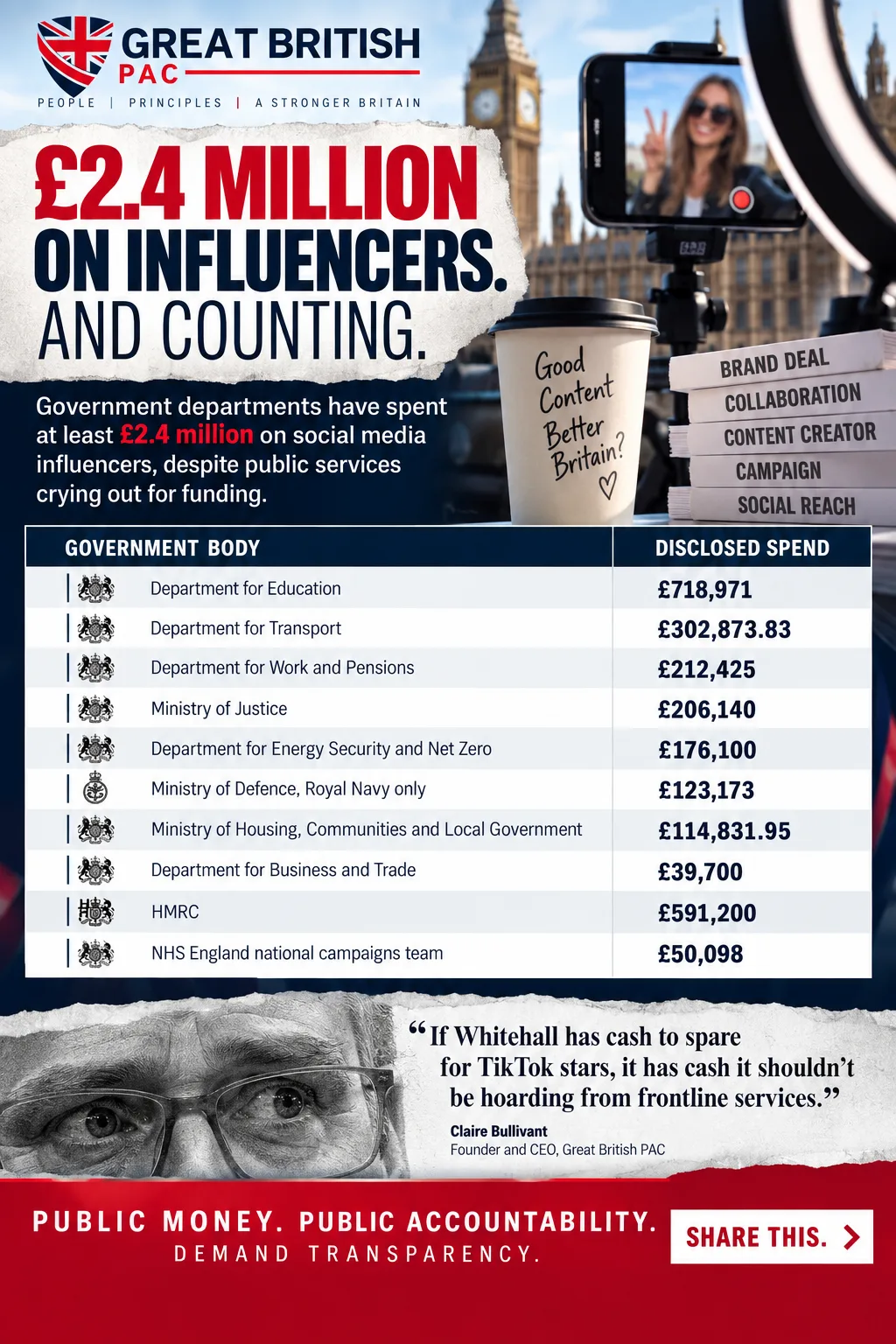
At least eight ministerial departments have disclosed £1,894,214.78 of spending on influencers and content creators since July 2024, according to written parliamentary answers, with HMRC and NHS England’s national campaigns team taking the disclosed total to £2,535,512.78.
The figure for ministerial departments covers only those that provided a monetary answer. It does not include departments that said they spent nothing, departments that said the information was not held centrally, or bodies outside that 23-department group. The total also combines figures reported on slightly different bases. Some departments gave totals since July 2024, while the Department for Education’s published figures are recorded by financial year and extend into the current year.
The spending sits awkwardly beside the Government’s own claim, made in a Treasury answer in March 2025, that it had taken “decisive action to reduce wasteful spend”.
The first eight rows are ministerial departments. Their disclosed spending comes to £1,894,214.78. HMRC and NHS England are separate public bodies, so they are not part of that ministerial-department total. Add them in, and the disclosed figure rises to £2,535,512.78.
The Department for Education accounts for the largest ministerial total. In a written answer in May, ministers said the department had spent £708,971 across the 2024-25 and 2025-26 financial years, made up of £119,300 in 2024-25 and £589,671 in 2025-26. A later answer said the department had also spent £10,000 in the current financial year to date, taking the disclosed total to £718,971.
Departments defend the practice by arguing that public information is now consumed differently. In a written answer on 8 September, the Department for Transport said today’s media landscape is “unrecognisable compared to even a decade ago” and that government has a duty to “engage with the public where they are, using channels and voices they trust”.
Since succeeding Sir Keir Starmer in July, Andy Burnham has signalled that he intends to keep a “more social first” approach. One Downing Street source told the BBC that No 10 wanted content that was “less high production, polished” and more “authentic to Andy”, including collaborations with creators on X, Instagram and TikTok.
HMRC disclosed spending of £591,200, excluding agency fees, between July 2024 and August 2026, more than any of the other bodies listed. In a written answer on 8 September, James Murray, the Financial Secretary to the Treasury, said HMRC worked with Pablo, part of Unlimited Group, now Accenture Song, as its “specialist agency to support engagement with social media influencers”. He said influencers helped HMRC reach audiences with “clear and accessible information through authentic and trusted voices”.
The Department for Transport disclosed £302,873.83 since July 2024, including agency and wider fees. Justin Madders, parliamentary under-secretary at the department, said content creators were “paid fairly for their services, time and expertise in content creation”. The department has used influencers as part of its long-running THINK! road safety work.
The Department for Work and Pensions disclosed £212,425 since July 2024. The Ministry of Justice said it had worked with 12 content creators on campaigns encouraging applications for prison officer, probation and magistrates’ roles. Jake Richards, a justice minister, said the use of content creators could “often provide a more effective and cost-efficient way of reaching audiences than traditional advertising”.
The Department for Business and Trade said that, apart from its 2025 National Minimum Wage and National Living Wage campaign, it had not commissioned influencers for other paid advertising campaigns since July 2024. The BBC reported that the department’s disclosed spending total was £39,700.
In May, Bridget Phillipson, then education secretary, appeared in a Department for Education video with Gemma Collins promoting vocational study. The department said Collins was not paid. The campaign was intended to draw attention to V-levels. Critics pointed to Collins’s long-quoted line, “I’m going to be famous, I don’t need maths.”
The Department for Education said it worked with influencers across a range of activities, including paid partnerships, PR activity and content creation. A later answer said spending in 2025-26 and the current year covered campaigns including Skills for Life, Best Start in Life, Get Into Teaching and further education teacher recruitment. The DfE says the reality star cost it nothing. What many of the others were paid remains undisclosed.
In the same March 2025 Treasury answer, ministers said the Government Communication Service expected to save £50 million in 2024-25 and £85 million in 2025-26 by “reducing unnecessary communications spend”. The shift towards creators has happened alongside a broader change in tone and channel. The Telegraph reported last year that No 10 had cut the Westminster lobby’s two daily briefings to one, with Sir Keir’s approval.
Younger voters also provide political context for the shift towards social media. YouGov’s post-election analysis of more than 35,000 voters found that Labour took between 41 and 46 per cent across every age group under 50 in the 2024 general election. In a separate YouGov analysis of more than 17,000 Britons published at the start of 2026, the Greens were leading among under-30s and had 37 per cent among 18 to 24 year olds.
Claire Bullivant, CEO of Great British PAC, said:
“This is taxpayers' money being funnelled into influencer marketing while public services are crying out for funding. Nearly £2.4 million and counting has gone to social media personalities, and two-thirds of departments won't even tell us what they've spent. If Whitehall has cash to spare for TikTok stars, it has cash it shouldn't be hoarding from frontline services. British taxpayers deserve transparency, not spin dressed up as 'communications strategy'.”
Official figures put the Government Communication Service workforce at 6,150 staff. Ministers have still disclosed at least £1.89 million of influencer spending by eight of the 23 ministerial departments asked since July 2024, with HMRC and NHS England’s national campaigns team taking the disclosed total to £2.54 million.