

There is, at last, some light at the end of the tunnel. After weeks of public anger, political pressure and a petition that gathered more than a million signatures, the Justice Secretary has told police chiefs he is confident that two of the killers of Pc Andrew Harper will be barred from early release from prison.
Alex Norris is expected to announce changes to the Government's early release scheme next week, changes that will exclude prisoners convicted of the type of manslaughter for which Albert Bowers and Jessie Cole were jailed in 2020. We at the Great British PAC are glad that this injustice could be stopped. It is a victory for common sense, for the police family, and above all for Lissie Harper, whose tireless campaigning has ensured that her husband's memory has never been allowed to fade from the national conscience.
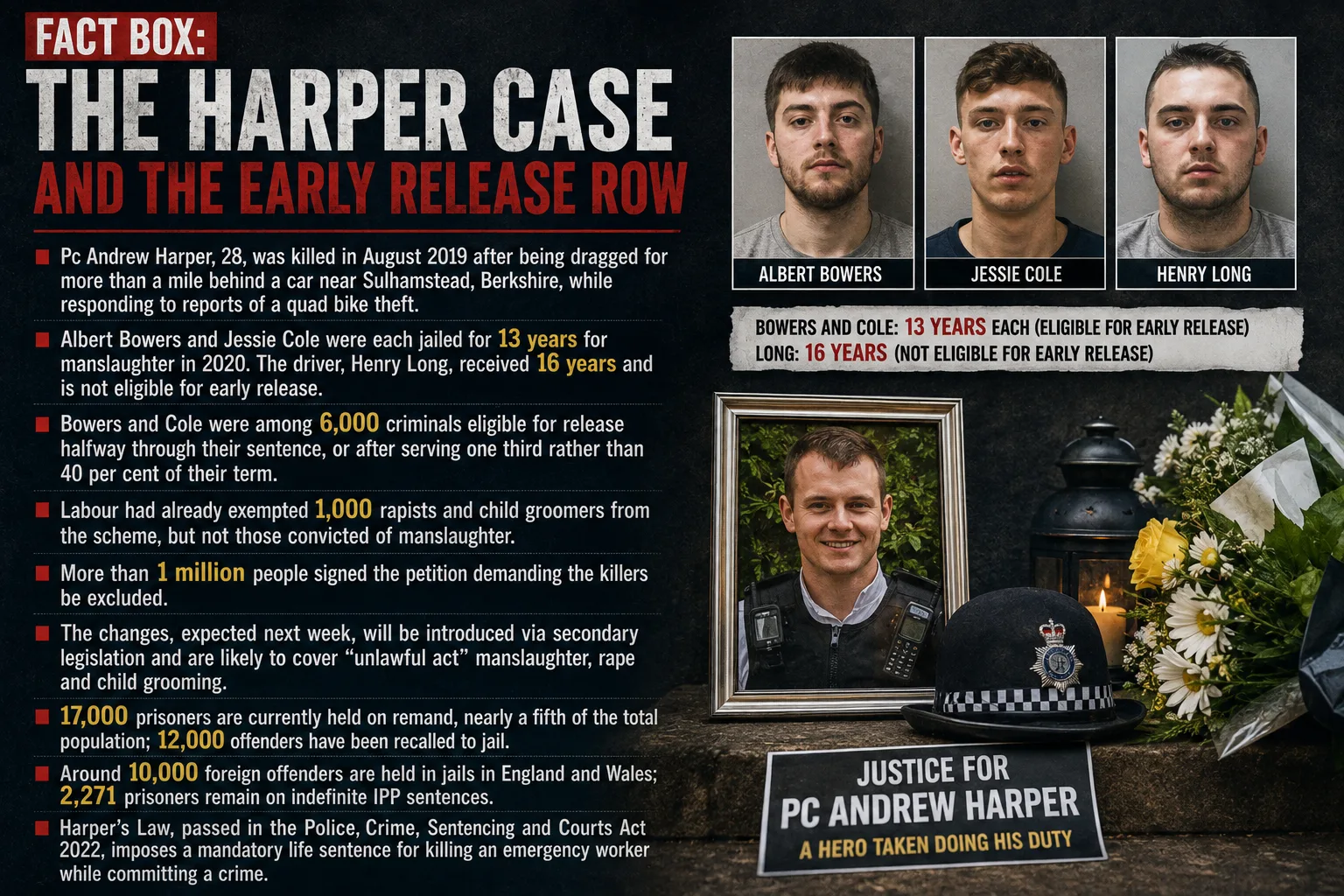
Pc Harper, just 28 years old and newly married, was dragged for more than a mile behind a car after responding to reports of a theft near Sulhamstead, Berkshire, in August 2019. Bowers and Cole, who were attempting to steal a quad bike and fled when the officer arrived, were each sentenced to 13 years for manslaughter. The driver, Henry Long, received 16 years and, crucially, is not eligible for early release under the existing rules.
The Great British PAC revealed last month that Bowers and Cole were among some 6,000 criminals eligible for release either halfway through their sentence, rather than the usual two thirds, or after serving one third rather than 40 per cent of their prison terms. The revelation caused uproar, and rightly so. The early release scheme, commonly known as SDS40, is a central plank of the Government's efforts to avoid running out of prison space, with eligible prisoners automatically released on licence after serving 40 per cent of their sentence rather than 50 per cent House of Commons Library.
After an initial backlash, Labour agreed to exempt around 1,000 rapists and child groomers from the scheme, but pointedly declined to exclude those convicted of manslaughter. That omission left the door open for two men responsible for the death of a serving police officer to walk free years early, a prospect that united police chiefs, front line officers and the wider public in disgust.
Under pressure from all quarters, including a million strong petition calling on the Government to stop the early release of Pc Harper's killers Change.org, the Deputy Prime Minister, Andy Burnham, announced a further review by Mr Norris to find a way to exempt the two killers and "other individuals" caught by the same anomaly.
Police chiefs have now been told that Mr Norris plans to introduce secondary legislation, a mechanism that allows existing laws to be changed quickly, to enact the reforms. The changes are likely to cover manslaughter, rape and child grooming. They are expected to exempt so called "unlawful act" manslaughter, where a person causes the death of another while committing an illegal act. That definition captures precisely what happened on the night Pc Harper died.
It is understood the unlawful killing exemption could also cover causing death by dangerous driving, but would not extend to voluntary manslaughter, an intentional killing with a partial defence such as sudden provocation, or gross negligence manslaughter, where death is caused by extreme carelessness.
Not everyone, however, will be satisfied. Domestic abusers may still be eligible for early release, partly because there is no specific offence to cover them other than coercive control. That gap is likely to prompt an angry response from domestic abuse campaigners and MPs, and the pressure on ministers is already building. Mr Burnham has been told in a letter signed by more than 100 organisations that the early release scheme "directly contradicts" Labour's manifesto pledge to halve violence against women and girls.
The letter states: "We note your party's manifesto commitment to halving VAWG in the decade and believe the scheme, the first major development for victims under your premiership, will instead put the lives of women and children at risk."
Police chiefs have been assured there will be no changes to the remand of suspects into custody, or to the recall of offenders to jail for breaches of licence or further crimes. There have been demands from some prison insiders to reduce the 17,000 prisoners held on remand, nearly a fifth of the total population, or the 12,000 offenders who have been recalled to jail. The Sentencing Act 2026 increased the length of time recalled prisoners must spend in custody to 56 days, to give prisons more time to prepare their re-release and avoid further licence breaches or reoffending.
Senior officers, including Sir Mark Rowley, the Commissioner of the Metropolitan Police, have complained that too many offenders are being freed on bail, allowing them to continue their criminal behaviour, because of concerns about prison overcrowding. The tension between prison capacity and public safety remains the defining problem of the Ministry of Justice.
The Justice Secretary is also said to want to repurpose some young offenders' institutions and parts of the women's prison estate to free up space, though it is thought unlikely that Mr Norris will announce any immediate decisions on such changes next week. The Prime Minister has previously said he wants the MoJ to deport more foreign offenders, who number around 10,000 in jails in England and Wales, and to review the 2,271 prisoners still serving indefinite Imprisonment for Public Protection sentences, many of whom were originally jailed for less serious offences. The IPP sentence, abolished in 2012, continues to cause profound controversy, and the Government has committed to reviewing those still subject to it House of Commons Library.
An MoJ spokesman said: "The death of Pc Andrew Harper was a horrific crime. Our thoughts are with his family and friends, and we share the anger from the police community that we are in this position.
"The Prime Minister has asked the Justice Secretary to work through further options to keep a greater number of the most serious offenders in prison, including the killers of Pc Harper.
"Thanks to tireless campaigning by Andrew's family, Harper's Law means that anyone convicted of killing an emergency worker whilst committing a crime now gets a mandatory life sentence. This Government has gone further by introducing a presumption that anyone convicted of murdering a police, prison or probation officer is handed a whole life order."
Harper's Law, introduced through the Police, Crime, Sentencing and Courts Act 2022, was a landmark reform born of tragedy GOV.UK. Section 3 of that Act inserted the required life sentence for the manslaughter of an emergency worker into law legislation.gov.uk. It stands as testament to what determined campaigning can achieve.
Yet the fact that a further battle was needed, simply to keep Pc Harper's own killers behind bars for the terms imposed on them, exposes how badly the early release scheme was conceived. A policy designed in haste to manage overcrowding came within weeks of freeing the very men whose crime shamed the nation.
The Great British PAC will continue to hold ministers to account. Exempting unlawful act manslaughter is a welcome and necessary correction, but the domestic abuse loophole, the remand crisis and the wider prison capacity emergency all demand the same urgency. The public has shown, through a million signatures, that it will not tolerate the premature release of those who kill. The Government has now listened. It must keep listening.