
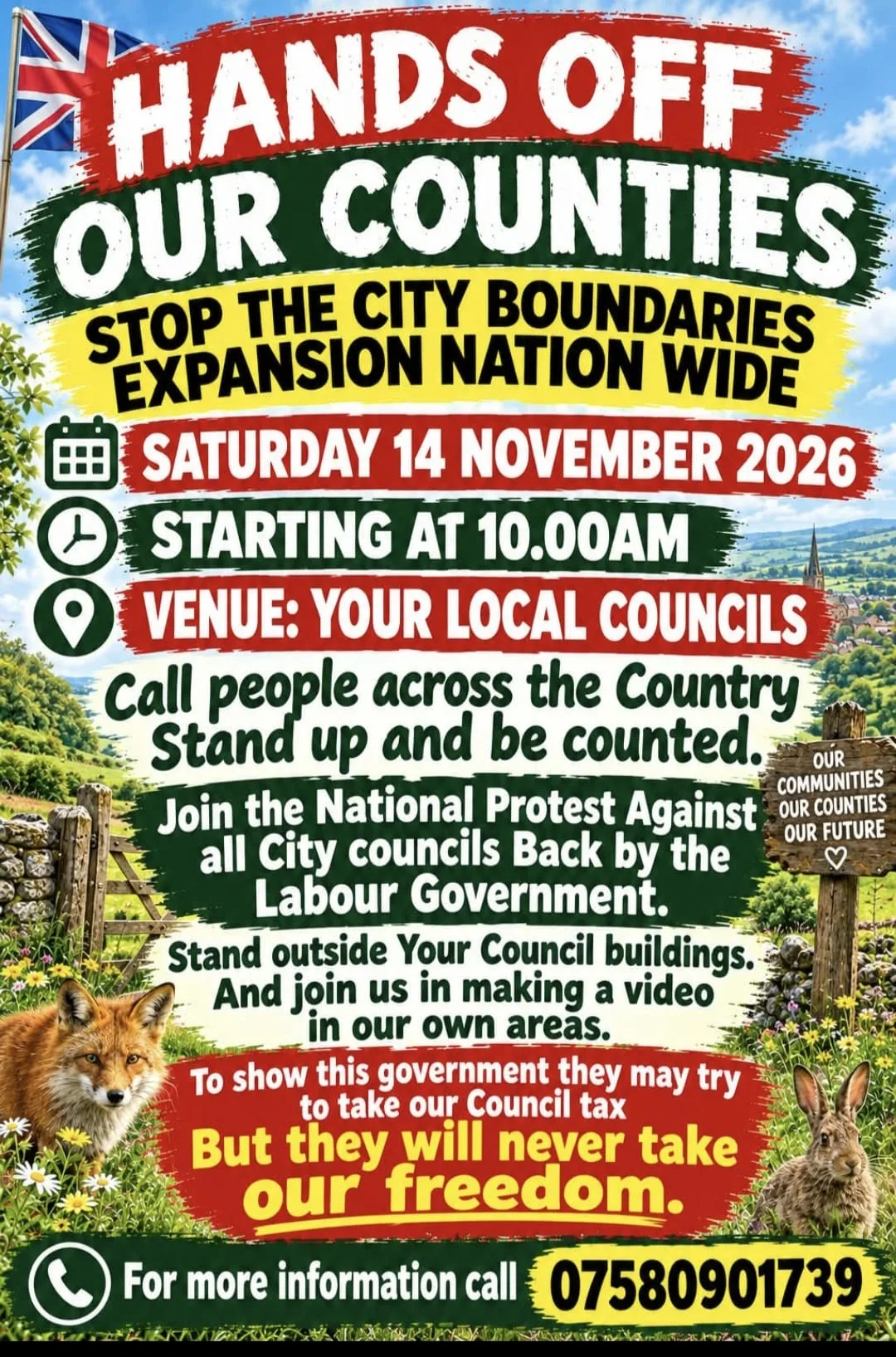
Local campaigns fighting council abolition, restructuring and boundary changes are preparing to join forces for a nationwide day of protest on Saturday 14 November. Under the slogan "Hands Off Our Counties", organisers are calling on residents across the country to gather outside their local council buildings and take part in coordinated local demonstrations.
It marks a step change in a dispute that has been fought, until now, county by county. Campaigners say the action is intended to draw together communities opposed to the Government's local government reorganisation programme, the process known as LGR, which has proposed abolishing existing councils, redrawing administrative boundaries and expanding cities into surrounding districts. Campaign material also carries the slogan "Stop the city boundaries expansion nationwide" and calls on residents to "Stand up and be counted".
From Leicestershire to a national protest
Organisers say demonstrations will begin at 10am on Saturday 14 November 2026 outside participating local council buildings. Supporters are being encouraged to gather peacefully, record videos from their communities and share them as part of the wider national campaign. Organisers are calling on residents across the country to take part. The full list of participating councils and groups has not yet been published, individual meeting points have not been confirmed, and local arrangements are expected to be announced locally. Residents should look to their own local organisers for details.
The national action follows the campaign reported by Great British PAC last month, in 40,000 signatures land at Downing Street as Leicestershire fights the carve-up of its councils.
On Monday 14 September, a delegation of Leicestershire MPs, council leaders and campaigners delivered petitions carrying more than 40,000 signatures to No 10 Downing Street, urging the Prime Minister, Andy Burnham, to abandon plans to expand Leicester into large parts of the surrounding county, as the BBC reported. The petitions were launched by the Conservative MPs Alberto Costa, Neil O'Brien, Peter Bedford and Alicia Kearns, and handed in with colleagues Luke Evans and Ed Argar.
The hand-in came a week after ministers paused the Leicester and Leicestershire scheme. For campaigners it was evidence that pressure was working, but not enough: they want the expansion scrapped altogether. That sequence, a local campaign, then a Downing Street petition, then a bid to mobilise nationally, is the one the 14 November event is designed to continue.
Government forced to review council shake-up
On 7 September 2026 the Government announced a review of the LGR programme. In a statement to the House of Commons, the Housing, Communities and Local Government Secretary, Angela Rayner, said she had withdrawn the decisions made in March for four areas, and that the Government's legal representatives had notified the court. She also announced a review and pause of decisions taken in July for a further 14 areas, alongside two areas where no decision has yet been taken.
The four withdrawn decisions cover Essex, Southend-on-Sea and Thurrock; Hampshire, the Isle of Wight, Portsmouth and Southampton; Norfolk; and Suffolk, according to the Government's letter to council leaders. The 14 areas now paused and under review are Derby and Derbyshire; Devon, Plymouth and Torbay; East Sussex and Brighton; Gloucestershire; Hertfordshire; Kent and Medway; Lancashire, Blackburn with Darwen and Blackpool; Leicester, Leicestershire and Rutland; Lincolnshire, North Lincolnshire and North East Lincolnshire; Nottingham and Nottinghamshire; Oxfordshire and West Berkshire; Staffordshire and Stoke-on-Trent; Warwickshire; and Worcestershire, as listed by the BBC.
It is important to be precise about what has and has not happened. Decisions in four areas have been withdrawn. Decisions in 14 areas are paused and under review. Cambridgeshire and Peterborough, and West Sussex, have no decisions yet and are being considered as part of the review. Reorganisation in Surrey is unaffected, with the new East and West Surrey authorities due to go live in April 2027. The Government has not abandoned LGR, and its stated legal powers remain valid, as its guidance published with the Local Government Association sets out. Local elections in May 2027 will go ahead on existing council boundaries.
The withdrawals followed legal challenges. Councils in Essex, Hampshire, Norfolk and Suffolk had launched or backed judicial review proceedings, and ministers cited updated legal advice when withdrawing the four decisions. But the four schemes were not struck down by a court. The decisions were withdrawn by ministers, and the Government's legal representatives notified the court of that step. Campaigners say the withdrawals and the wider review have given them additional reason to keep pressing ministers.
LGR is the replacement of existing county, district or borough councils with larger unitary authorities. Depending on the proposal in a given area, it can involve councils being abolished, administrative boundaries being redrawn, services being transferred, political representation changing, and responsibility for planning, social care, waste, housing and other local services shifting to a new authority. Not every proposal contains all of these changes. The Institute for Government and the House of Commons Library both set out the programme and its current status in detail.
Opponents argue the changes are being imposed without local consent. Concerns raised by MPs, councillors, campaign groups and sector bodies include loss of local identity; communities being absorbed into larger urban authorities; reduced local democratic representation; the absence of local referendums; disruption to services; transition costs; council tax; planning and housing; social care; accountability; and whether projected savings will actually materialise.
The Local Government Association, which represents councils, said there was "no excuse for the government's mishandling of this process" and that the announcement "will have caused significant uncertainty, after councils have invested scarce public money and countless hours". Sean Matthews of the County Councils Network said many members would be "relieved that the decisions they viewed as damaging to local services and financially unsustainable have been withdrawn or are being reviewed", The Guardian reported.
The Government argues that reorganisation can simplify local government, reduce duplication, improve efficiency, clarify who is responsible for services and support devolution, with the potential to deliver savings and better coordination. Its stated position is that it remains committed to "strong and sustainable local government", and to reorganisation "where it can help simplify structures, strengthen local leadership and create councils that are better placed to deliver for their communities". Single tier unitary authorities, it says, are "the foundation for devolution and best placed to be partners with mayors and strategic authorities", a case set out in the LGA and MHCLG guidance and in the Government's Cabinet statement on rewiring the state. Rayner told the Commons that her focus was "not savings but the outcomes for people in their local area".
Leicestershire remains a flashpoint
Leicestershire remains the most visible flashpoint. Under the Government's decision in July, the ten existing councils serving Leicestershire and Rutland would be dissolved and replaced by two unitary authorities from April 2028, Harborough District Council confirmed. One would cover Leicester, Oadby and Wigston and parts of Blaby, Charnwood and Harborough, taking in communities such as Syston and Birstall. The other would cover the remaining area of Leicestershire and Rutland. The Government consulted on the proposals in Leicester, Leicestershire and Rutland before reaching its decision.
Leicester's Labour mayor, Sir Peter Soulsby, who proposed the expanded city, argues that the communities in question are already closely connected to Leicester and that extending the boundary would provide space for growth, including a city housing need he puts at 30,000 new homes by 2046, according to Leicester City Council. The city council estimates that its preferred option would deliver annual efficiency savings of £46 million across Leicester, Leicestershire and Rutland, based on financial modelling it says was jointly commissioned with the county council, with the savings returned to frontline services. That figure is the city council's estimate and depends on its assumptions about the proposed structure.
Critics describe the proposals as a land grab. Harborough District Council's leader, Cllr Whelband, said the decision was "a slap in the face for the people of Harborough" and that the Government had "chosen to ignore the views of local communities". The Government has made a similar case for reform, saying one council in charge of decisions "will speed up the construction of new homes and infrastructure, improve public services and boost regional growth". Soulsby expects delay rather than cancellation, and the scheme now sits among the 14 paused areas, so its future turns on the review.
Great British PAC has supported the Leicestershire campaign from the ground up and covered the Downing Street hand-in. Its East Midlands Regional Director, Danuta Jeeves, joined the September delegation at Downing Street, as the PAC's previous report set out. The PAC has also said it has coordinated with campaign groups in other counties facing similar reorganisation plans. The 14 November action is being coordinated by campaigners nationally; organisers have not yet published the full list of participating groups, councils or locations.
East Midlands Regional Director, Danuta Jeeves said:
„Calling all UK counties affected by the Government's LGR ( Local Government Reorganisatiion / landgrab ) proposals:
To protest agaibst the LGR get together with as many people as possible outside any council building on November 14thx10.00-2.00 to stand in unison and show that People Power can work!“
Claire Bullivant, CEO of Great British PAC, mentioned:
“This is exactly why people have had enough of decisions being handed down from Whitehall as though their counties, towns and villages are simply pieces on a bureaucrat’s chessboard.
Labour did not put this sweeping reorganisation of local government in its general election manifesto, yet communities across England have found themselves facing the abolition of councils, the redrawing of historic boundaries and the prospect of being swallowed into much larger authorities.
Kemi Badenoch was right to describe the handling of this process as ‘predictable chaos’. Ministers have already been forced to withdraw decisions in some areas and pause and review others.
If there is a compelling case for changing the way a community is governed, make that case to the people who actually live there. Publish the figures, explain the benefits and listen to local residents. Do not simply impose new boundaries because somebody in Whitehall thinks they look tidier on a map.
Our counties are not administrative inconveniences. They are communities with histories, identities and democratic institutions of their own.
The Great British PAC believes in bringing power to the people, not concentrating it further away from them. If politicians want to redraw communities and abolish councils, local people must have a meaningful voice in what replaces them.
Hands off our counties. Listen to the people who live in them.”
The protest is scheduled for Saturday 14 November, beginning at 10am outside participating local council buildings. Local meeting points are expected to be confirmed by organisers.
The Government's review will determine what happens to the reorganisation programme. Campaigners are not waiting for Whitehall's answer. On 14 November, organisers want opposition that began in individual towns and counties to appear outside council buildings across the country, and to press the question at the heart of the dispute: who decides where a community's boundaries end?