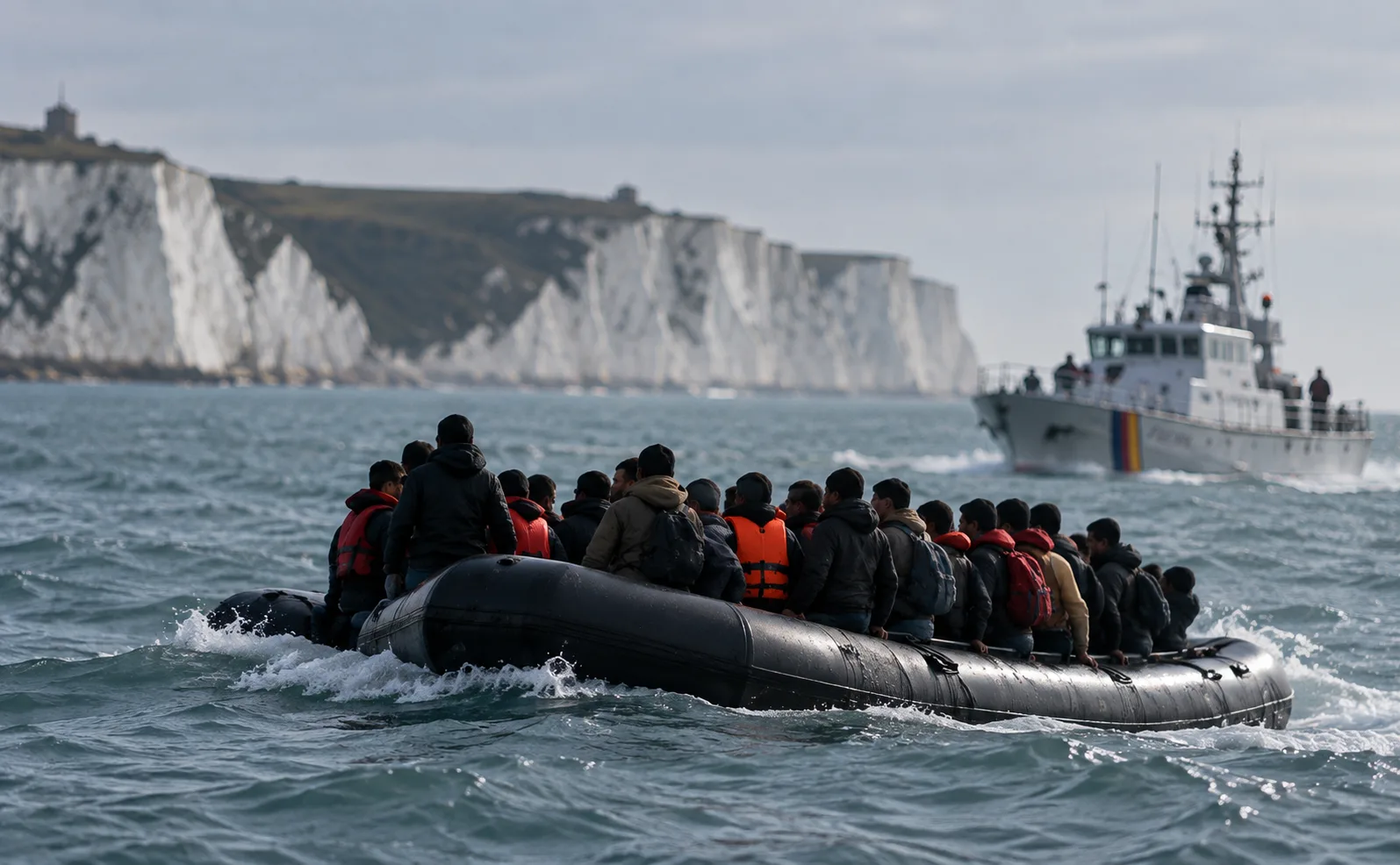
Labour's flagship migrant returns deal with France has been scrapped after a little over a year in operation, ending one of the Government's key measures for tackling small boat crossings.
The Home Office announced on Wednesday that the "one in, one out" pilot is no longer processing new cases. Under the arrangement, Britain could return small boat arrivals to France after declaring their asylum claims inadmissible and, in exchange, admit an equivalent number of asylum seekers from France who had not attempted the crossing. The scheme was introduced in August 2025, with the first removal taking place on 18 September that year, and it stopped accepting new cases at the end of September 2026.
Cases already in the system will continue, the Home Office said, including transfers from France where migrants have been accepted under the reciprocal terms. Deportation flights will continue over the coming weeks.
A Home Office spokesman said: "We continue to work with France to relentlessly tackle small boat crossings, and we've made real progress. Numbers are significantly down on last year and crossings this summer were the lowest in six years. The government's pilot with France to remove asylum seekers in exchange for an equal number of legal migrants is no longer processing new cases. However, flights will continue over the coming weeks to swiftly remove small boat migrants from the UK, and we will use lessons learned from the pilot to accelerate efforts to return small boat migrants with no right to remain in the UK."
By the end of the scheme, around 1,500 people had been returned to France, according to the BBC, with a similar number transferred to Britain under its reciprocal terms. The most recent published Home Office figures, covering the period to 30 June 2026, recorded 1,087 returns and 1,117 admissions.
The cost of each removal has risen sharply. Earlier this month the Home Secretary, Shabana Mahmood, told the Home Affairs Committee that sending a small boat migrant back to France cost about £56,000 a head, above the Home Office's estimated average cost for enforced returns of £48,800. She said the numbers involved had been "relatively small" and that it had been "operationally difficult to scale up very large numbers of removals" into the French system. The figure is an average cost per return, not the total cost of the scheme.
The Government points to a substantial fall in arrivals. Home Office figures show that 19,135 people had crossed the Channel by 27 September 2026, approximately 42 per cent fewer than the 32,188 who had arrived by the equivalent point in 2025. The department says this summer recorded the lowest number of summer arrivals since 2020, and credits French policing under a new £662 million, three-year agreement signed in April. That funding deal, which runs from 2026/27 to 2028/29 and provides £501 million to strengthen controls in northern France and £161 million for new tactics, is separate from the "one in one out" pilot.
The Shadow Home Secretary, Chris Philp, said: "This is another borders humiliation for the Labour government. First their laughable promise to smash the gangs disintegrated. Then the plans to get the French to stop boats launching in shallow water fell apart. And now this. With 95 per cent of illegal Channel migrants allowed to stay in the UK, no wonder almost 20,000 have crossed so far this year with over 1,000 arriving last week alone. Only when all illegal immigrants are deported within a week of arrival will the crossings finally stop, which the Conservative borders plan will do."
His 95 per cent figure refers to Migration Observatory research showing that 95 per cent of people detected arriving by small boat between 2018 and 2025 went on to claim asylum. It is not a measure of how many are allowed to remain. Of the asylum claims from small boat arrivals that have reached an initial decision, 59 per cent resulted in a grant of protection and 41 per cent were refused. Around 4 per cent of those who arrived by small boat between 2018 and 2025 had been returned to another country by the end of last year.
Why the deal ended
The British Government would have preferred the arrangement to continue but concluded that it had not reached the scale ministers wanted, the BBC reported. France favoured a wider arrangement. The French interior ministry said it was discussing with Britain the terms of exit from the agreement. The interior minister, Laurent Nunez, has argued that France should not carry the burden alone. He told a parliamentary hearing that France "should not have to bear the burden alone" and that it "would be better to incorporate it into an agreement between the European Union and the United Kingdom", according to the Guardian. He has also said the scheme was not fully effective as a deterrent, telling Le Monde he was "not saying that the 'one in, one out' agreement is 100% effective as a deterrent, far from it".
The pilot had practical problems. A number of those returned to France later came back to Britain after saying they felt unsafe there. Some were removed to France a second time, while others were allowed to remain in the UK while their claims were processed, the Guardian reported. The newspaper has also reported that some returned migrants disappeared from the system, and that some asylum seekers said they had been threatened by smugglers over debts.
Ms Mahmood has said the scheme had a deterrent effect, citing UN and other agencies that reported some migrants were not getting on boats because they thought there was a chance they could be accepted under it. She has also said it was difficult to pinpoint why crossings had fallen by more than 40 per cent. The Migration Observatory notes that lower levels of irregular migration into Europe overall are likely to be at least part of the explanation, alongside enforcement.
Labour scrapped the Conservatives' Rwanda asylum scheme as one of its first acts in office in 2024, and has instead emphasised law enforcement, the disruption of smuggling networks, returns and closer cooperation with France.
Richard Thomson of Great British PAC said:
"Labour's flagship returns deal has collapsed and what a humiliation it has been.
"The Government returned roughly 1,500 to France, at an extraordinary cost of £56,000 per person and then admitted the same number back through the other side of the scheme.
"It is an expensive migrant exchange programme that never even had the ambition of lowering the net arrivals.
"Now France has walked away, the scheme is processing no new cases, and Britain is left with the bill, the boats and absolutely no control.
"A sovereign country does not pay another nation to decide who it may return. It secures its borders, detains illegal arrivals and removes them swiftly and consistently.
"Britain does not need another pilot scheme, another task force or another empty announcement.
"We need a government with the spine to enforce our laws, defend our borders and put the safety and sovereignty of the British people first."
The pilot was designed to test whether reciprocal returns could become a workable part of Britain's response to Channel crossings. It was introduced in August 2025 and stopped taking new cases at the end of September 2026. Around 1,500 people were returned to France under the scheme. More than 40,000 people crossed the Channel in small boats during the period in which the agreement operated, according to the Guardian. The Government says lessons from the pilot will now be used to accelerate returns of people with no right to remain in Britain. What replaces the reciprocal arrangement with France has yet to be set out.