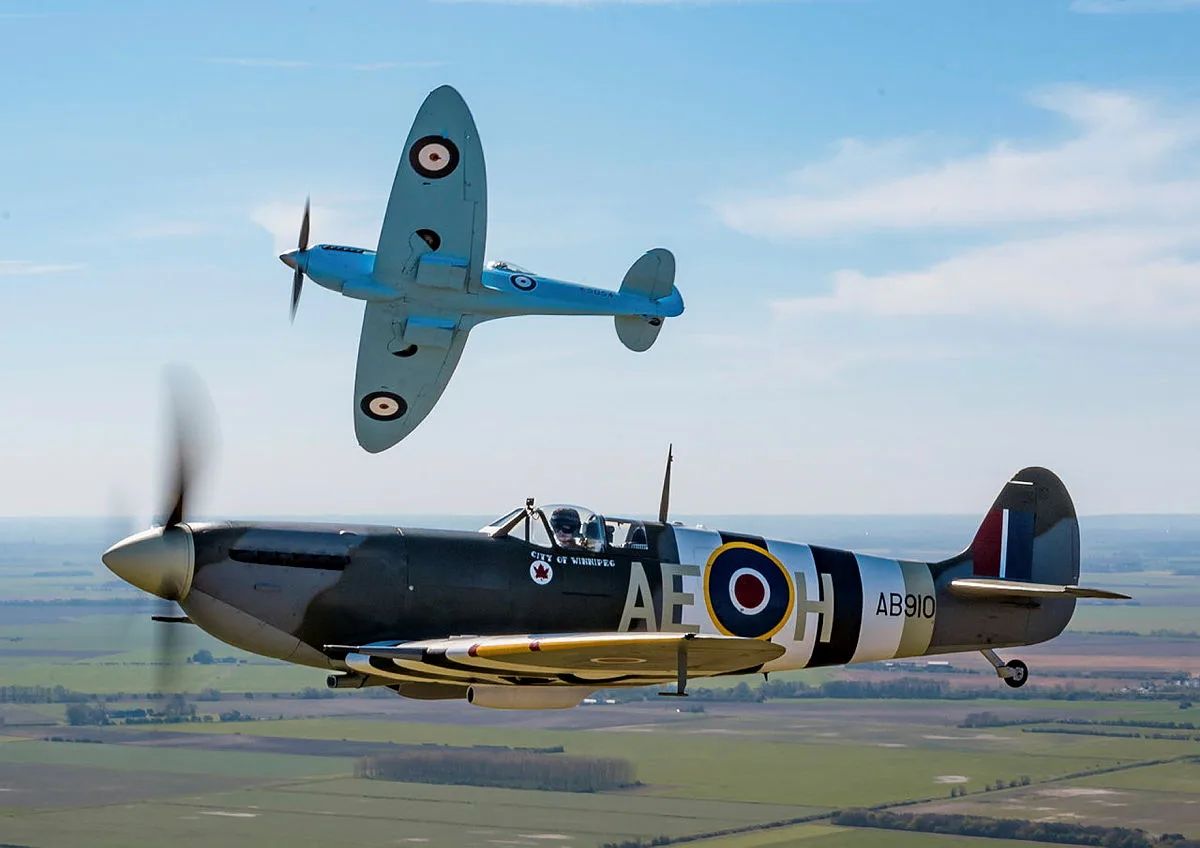
Eighty-six years ago today, young men climbed into Hurricanes and Spitfires and took to the skies knowing that the survival of their country might depend upon what happened next. Today, September 15, Britain remembers them.
Battle of Britain Day marks one of the defining moments in our national story, when RAF Fighter Command confronted the overwhelming might of Nazi Germany's Luftwaffe and helped prevent Hitler from gaining the air superiority required for an invasion of Britain. It is a story of extraordinary courage, but also of something deeply British, a country under mortal threat refusing to surrender.
By the summer of 1940, much of Europe had fallen. France had been defeated, British troops had been evacuated from Dunkirk and Nazi Germany stood triumphant across much of the Continent. Britain could have sought terms. It did not. Instead, this island prepared to fight.
From July to October 1940, the Battle of Britain raged above our towns, fields, coastline and cities. It became the first major battle in history fought principally in the air and resulted in Nazi Germany's first major military defeat.
At the heart of that victory were the men who became immortalised as "The Few". The RAF records 2,945 aircrew who fought against the Luftwaffe during the Battle of Britain. Their average age was just 20.
Some had received astonishingly little preparation for the ordeal ahead. At the height of the battle in August 1940, an RAF fighter pilot could receive as little as two weeks' training before being sent into action. Five hundred and forty-four members of The Few were killed during the battle. They were frighteningly young men asked to shoulder an almost unimaginable responsibility, and they did.
The day Britain held the line
September 15 became Battle of Britain Day because of the scale and importance of the fighting that Sunday in 1940. The Luftwaffe launched a huge assault against Britain, believing RAF Fighter Command was close to breaking point. It was not.
British fighters were scrambled to intercept wave after wave of German aircraft. Battles erupted across the skies of southern England as Hurricanes and Spitfires tore into the attacking formations. The Luftwaffe suffered heavy losses and failed to achieve the air supremacy Hitler needed.
The RAF describes September 15 as a decisive defeat for the Luftwaffe. Within weeks, the German attempt to establish air superiority over Britain had failed. Britain had survived, and that survival mattered far beyond our shores.
Had Britain been defeated or forced from the war in 1940, the subsequent history of Europe could have been unimaginably different. Instead, Britain remained free, an unsinkable base from which the fight against Nazi tyranny could continue. Four years later, Allied forces would leave these shores for Normandy to begin the liberation of Western Europe.
The young men fighting above Kent and Sussex in 1940 could not know what lay ahead. They only knew what was required of them that day.
Churchill's immortal words
The bravery of the RAF inspired some of the most famous words ever spoken in the English language. As the battle raged, Winston Churchill told the House of Commons: "Never in the field of human conflict was so much owed by so many to so few."
More than eight decades later, those words have lost none of their power. But The Few were never entirely alone. Behind every fighter pilot stood an extraordinary national effort.
There were radar scientists and operators giving Britain a vital technological advantage, Royal Observer Corps volunteers tracking enemy formations, controllers directing fighters towards incoming raids and ground crews working furiously to refuel, rearm and repair aircraft.
There were engineers, telephone operators, factory workers and plotters. Women of the Women's Auxiliary Air Force served throughout the command and control system upon which Fighter Command depended. The victory belonged not only to The Few, but to the many thousands of people whose work made it possible.
It was British science, British industry, British organisation and extraordinary human courage working together.
They came from across the world
It is also important to remember that The Few came from far beyond these islands. Around one fifth of the RAF's Battle of Britain aviators were not British.
Poles, Czechoslovaks, Canadians, New Zealanders and airmen from across the Commonwealth and occupied Europe joined British pilots in defending these shores. Polish airmen made a particularly remarkable contribution. According to the RAF Museum, 145 Polish pilots fought during the battle and, on Battle of Britain Day itself, September 15, around one in five pilots in action was Polish.
Many had already watched their own countries fall to Hitler. They came to Britain and carried on fighting. Their courage is part of our story too.
Britain remembers
Across Britain, the anniversary continues to be marked by the RAF, veterans' organisations, museums, memorials and communities determined to ensure that the sacrifice of 1940 is never forgotten.
The annual commemorations traditionally include the Battle of Britain Service of Thanksgiving and Rededication at Westminster Abbey, a ceremony with roots stretching back more than eight decades. Last year's 85th anniversary saw a particularly significant programme of remembrance, with historic aircraft once again taking to Britain's skies.
Spitfires and a Hurricane flew over the Battle of Britain Memorial at Capel-le-Ferne, overlooking the English Channel and the stretch of sky in which so much of the battle was fought. The commemorations later included the unmistakable sight and sound of Lancaster PA474 flying over Westminster Abbey.
These aircraft are now treasured pieces of history. In 1940 they were machines of war, maintained by tired ground crews and flown by young men who knew each scramble might be their last.
That is what makes the sound of a Merlin engine overhead so much more than nostalgia. It is the sound of memory.
Freedom was not inevitable
There is a temptation, 86 years later, to view Britain's victory as inevitable. It was anything but. The RAF records that at one stage Fighter Command had 749 fighters available against 2,550 aircraft available to the Luftwaffe.
Britain's fate rested upon an extraordinary combination of technology, radar, intelligence, industrial production, leadership, organisation and, ultimately, individual courage. Men climbed into cockpits, ground crews sent them back into the sky, radar operators watched their screens, controllers made decisions measured in seconds and families looked upwards and waited. Nobody knew how the story would end.
That is why Battle of Britain Day matters. It is not simply an opportunity to admire Spitfires or look back sentimentally upon a sepia-tinted version of wartime Britain. It is a reminder that the freedoms we enjoy were defended by real people at enormous personal cost.
The right to argue with our government, to vote it out, to publish newspapers criticising those in power, to worship freely, to speak freely and to raise our children in a democratic country were not historical certainties. There was a moment when those freedoms were in genuine peril, and ordinary people defended them. Some never came home.
The Few belong to the ages
Eighty-six years is a long time. The generation that fought the Second World War is disappearing from living memory and, before long, there will be nobody left who remembers those extraordinary summer days first-hand.
That makes our responsibility greater, not smaller. We must tell their stories, teach our children who they were and preserve the aircraft, airfields, memorials and records that connect modern Britain with those who defended it.
And when a Spitfire passes overhead, we should still look up.
Somewhere above the fields and towns of southern England, 86 years ago today, boys scarcely out of school were fighting one of the most consequential battles in the history of the world. They did not know that future generations would call them The Few. They did not know their aircraft would one day sit reverently in museums. They did not know Churchill's words would still be repeated nearly a century later.
They knew only that their country needed them, so they went up.
Today, a free Britain remembers them, the pilots, the ground crews, the WAAFs, the radar operators, the observers, the engineers, the factory workers and the men and women from Britain, the Commonwealth and allied nations who stood together when freedom itself was at stake.
Eighty-six years on, the debt remains.
Never was so much owed by so many to so few, and never should Britain forget them.