

These Are Not Sweeties: The Great British PAC Investigation into Britain’s Puberty Blocker Trial
A Great British PAC Special Report
In forty-eight hours, unless the High Court intervenes at the last hour, researchers at King’s College London will begin recruiting British children as young as eleven into a state-sanctioned trial of puberty-suppressing hormones. The programme has a technocratic name, PATHWAYS, and a technocratic tone. It is neither.
A months-long investigation by Great British PAC, drawing on peer-reviewed clinical literature, regulatory disclosures, Hansard, court filings and pharmacological archives dating back to the 1980s, has found a policy edifice riddled with contradiction. Ministers who called the historic use of these drugs a “scandal” are now presiding over their expansion under a research label. A medicines regulator that in February suggested a minimum entry age of fourteen has, four months later, approved a floor of eleven for birth-registered girls and twelve for birth-registered boys. And a government that indefinitely banned puberty blockers for under-eighteens because its own experts said the drugs presented an “unacceptable safety risk” is now content to allow the same class of drug to be administered to healthy children in exchange for shopping vouchers redeemable at Currys, Uber Eats and Xbox.
What follows is what our investigation actually found.
The state contradicts itself on the same drug for the same children
The central paradox is in plain sight in the Department of Health and Social Care’s own paperwork. In December 2024, on the advice of the Commission on Human Medicines and the findings of the Cass Review, ministers made permanent an indefinite ban on the sale and supply of puberty blockers to under-eighteens for gender incongruence or gender dysphoria. The CHM was blunt: continued prescribing to children posed an “unacceptable safety risk.” Wes Streeting, then Health Secretary, described the historic use of the drugs as a “scandal,” and later said he was “deeply uncomfortable” with drugs to delay puberty.
Yet the same government cleared the way for PATHWAYS, a trial that will administer the same class of drug to children as young as eleven. The rationale offered by ministers and by Baroness Cass is that a trial is the only way to produce evidence that has been missing for decades. Great British PAC found no publicly disclosed regulatory analysis reconciling those two positions. The public has been told the drugs are unsafe enough to ban, and safe enough to study, on the same population, at the same time. On the eve of the Commons vote, Baroness Cass told the BBC she was “absolutely convinced that more children will be harmed if we don’t do the trial than if we do,” and that some of the “hype about risks” had been “exaggerated.” That is a defensible political judgment. It is not a resolution of the underlying contradiction.
The regulator was overruled by process
The second finding concerns the arc of the MHRA’s own position. In February, the regulator paused PATHWAYS, warning of “potentially significant” long-term biological harms and suggesting a minimum entry age of fourteen. This suggestion was not decorative. It was the professional judgment of the body legally charged with medicines safety in the United Kingdom.
Four months later, the same regulator approved a protocol permitting entry from age eleven for birth-registered girls and twelve for birth-registered boys. Great British PAC could find no substantive published explanation of what changed in the underlying pharmacology or safety data between February and June to justify a three-year reduction of the proposed minimum age. Additional safeguards were introduced, on bone density, brain function, vaginal bleeding and fertility information, but the underlying design was left largely intact. Around 226 children are expected to take part if recruitment proceeds. Participants can receive up to £135 in shopping vouchers, redeemable at retailers including Currys, Uber Eats and Xbox, for completing assessments. When a regulator raises the possibility of a legal minimum age of fourteen and settles at eleven within months, without published scientific justification, that is a governance failure, whatever one’s view of the underlying medicine.
The clinical picture is layered, not simple
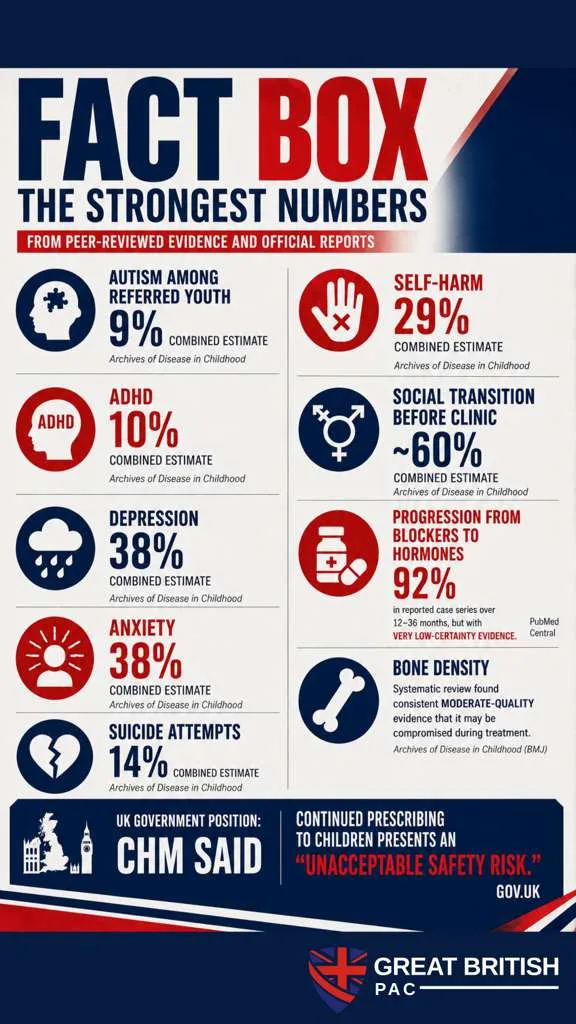
Great British PAC reviewed the systematic literature underpinning the Cass Review and drew a portrait of the referred cohort that is at odds with much of the public conversation. Using data from the Archives of Disease in Childhood review of 143 studies, we found combined estimates of 9 per cent for autism, 10 per cent for ADHD, 38 per cent for depression, 38 per cent for anxiety, 14 per cent for suicide attempts, and 29 per cent for self-harm among referred children and adolescents. About 60 per cent had already taken steps toward social transition before ever crossing a clinic threshold.
These are not the numbers of a population whose primary problem is chromosomal. They are the numbers of a population carrying multiple layers of distress, neurodevelopmental complexity and safeguarding risk. The Royal College of Psychiatrists, in its response to the Cass Review, explicitly backed a comprehensive biopsychosocial approach, and stressed that co-occurring mental illness and neurodevelopmental disorders must be considered and treated as part of child-centred care. A trial that recruits eleven-year-old girls, of whom a significant proportion are likely to be autistic, anxious, depressed or self-harming, is not a neutral scientific instrument. It is an intervention on a vulnerable population whose first clinical need, on the evidence, is comprehensive mental health treatment, not endocrine suppression.
The evidence base is weaker than the public has been led to believe
Great British PAC examined the two most recent systematic reviews. The 2024 Archives of Disease in Childhood review found consistent moderate-quality evidence that bone density may be compromised during treatment, that height may not follow expected trajectories, and that evidence on psychological and psychosocial outcomes was limited or inconsistent. A 2025 systematic review indexed on PubMed Central described the overall evidence base as of very low certainty, concluding that researchers “cannot exclude the possibility of benefit or harm.”
The much-repeated public claim that puberty blockers are a neutral “pause button” also does not survive contact with the data. In the same 2025 review, 92 per cent of those who received puberty blockers in the reported case series progressed to gender-affirming hormones within twelve to thirty-six months, though the authors urged caution about causal claims. Whatever else these drugs are, they do not, in the reported data, look like a reversible timeout. They look like a threshold that most who cross it do not cross back.
The drug class has a history the public has not been told
Great British PAC also examined the pharmacological lineage of these compounds, and found a history largely absent from public communication about PATHWAYS. The first FDA-approved leuprolide product, Lupron, was authorised in 1985 for advanced prostate cancer. Histrelin acetate was approved for central precocious puberty in 1991, and Lupron Depot-Ped followed in 1993. Longer-acting paediatric formulations arrived across the following decades.
But peer-reviewed literature also documents the use of related GnRH analogues, particularly leuprorelin, in the management of sexual offenders with paraphilic disorders, including under compulsory legal frameworks in several jurisdictions. Human-rights scholarship has treated forced or coerced anti-libidinal interventions as raising grave concerns under Article 3 of the European Convention on Human Rights, especially where consent is compromised by imprisonment or parole.
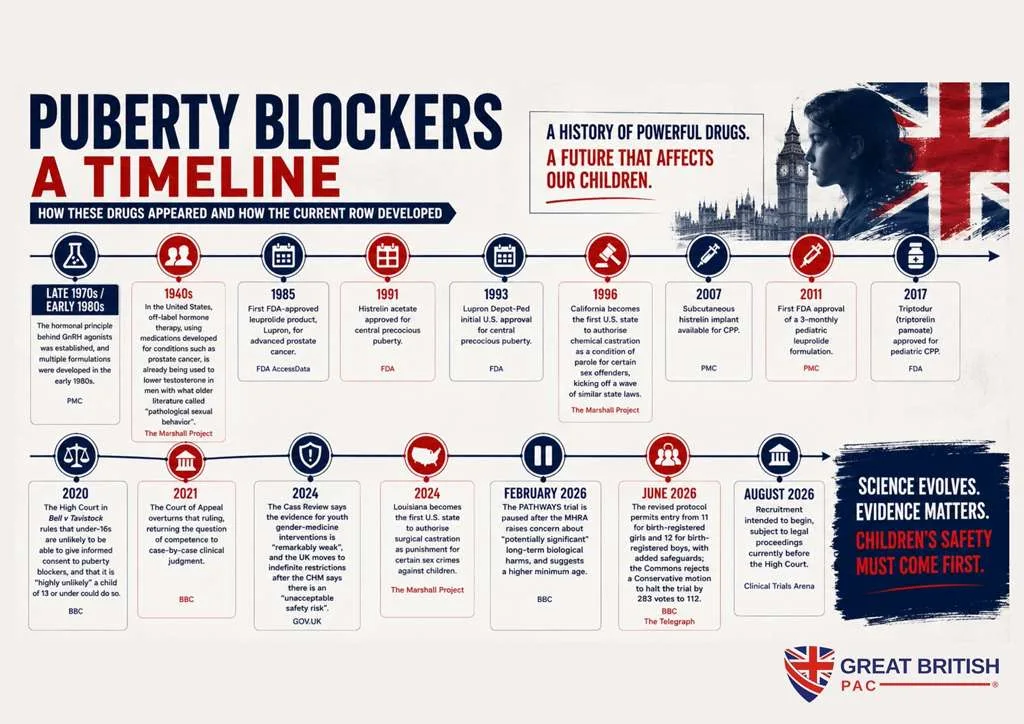
The moral weight of that history has only sharpened. In 2024, Louisiana became the first U.S. state to authorise surgical castration as a punishment for certain sex crimes against children, according to a 2025 investigation by The Marshall Project. The same report noted that off-label hormone therapy has been used in the United States since the 1940s to reduce testosterone in men with what older literature called “pathological sexual behavior,” and that experts described the approach as cruel and scientifically baseless as a deterrent. Kristen M. Budd of the Sentencing Project told the publication there is “literally no evidence that testosterone is the driving factor of individuals committing crimes of a sexual nature.” The purpose of raising this history is not to conflate contexts. It is to note that a class of drug treated with grave ethical caution when used on incarcerated adults cannot plausibly be treated as weightless when handed to eleven-year-old girls in exchange for a shopping voucher.
Parental authority is being marginalised in practice, if not on paper
Ministers stress that no child can enter PATHWAYS without parental consent. Formally, this is correct. Practically, it is thin. Great British PAC found that the judicial review currently before the High Court has been brought in part by the Bayswater Support Group, an organisation of parents of gender-questioning children, alongside detransitioner Keira Bell and psychotherapist James Esses. They argue the trial is unethical, scientifically flawed, and unlawfully approved.
Their claims include two design flaws that our investigation regards as substantive. First, because every participant in PATHWAYS will eventually receive puberty blockers, the study lacks a meaningful control arm. Second, because NHS England has separately paused routine cross-sex hormone prescribing for under-eighteens, children entering the trial may now spend years on puberty blockers with no clear onward pathway, an outcome the trial’s original scientific design did not anticipate. When parents must seek judicial review to challenge the terms of an experiment on distressed children, parental rights on paper are not the same as parental rights in practice.
The politics does not match the evidence
On 23 June, the Commons rejected a Conservative motion to halt the trial by 283 votes to 112. Dr Caroline Johnson, the shadow health minister and herself a paediatrician, warned that puberty blockers were being treated “like sweeties,” and told MPs, “we would not give children cocaine on the basis that they wanted it and will go and get it illegally. These are not sweeties, they are powerful drugs.” James Murray, the Health Secretary, told MPs he had “struggled with the profound challenges this subject raises,” but concluded that a trial was preferable to continuing “with uncertainty and with conflicting opinions and advice.”
Yvette Cooper, appointed Health Secretary earlier this week, arrives at the department with a public record on gender that critics and supporters will read into every subsequent decision. Ahead of the 2015 general election, she said Labour would look into gender-neutral passports if it won. As shadow home secretary in 2022, she declined to define what a woman is, saying people risked getting themselves “down rabbit holes on this one.” She now inherits, from her predecessors, a trial her own critics say she should stop, and a legal case that will test whether she does.
Conclusion
Great British PAC’s investigation finds that Britain is preparing to conduct, on children as young as eleven, a trial of a class of drug its own regulator has already described as unacceptably risky outside research; that the ages permitted are lower than the regulator itself initially proposed; that the evidence base is of very low certainty; that the referred population is disproportionately affected by autism, ADHD, depression, anxiety and self-harm; that the drug class has a long and ethically contested history in adult medicine and criminal justice; and that the parents of the children most likely to be recruited have been forced into the High Court to challenge the terms of the study.
None of these findings, taken alone, would be enough to condemn a trial. Taken together, they describe a country running an experiment on its most vulnerable children in defiance of its own stated safety judgment. On 1 August, unless the High Court decides otherwise, that experiment begins. Baroness Cass was correct when she described the evidence base in this field as “remarkably weak.” The proper response to shaky foundations is not to build faster on them. It is to build differently. Distressed children need truth more than slogans, and care more than ideology. Treat the pain the child actually has, before rewriting the body the child was born with.
If you have tips, documents, or stories that Great British PAC should investigate in the public interest, please contact us. We want to hear from people with information that matters to the British public.