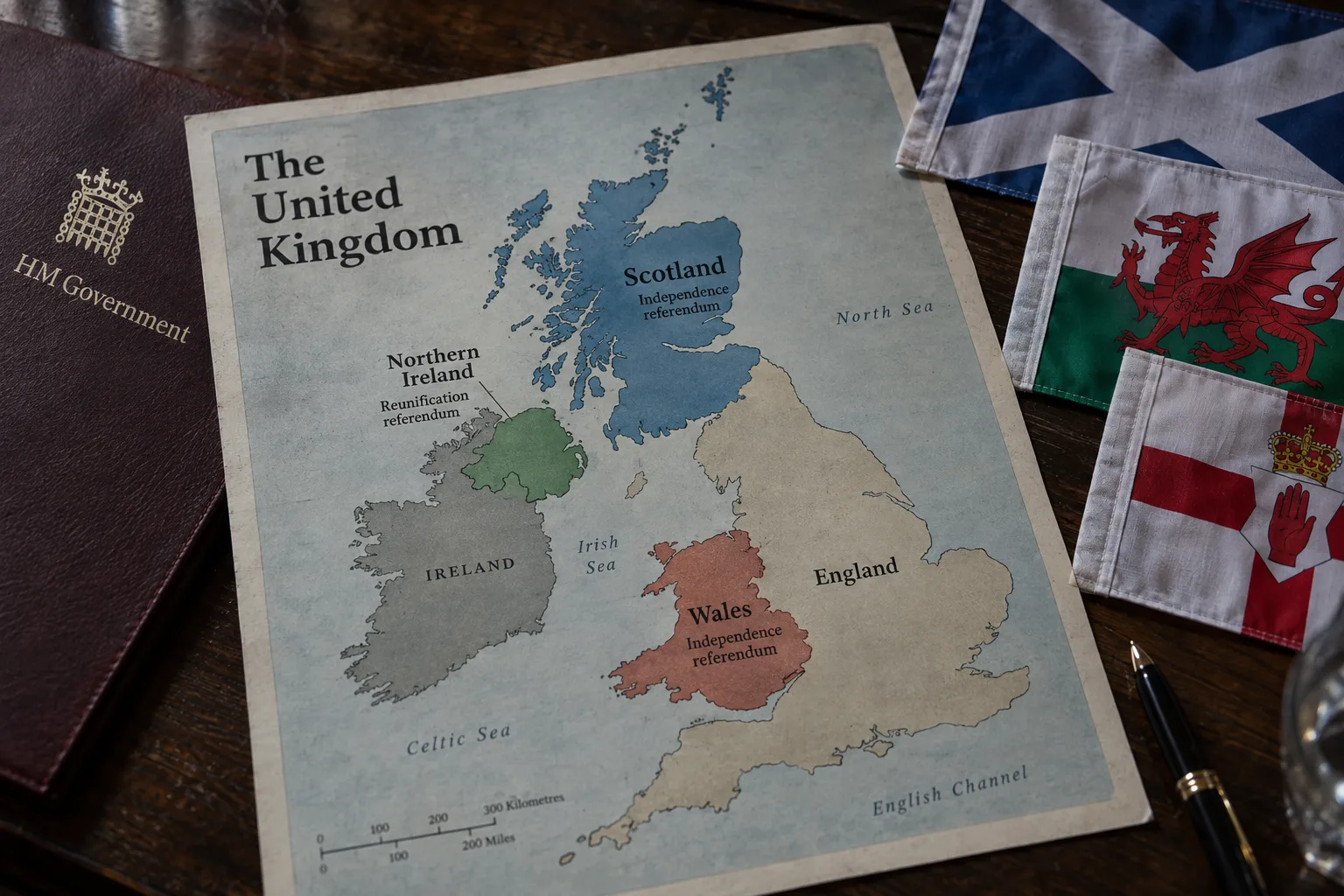
SNP, Plaid Cymru and Sinn Féin figures will sign a memorandum of understanding in Cardiff calling for the right to hold independence or reunification referendums
The leaders of Scotland, Wales and Northern Ireland are to meet in Cardiff on Monday, 14 September, to sign an agreement committing their parties to closer cooperation on independence, self-determination and the future of the United Kingdom.
John Swinney, Scotland’s First Minister, Rhun ap Iorwerth, Wales’s First Minister, and Michelle O’Neill, Northern Ireland’s First Minister, will be joined by Mary Lou McDonald, president of Sinn Féin and leader of the opposition in Ireland’s Dáil.
The meeting will take place at the St David’s Hotel in Cardiff Bay. The leaders are expected to sign a memorandum of understanding covering the economy, energy, relations with Europe, international cooperation and self-determination.
The agreement is understood to support independence for Scotland and Wales, and Irish reunification for Northern Ireland. It is also expected to commit the parties to working more closely with European neighbours as they prepare for possible constitutional change.
The summit comes at a moment when pro-independence parties hold power in all three devolved nations for the first time.
Plaid Cymru became the largest party in the Welsh Senedd at the May election, with Rhun ap Iorwerth subsequently becoming First Minister. The SNP remains the largest party in the Scottish Parliament, while Sinn Féin holds the office of First Minister in Northern Ireland.
The Cardiff meeting follows remarks by Andy Burnham, the Prime Minister, which appeared to draw a parallel between the constitutional arrangements in Scotland and Northern Ireland.
At Prime Minister’s Questions, Mr Burnham said that a second Scottish independence referendum could be considered if public opinion changed and there was a clear consensus in favour of one. He was responding to a question from Dundee SNP MP Chris Law about whether a mechanism similar to the one in Northern Ireland should apply to Scotland.
Mr Burnham later wrote to Mr Swinney to insist that another Scottish referendum remained “off limits” before the next general election. He said there was no current consensus for a vote in Scotland and no clear basis for believing that a majority in Northern Ireland wanted to leave the United Kingdom.
The Prime Minister also pointed to Labour’s 2024 manifesto, which said that the party did not support independence or another Scottish referendum.
The distinction between Mr Burnham’s initial comments and his subsequent clarification is central to the argument now being made by the nationalist parties. He did not announce a referendum, or endorse one. But his reference to public opinion and consensus gave the SNP an opening to argue that Westminster had accepted the principle that constitutional change should follow a clear democratic shift.
Mr Swinney said the summit marked a significant moment.
“For the first time ever, Scotland, Wales and Northern Ireland are led by pro-independence first ministers,” he said. “There could be no clearer sign that the status quo is not sustainable, and that Westminster must prepare for a post-UK future.”
He added that Mr Burnham would have to consider whether he might become “the final prime minister of the United Kingdom”.
The Good Friday Agreement, together with the Northern Ireland Act 1998, provides a specific legal route to a referendum on Northern Ireland’s constitutional status. The Secretary of State for Northern Ireland must call a poll if it appears likely that a majority of those voting would support Northern Ireland leaving the United Kingdom and joining a united Ireland.
That mechanism does not automatically apply to Scotland or Wales.
The 2014 Scottish independence referendum was held after an agreement between the UK Government and the Scottish Government, followed by legislation and a Section 30 order allowing the Scottish Parliament to legislate for the vote. Scotland voted to remain in the United Kingdom by 55.25 per cent to 44.65 per cent.
Claire Bullivant, CEO of Great British PAC, argues that the 2014 result should continue to carry democratic weight.
“The people of Scotland were asked a clear question and they voted to remain in the United Kingdom. That vote matters. Democracy cannot mean asking people the same question again and again until nationalists finally get the answer they want.”
Recent Scottish polling has produced a closely balanced and sometimes conflicting picture. Some surveys have put support for independence ahead, while others have shown the two sides level or the Union ahead. The evidence does not establish that Scotland is likely to vote for independence, particularly where the margins are narrow.
The polling should also be separated from the performance of pro-independence parties at elections. A party vote is not the same as an answer to a referendum question.
The 2026 Scottish Parliament election result left the SNP with 58 seats and the Scottish Greens with 15. Together, they hold 73 of the Scottish Parliament’s 129 seats, giving pro-independence parties a parliamentary majority.
Holyrood elections use the additional member system. Voters cast one constituency vote and one regional list vote, with 73 constituency MSPs and 56 regional MSPs elected. The Greens also won 13 regional list seats.
The Scottish Parliament’s own analysis records that the SNP’s share of the vote fell on both ballots compared with 2021, while the Greens’ regional vote increased. The result produced a seat majority for pro-independence parties, but that should not be read as evidence that a majority of Scottish voters would back independence in a referendum.
The financial consequences of separation would be one of the most difficult issues facing the nationalist parties.
The latest Scottish Government GERS figures show that Scotland recorded a net fiscal balance of minus £26.2 billion in 2024 to 2025, equivalent to 11.6 per cent of Scottish GDP.
The figures estimate that Scotland raised £91.4 billion in public revenue while public spending allocated to Scotland reached £117.6 billion. North Sea revenue was included in the total, although Scottish North Sea revenue fell by £800 million during the year to £4.1 billion.
The Scottish Government is clear that GERS is not a measure of the Scottish Government’s own budget position. It is an estimate of Scotland’s overall public sector finances under the current constitutional arrangements.
The Office for National Statistics also warns that regional fiscal figures are estimates based on the principles of where revenue is raised and where public spending benefits people. They are useful for comparing the nations and regions of the United Kingdom, but they are not a forecast of what an independent Scotland’s finances would look like.
Independence would change tax policy, public spending, borrowing, debt arrangements and the allocation of national assets. It would also require negotiations over pensions, public sector contracts, defence infrastructure, energy networks and existing UK liabilities.
The economic case for separation cannot be reduced to a single deficit figure. But neither can the fiscal gap simply be wished away.
Defence would present another immediate challenge.
HM Naval Base Clyde, commonly known as Faslane, is home to the core of the Royal Navy’s Submarine Service, including the United Kingdom’s nuclear deterrent. It also supports the Royal Navy’s hunter-killer submarines.
The nearby Royal Naval Armaments Depot at Coulport stores, processes, maintains and issues key elements of the UK’s Trident missile system, as well as supplying weapons for submarines.
The Office for Nuclear Regulation says that more than 6,500 civilian and service personnel work at HMNB Clyde.
Any change to Scotland’s constitutional status would raise major questions about the future location, legal status and security arrangements of the UK’s nuclear submarine fleet.
Scotland also contains extensive military training areas. The Ministry of Defence’s Defence Training Estate includes major training areas across the UK, with Scotland and Northern Ireland forming part of the northern regional training area. The MOD’s Scottish estate includes sites such as Cape Wrath, which supports land, sea and air training, and Barry Buddon, which covers 930 hectares of coastal plain.
Scotland’s position on the North Atlantic approaches also gives it continuing strategic importance to the United Kingdom’s maritime defence planning.
Scottish independence would therefore require major decisions about how the Ministry of Defence operates across the British Isles, rather than simply redraw a border on a map.
The Cardiff summit is also intended to put pressure on Westminster over the distribution of economic powers.
Plaid Cymru is seeking greater Welsh control over taxation and spending. Its demands include access to revenues connected to the Crown Estate and offshore energy, reform of the Barnett Formula and the devolution of further responsibilities, including policing and rail funding.
Those are party demands, rather than settled features of the Cardiff agreement. Plaid Cymru has described cooperation with the SNP and Sinn Féin as useful in areas including energy, the economy, Europe and the wider constitutional questions facing the three nations.
Sinn Féin has framed the meeting as part of preparations for a future referendum on Irish unity.
A Sinn Féin source said the leaders would discuss how each nation could shape its future “through democratic means, guided by the will of its people”.
“The Good Friday Agreement gives us the democratic means to decide it, and now is the time to prepare seriously for that choice,” the source said. “Irish unity is not a distant aspiration.”
Sinn Féin has separately described Irish unity as a central constitutional priority and has argued that the Irish and British governments should prepare for the possibility of a future referendum.
The Cardiff agreement will not itself trigger a referendum. It will not alter the constitutional position of Scotland, Wales or Northern Ireland, and it does not bind the UK Government to accept the demands of the parties involved.
It is, however, a coordinated political challenge to Westminster from the three devolved nations.
Bullivant said Great British PAC would continue to argue for maintaining the Union.
“The United Kingdom is not some embarrassing historical accident to be dismantled piece by piece. It is one of the most successful political unions the world has ever known. England, Scotland, Wales and Northern Ireland are stronger together, and Great British PAC will fight tooth and nail to keep them that way.”
Ben Habib, Chairman of Great British PAC, said:
“Blair sold devolution on the basis it would strengthen our kingdom. There can be no strength in politically separating our four nations.
Holyrood, Stormont and the Senedd simply provide a soapbox to those who wish to break our country.
This will not concern Burnham. He is an heir to Blair.”
For decades, the Union was treated by the British political establishment as the settled framework within which arguments took place. That assumption is now being tested openly, in Cardiff, Edinburgh and Belfast at the same time.
The leaders meeting in Cardiff are not yet negotiating the terms of a new map. But they are beginning to behave as if one may eventually be needed.